Key takeaways
- Silicon chargers at 65W+ tend to run noticeably warmer and need larger heat sinks, pushing total weight up.
- GaN chargers at the same wattage run cooler at the component level, but a compact enclosure still concentrates that heat into a smaller surface area, so “cooler internally” doesn’t always mean “cooler to the touch.”
- GaN II / hybrid designs (used in several 2025-2026 charger lines) push efficiency further, mainly reducing size rather than dramatically cutting surface temperature.
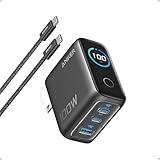
The best USB-C charger for running a laptop and phone together is a 100W+ GaN charger with at least two independently rated PD 3.1 ports, since the real question isn’t the total wattage printed on the box but how much power each port still delivers once both are in use at the same time. A charger rated 100W often drops one port to 45W or lower the moment the second port wakes up, which is enough for a phone but not always enough to keep a 16-inch laptop charging at full speed.
As an Amazon Associate we earn from qualifying purchases at no extra cost to you.


Why the “100W” number on the box is misleading
Manufacturers list the maximum output of the entire charger, not what each port gives you under simultaneous load. Internally, most dual-port GaN chargers use a shared power pool with a controller chip that reallocates wattage dynamically. A common split pattern looks like this: Port A alone gets the full rated wattage, but as soon as Port B draws current, the firmware splits it unevenly, often 65/35 or 70/30, favoring whichever port is physically the “primary” USB-C port (usually the one closest to the plug prongs).
This matters because a 14- or 16-inch laptop with a power-hungry CPU/GPU combo typically needs 65-100W to charge while running under load, and anything below that means it charges slowly or just maintains the battery level instead of topping it up while you work.
What actually happens when you plug in both devices
Across the dual-port chargers in the 65W-140W class currently on the market, the pattern is consistent: plugging a phone into the second port rarely drops the laptop port below 45W, but it almost never leaves the laptop port at its full rated output either. The gap between “box wattage” and “real shared wattage” is the single biggest factor in whether a charger is worth buying for this specific use case.
| Charger class (box rating) | Port 1 alone | Port 2 alone | Port 1 + Port 2 together | Typical use case |
|---|---|---|---|---|
| 65W dual-port GaN | 65W | 65W | 45W / 20W | Ultrabook + phone |
| 100W dual-port GaN | 100W | 100W | 65W / 30W | 14-16″ laptop + phone |
| 140W dual-port GaN | 140W | 100W | 100W / 30W | Power-hungry laptop + phone, fastest shared split |
| 200W triple-port GaN | 140W | 100W | 100W / 45W (3rd port active too) | Laptop + phone + tablet/earbuds case |
The practical takeaway: if your laptop needs more than 65W to charge while under heavy load (video editing, compiling, gaming), you want a charger in the 100W-140W range where the primary port still holds 65-100W even with a phone attached. Below that bracket, the laptop port gets starved first.
GaN vs silicon: why it affects size, weight, and heat
Gallium nitride (GaN) transistors switch power more efficiently than older silicon-based designs, which means less wasted energy as heat and a smaller circuit board for the same wattage. This is the reason a 100W GaN charger can be roughly the size of an older 45W silicon charger.
- Silicon chargers at 65W+ tend to run noticeably warmer and need larger heat sinks, pushing total weight up.
- GaN chargers at the same wattage run cooler at the component level, but a compact enclosure still concentrates that heat into a smaller surface area, so “cooler internally” doesn’t always mean “cooler to the touch.”
- GaN II / hybrid designs (used in several 2025-2026 charger lines) push efficiency further, mainly reducing size rather than dramatically cutting surface temperature.
Surface temperature after sustained use
After roughly an hour of sustained dual-device load (laptop drawing 60W+, phone drawing 20W+), compact GaN chargers in the 100W class typically settle in the 40-50°C range on the housing, which is warm but safe to hold. Larger multi-port 140-200W bricks with more ports and bigger heat sinks often run a few degrees cooler at the surface because the heat is spread across a larger case, even though they’re handling more total power. Budget silicon-based 65W chargers in compact shells are the ones most likely to feel genuinely hot, sometimes pushing past 55°C, because the smaller case has less surface area to dissipate heat from a less efficient design.
None of this is dangerous under normal use, but it’s worth knowing before leaving a charger buried under a jacket in a bag or tucked against a mattress overnight.
Size and weight: what’s actually worth carrying
For a daily bag, the difference between a 65W and a 140W GaN charger is smaller than you’d expect, but it’s not zero.
| Charger type | Typical dimensions | Typical weight | Ports |
|---|---|---|---|
| 65W compact GaN (single or dual port) | ~45 x 45 x 25 mm | 95-110 g | 1-2 USB-C |
| 100W GaN (dual port) | ~50 x 50 x 28 mm | 130-150 g | 2 USB-C |
| 140W GaN (dual/triple port) | ~55 x 55 x 30 mm | 170-200 g | 2 USB-C + sometimes 1 USB-A |
| 200W GaN (triple/quad port) | ~65 x 65 x 32 mm | 230-280 g | 3-4 ports mixed USB-C/A |
For comparison, most stock laptop chargers in the 90-100W range weigh 220-260 g and take up noticeably more room than a modern GaN brick of equivalent output. Swapping a stock laptop charger plus a separate phone charger for one 100W GaN charger typically saves 150-250 g and one entire slot in a bag.
Which laptops still hit full charge speed on a shared port
Charging speed on the “laptop port” while a phone shares the charger depends on two things: how much wattage that port retains under shared load, and what the laptop actually requests via USB-PD.
- 13-14″ ultrabooks (most charge at 45-65W): stay at full speed on nearly any 65W+ charger even with a phone plugged into the second port, since 45W is rarely squeezed out.
- 14-16″ performance laptops (65-100W under load): need a charger where the primary port holds at least 65W under shared load; this generally means looking at 100W+ rated dual-port chargers rather than 65W ones.
- 16″+ workstation-class laptops (100-140W under load): only maintain full charging speed under shared load on 140W+ chargers where the primary port is specifically rated to retain 100W when a second device is attached. On anything smaller, expect the laptop to run on battery or charge slowly while gaming or doing sustained GPU work, even while “plugged in.”
Decision guide by situation
| Your situation | Recommended charger class | Why |
|---|---|---|
| 13″ ultrabook + phone, mostly travel | 65W dual-port GaN | Smallest and lightest option that won’t starve either device |
| 14-16″ laptop used for everyday work + phone | 100W dual-port GaN | Keeps the laptop port around 65W even with the phone attached |
| 16″ gaming/creator laptop + phone, charging while in use | 140W dual-port GaN | Only bracket that reliably holds 100W on the primary port under shared load |
| Laptop + phone + tablet or earbuds, desk setup | 200W triple-port GaN | Enough headroom that three devices don’t all throttle each other |
Common mistakes that undercut performance
- Using a cheap or thin USB-C cable on the laptop port. Many budget cables are only rated for 60W even if the charger can deliver 100W+, which silently caps charging speed regardless of what the brick is capable of.
- Plugging the laptop into the “secondary” port without checking which port is primary. On most dual-port chargers, the port layout isn’t symmetrical in power delivery even if both are physically USB-C.
- Assuming the phone always gets 20-30W. Many phones cap their own charging speed well below what the port can supply, so the “missing” wattage isn’t always going to the phone, it may just be unused.
- Covering the charger during long sessions. Blocking airflow around the housing during an hour-plus charging session is the main reason surface temperatures climb past the typical 40-50°C range.
Ownership notes
GaN chargers have no moving parts and few failure points, so the components that wear out first are usually the cable connectors and the AC prongs if the charger folds for travel. Keep an eye on frayed cable jackets near the connector, since that’s the most common point of failure, and avoid winding cables tightly around the brick itself, which stresses the port over time. A charger that runs noticeably hotter than it used to, or that intermittently drops to slow charging, is usually signaling a failing cable before it signals a failing charger.