Key takeaways
- Compare four network integrated amplifiers with built-in streaming and hi-res audio support on power, TV inputs, phono stages, and platforms.
The real decision here is whether one box can replace a separate streamer, DAC, and amplifier without giving up sound quality or convenience. A network integrated amplifier connects to your home network, streams music on its own, and drives passive speakers directly, so the rack shrinks to one unit plus speakers. What separates the good ones is not the feature list but the details: how much clean power reaches your speakers, which streaming platform runs the show, and whether your TV and turntable can plug in without adapters or extra boxes.
This guide is for listeners upgrading a living-room two-channel system, TV watchers who want better sound than a soundbar, and vinyl owners who stream most days. Every pick below is an integrated amplifier with network streaming built in and hi-res audio support stated on its Amazon product page. The four were chosen from the name and specifications on those pages, then compared on rated power into 8 ohms, streaming platform, TV connection, and whether a phono stage is included.
Quick Picks
As an Amazon Associate we earn from qualifying purchases
| Product | Best for | Key spec |
|---|---|---|
| WiiM Amp Ultra with Voice Remote 2 (Space Gray) | The most power and control in a main living-room system | 100 W per channel at 8 ohms |
| Marantz Model M1 Wireless Streaming Amplifier | A compact premium setup in a HEOS household | 100 W per channel into 8 ohms |
| Denon PMA-900HNE Integrated Network Amplifier | Vinyl plus streaming in one full-width amplifier | MM and MC phono stage built in |
| WiiM Amp Pro (Dark Gray) | A compact TV-and-music setup in a smaller room | 60 W per channel at 8 ohms |
How to Choose
Start with the streaming platform, not the spec sheet
The platform decides how you will actually use the amplifier every day. WiiM Home and HEOS are the two ecosystems in this guide, and they do not talk to each other, so a second room added later should run the same one. Check which services and protocols you rely on: Google Cast, Spotify Connect, TIDAL Connect, AirPlay 2, and Roon support vary by model, and two of the four picks here leave AirPlay out entirely. If your household mixes phones and laptops from different brands, list the casting methods each person uses before choosing, because the wrong platform cannot be fixed with a settings change.
Read the power rating at 8 ohms
Speaker power figures only compare fairly at the same impedance. Listings often headline a larger 4-ohm number, which can make a modest amplifier look stronger than a rival rated honestly at 8 ohms. Look for the watts-per-channel figure at 8 ohms with both channels driven, and treat any headline number without an impedance attached as marketing until you find the full specification. Most bookshelf and floorstanding speakers in living rooms present an 8-ohm or 6-ohm load, so the 8-ohm rating is the one that predicts how loud and controlled the pairing will play in your room.
Match the TV connection to how you watch
Three of these amplifiers take TV audio over HDMI, which lets the TV remote control volume and powers the amp on with the screen. ARC and eARC variants differ in which formats they pass, and on these models the HDMI path carries stereo PCM and Dolby Digital rather than object-based surround formats. The fourth pick has no HDMI at all and uses an optical cable instead, which works fine but gives up remote integration and CEC convenience. Decide before buying whether the TV is a primary source or an occasional one, because that choice narrows this list quickly.
Count your analog sources and check for a phono stage
Only one pick here includes a phono stage, and it handles both moving-magnet and moving-coil cartridges. The other three have line-level inputs only, so a turntable needs its own built-in preamp or a separate phono preamp box between the deck and the amplifier. The same logic applies to older CD players and cassette decks: they need a spare RCA input, and input counts are small on compact models. Make a list of everything you own with an analog output, then confirm the amplifier you like has a home for each one.
The 4 Best Options
WiiM Amp Ultra with Voice Remote 2 (Space Gray)
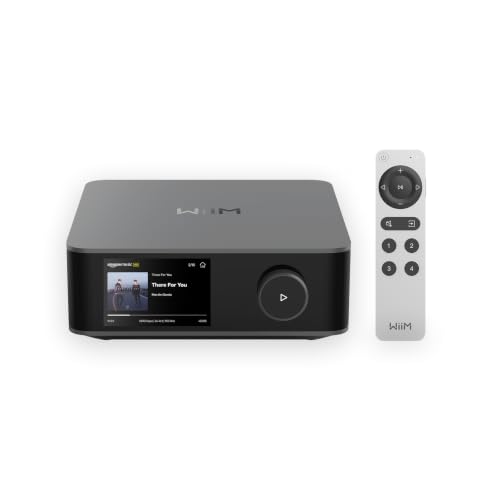
This is the pick for the buyer who wants one box to run a serious living-room system and be done. It pairs the strongest power rating in this group with a glass-covered touchscreen on the front panel, a voice remote in the box, and built-in room correction that adjusts the sound to your space. The WiiM platform covers the widest protocol list here, including Roon, and the HDMI ARC input handles TV duty alongside optical and line-in sources. Buyers who need AirPlay or a turntable input should read the watch-out line closely before ordering.
Specs
- Power output: 100 W per channel at 8 ohms; 200 W per channel at 4 ohms
- DAC: ESS ES9039Q2M SABRE
- Streaming: Wi-Fi 6 and Ethernet built in; Google Cast, Spotify Connect, TIDAL Connect, Qobuz Connect, Alexa Cast, DLNA, Roon Ready
- Hi-res support: optical and HDMI ARC inputs accept PCM up to 192 kHz/24-bit
- Inputs: HDMI ARC, optical (TOSLINK), RCA line-in; subwoofer output
- Control: 3.5-inch touchscreen; Voice Remote 2 included; RoomFit EQ built in
- Bluetooth: 5.3, receiver and transmitter
- Dimensions: 7.87 x 8.3 x 3 in; weight 5.4 lb
- Phono input: not stated
Best for: the buyer who wants the most powerful one-box streaming amp here, with a touchscreen, room correction, and a TV input.
Watch out for: there is no AirPlay support, the HDMI ARC path accepts PCM and Dolby Digital only, and there is no phono input, so a turntable needs its own phono preamp.
ASIN: B0F995W2NG
Marantz Model M1 Wireless Streaming Amplifier

The Model M1 suits a buyer who wants a compact, premium-feeling amplifier that disappears into a room instead of dominating a rack. Its HEOS platform handles hi-res files up to 24-bit/192 kHz plus DSD playback, and AirPlay 2 covers Apple households that the WiiM models leave out. The HDMI eARC input makes it a natural TV partner, passing Dolby Digital Plus from streaming apps, while the subwoofer connection lets a small speaker pair grow into a 2.1 system. It fits especially well in homes already running other HEOS or Marantz and Denon gear.
Specs
- Power output: 100 W per channel into 8 ohms; 125 W per channel into 4 ohms
- Channels: 2.1, loudspeaker plus subwoofer connection
- Streaming: HEOS Built-in over Wi-Fi and Ethernet; AirPlay 2; Spotify Connect; Bluetooth receive
- Hi-res support: WAV, ALAC, and FLAC up to 24-bit/192 kHz; DSD 2.8 MHz and 5.6 MHz
- Inputs: HDMI eARC, Toslink optical, one pair of RCA analog inputs
- Design: Marantz Musical Digital Filtering; built by Shirakawa Audio Works in Japan
- Dimensions: 8.54 x 9.41 x 3.31 in
- Phono input: not stated
- Headphone output: not stated
Best for: a premium compact TV-and-music system, especially in a home already using HEOS or other Denon and Marantz gear.
Watch out for: there is no phono input, so a turntable needs an external phono preamp, and the Bluetooth connection is receive-only on an older 4.2 version.
ASIN: B0D5CM6X9M
Denon PMA-900HNE Integrated Network Amplifier

This is the traditionalist’s pick: a full-width amplifier that looks and feels like classic hi-fi while adding HEOS streaming, AirPlay 2, and voice control. It is the only model here with a phono equalizer built in, and it accepts both moving-magnet and moving-coil cartridges, which makes it the natural home for a serious turntable. Network and USB playback covers hi-res files up to 192 kHz/24-bit along with DSD, and a filtered subwoofer output is included. The trade-off is the TV connection, which is optical only, so plan the setup around that before it arrives.
Specs
- Power output: 50 W + 50 W at 8 ohms
- Streaming: HEOS Built-in over Wi-Fi; AirPlay 2; Bluetooth; Amazon Alexa, Google Assistant, and Siri voice control
- Hi-res support: network and USB gapless playback of FLAC, WAV, and ALAC up to 192 kHz/24-bit; DSD 2.8 and 5.6 MHz
- Phono stage: MM and MC phono equalizer built in
- Digital inputs: optical and coaxial, PCM up to 192 kHz/24-bit
- Subwoofer output: dedicated, filtered at 150 Hz
- Dimensions: 17.1 x 14.8 x 5.1 in
- HDMI input: none; TV connects by optical
- Weight: not stated
Best for: the vinyl-plus-streaming buyer who wants a traditional full-width amp with a real phono stage and HEOS multiroom.
Watch out for: there is no HDMI input at all, so TV audio arrives by optical as PCM only, and the wattage in the listing title is a 4-ohm figure rather than the 8-ohm rating printed above.
ASIN: B0B3M1W4FG
WiiM Amp Pro (Dark Gray)

The Amp Pro is the smaller, simpler way into the WiiM platform for a TV-and-music setup in a modest room. It keeps the same streaming protocol list as its bigger sibling, adds automatic room correction with a 10-band equalizer, and takes TV sound over HDMI ARC. Power is lower than the Ultra, which matters with demanding speakers, but the footprint is the smallest here and the anodized aluminum shell looks tidy on a media console. It is a sensible pick for a household built around Google Cast, Spotify, and TIDAL rather than Apple devices.
Specs
- Power output: 60 W per channel at 8 ohms; 120 W per channel at 4 ohms
- DAC: ESS ES9038Q2M
- Streaming: Wi-Fi 6 and Ethernet built in; Google Cast, Spotify Connect, TIDAL Connect, Qobuz Connect, Alexa Cast, DLNA, Roon Ready
- Hi-res support: USB audio output up to 192 kHz/24-bit; FLAC, ALAC, AIFF, WAV, and other formats supported
- Inputs: HDMI ARC, optical, line-in; subwoofer output with adjustable 30-250 Hz crossover
- EQ: automatic room correction; 10-band graphic and parametric EQ
- Bluetooth: 5.3, receiver and transmitter
- Dimensions: 8.54 x 7.48 x 2.6 in; weight 4.59 lb
- AirPlay: not supported; phono input: none
Best for: a compact streaming amp for a TV-plus-music setup in a Google Cast, Spotify, and TIDAL household.
Watch out for: the listing states this model cannot work as an AirPlay receiver, there is no phono input, and ARC audio is stereo PCM or Dolby Digital only.
ASIN: B0DFPJ91ZX
Which One Fits Your Situation
Your TV and music share one pair of speakers
Pick between the WiiM Amp Ultra and the Marantz Model M1. Both take TV audio over HDMI and drive a 2.1 speaker setup, so film dialogue and music come from the same system. The Ultra adds a touchscreen and more power for bigger rooms, while the M1 is the one to choose if AirPlay matters or your other rooms already run HEOS.
You play records most evenings but stream all day
The Denon PMA-900HNE is the only pick with a phono stage, and its MM and MC support means it will not limit a future cartridge upgrade. Its HEOS streaming and hi-res file playback cover the daytime listening, so the turntable and the network library live in one full-width box without extra preamps or adapters in the chain.
Your household runs on Apple devices
AirPlay narrows this list to the two HEOS models. The Marantz Model M1 is the compact choice for a living room or kitchen system, and the Denon PMA-900HNE is the full-width alternative with a phono stage. Both WiiM picks should be crossed off your list, since neither can receive an AirPlay stream from an iPhone, iPad, or Mac.
You are downsizing a component stack in a small room
The WiiM Amp Pro replaces a streamer, DAC, and amplifier with the smallest box here and still covers TV sound over HDMI ARC. Its room correction and equalizer help in awkward spaces where speakers sit close to walls. If your speakers are large or inefficient, step up to the Amp Ultra for the extra power instead.
Common Mistakes
- Comparing headline wattage across brands without checking the impedance, since a 4-ohm figure always looks bigger than the same amplifier’s 8-ohm rating.
- Assuming AirPlay is standard on streaming amplifiers, when two of the four picks here leave it out entirely.
- Ordering an amplifier for a turntable without confirming it has a phono stage, then needing an extra preamp box.
- Expecting surround or object-based audio formats from an HDMI ARC connection that carries stereo PCM and Dolby Digital.
- Mixing streaming platforms across rooms, then finding the WiiM and HEOS systems cannot group or share sources.
Frequently Asked Questions
Do these amplifiers replace a separate streamer and DAC?
Yes. Each pick connects to your network on its own, runs its streaming services and casting protocols internally, and converts the digital stream with a built-in DAC before the amplifier stage drives your speakers. A separate streamer or DAC only makes sense if you later want a different platform or a specific converter, not to make these work.
Can I connect my TV to any of these amplifiers?
Three of the four take TV audio over HDMI: the two WiiM models use ARC and the Marantz uses eARC, which also enables TV-remote volume control. The Denon has no HDMI input, so its TV connection is an optical cable carrying PCM stereo. None of them decodes object-based surround formats, so set the TV to PCM or Dolby Digital output.
Which pick works with a turntable?
Only the Denon PMA-900HNE has a phono stage, with support for both moving-magnet and moving-coil cartridges. The other three have line-level inputs only, so a turntable connected to them needs a built-in preamp in the deck itself or a separate phono preamp between the turntable and the amplifier. Check your deck’s specification before ordering.
What does hi-res support mean on these models?
It means the amplifier can play digital audio files and streams at resolutions above CD quality, as stated on each listing. The HEOS models handle WAV, ALAC, and FLAC files up to 24-bit/192 kHz plus DSD, while the WiiM models accept hi-res PCM through their digital inputs and streaming services. Your source files or service tier still decide what resolution actually arrives.
More from Amazon
Programs that pair well with the guide above. Offers and eligibility are set by Amazon and may change.
Free shipping on eligible items, Prime Video and more. Eligible new members can start with a free trial.
Start a Prime free trialAd-free music streaming. Eligible new subscribers can start with a free trial.
Try Music Unlimited freeA Prime membership for ages 18-24 with a trial period. Eligibility is set by Amazon.
See Prime for Young AdultsAudiobooks and podcasts to listen to on the go. Eligible new members can start with a free trial.
Try Audible freeAs an Amazon Associate we earn from qualifying purchases.