Key takeaways
- Security subscriptions: HomeShield’s basic tier is free; advanced parental controls and threat protection on some models require a paid plan.
- Heat: Compact models like the AX21 run warm. Leave space around vents and avoid stacking them on a modem.
- Clients matter: Older Wi-Fi 5 devices connect fine but do not gain Wi-Fi 6 efficiency. The benefits grow as you replace phones and laptops.
- Wi-Fi 6 vs 6E and 7: These Wi-Fi 6 models have no 6 GHz band. If you already own several 6 GHz-capable devices and live in a crowded apartment building, a Wi-Fi 6E or Wi-Fi 7 router is worth the higher price; otherwise Wi-Fi 6 remains good value in 2026.
- SIM-card routers are a separate line: TP-Link’s cellular routers with SIM slots are built for locations without wired internet and are a different purchase from the home Archer models above.
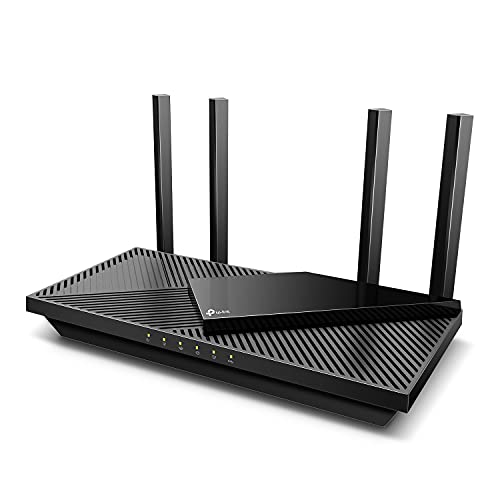
The best TP-Link Wi-Fi 6 router for most homes is the Archer AX55 (AX3000), because it adds 160 MHz channel support on 5 GHz for a modest price premium over the entry models; budget buyers should look at the Archer AX21 (AX1800), and gigabit-plus households are better served by the Archer AX73 or a Deco X55 mesh kit. The “AX” number on each box is the key to choosing, so it helps to know what it actually measures before comparing models.
Our top picks


As an Amazon Associate we earn from qualifying purchases at no extra cost to you. Ratings are shown as listed on Amazon.
What the AX Number Really Means
TP-Link, like every router maker, names Wi-Fi 6 models by adding up the maximum theoretical link rates of each band. An AX1800 router, for example, combines roughly 1,201 Mbps on 5 GHz with 574 Mbps on 2.4 GHz. No single device ever sees that total. A typical phone or laptop with a two-stream Wi-Fi 6 adapter connects at up to 1,201 Mbps on an 80 MHz channel or 2,402 Mbps on a 160 MHz channel, and real-world throughput lands at roughly 50–70% of the link rate close to the router.
That makes 160 MHz support the single most important dividing line in the lineup. It is what separates AX1800 and AX3000.
TP-Link Wi-Fi 6 Routers Compared
| Model | Class | 5 GHz max link | 2.4 GHz max link | Wired ports | Typical price range |
|---|---|---|---|---|---|
| Archer AX10 | AX1500 | 1,201 Mbps | 300 Mbps | 1 WAN + 4 LAN, gigabit | $50–$70 |
| Archer AX21 | AX1800 | 1,201 Mbps | 574 Mbps | 1 WAN + 4 LAN, gigabit, USB 2.0 | $60–$90 |
| Archer AX55 | AX3000 | 2,402 Mbps (160 MHz) | 574 Mbps | 1 WAN + 4 LAN, gigabit, USB 3.0 | $80–$130 |
| Archer AX73 | AX5400 | 4,804 Mbps (4 streams, 160 MHz) | 574 Mbps | 1 WAN + 4 LAN, gigabit, USB 3.0 | $120–$180 |
| Archer AX6000 | AX6000 | 4,804 Mbps | 1,148 Mbps | 2.5G WAN + 8 LAN gigabit, USB-A and USB-C | $200–$300 |
| Deco X20 (mesh, per unit) | AX1800 | 1,201 Mbps | 574 Mbps | 2 gigabit per unit | $150–$250 for a 3-pack |
| Deco X55 (mesh, per unit) | AX3000 | 2,402 Mbps | 574 Mbps | 3 gigabit per unit | $180–$300 for a 3-pack |
Hardware revisions and regional variants differ slightly, so check the version label on the box if a specific port or feature matters to you.
Picks by Situation
Best budget Wi-Fi 6 router: Archer AX21 (AX1800)
The AX21 is the sensible floor. Compared with the AX10 (AX1500), it nearly doubles 2.4 GHz capacity, which matters if the home has many smart plugs, cameras and speakers that only speak 2.4 GHz. It suits apartments and small houses up to roughly 1,500 sq ft on internet plans up to about 500 Mbps. Its limit is the 80 MHz channel ceiling on 5 GHz: fast enough for most plans, but it caps how much a single laptop can pull.
Best all-round pick: Archer AX55 (AX3000)
The AX55 earns the recommendation because 160 MHz channels let a modern two-stream laptop or phone link at 2,402 Mbps, so a gigabit plan can actually be felt over Wi-Fi near the router. It also offers OneMesh compatibility with TP-Link extenders, and its USB 3.0 port is handy for simple network file sharing. For a typical three-bedroom home on a 300 Mbps–1 Gbps plan, this is the price-to-performance sweet spot.
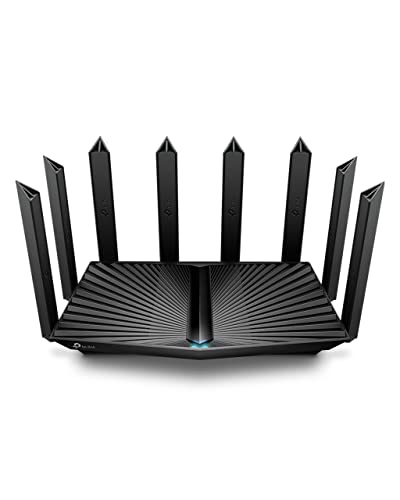
Best for gigabit plans and busy households: Archer AX73 (AX5400)
Four 5 GHz streams do not make one phone faster, but they give the router more capacity to serve several heavy users at once through MU-MIMO and OFDMA. Six external antennas also help a bit with range in larger single-floor homes. Choose it when there are four or more people streaming, gaming and on video calls simultaneously.
Best for multi-gig internet: Archer AX6000
The AX6000 is the only model in this group with a 2.5 Gbps WAN port, which is necessary to use more than about 940 Mbps from a multi-gig fiber or cable plan. Eight gigabit LAN ports also make it a good fit for desks crowded with consoles, NAS boxes and wired PCs. It is large and more expensive, so it only makes sense if you can use that wired headroom.
Best Wi-Fi 6 mesh: Deco X55 (or Deco X20 on a budget)
No single router reliably covers a multi-story home or one with brick and concrete interior walls. A Deco X55 three-pack places nodes about one or two rooms apart, and if you can run Ethernet between them (wired backhaul), each node delivers close to full speed. The Deco X20 is the cheaper AX1800 version and is fine for plans under about 500 Mbps.
Decision Matrix
| Home size and layout | Internet plan | Recommended |
|---|---|---|
| Apartment, under 1,000 sq ft | Up to 300 Mbps | Archer AX10 or AX21 |
| Small house, 1,000–1,800 sq ft | 300 Mbps–1 Gbps | Archer AX55 |
| Single-floor home, 1,800–2,500 sq ft | 1 Gbps | Archer AX73 |
| Multi-story or thick walls | Any | Deco X55 2- or 3-pack |
| Any size, multi-gig fiber | 2 Gbps and above | Archer AX6000 (plus mesh if needed) |
How to Connect to a TP-Link Router
- Connect the modem or fiber terminal to the router’s WAN port (usually a different color) with an Ethernet cable, then power on the modem first and the router second.
- Join the default Wi-Fi network printed on the label under the router, or connect a computer by Ethernet to a LAN port.
- Open the TP-Link Tether app (Archer) or Deco app (mesh), or browse to tplinkwifi.net or 192.168.0.1.
- Create the admin password, pick the connection type (Dynamic IP covers most cable and fiber connections; PPPoE is used by some DSL and fiber providers), and set your network name and Wi-Fi password.
- Update firmware before anything else; early firmware often lacks fixes for stability and security.
- Decide on Smart Connect. Combining 2.4 GHz and 5 GHz under one name is simpler, but splitting them helps when a smart-home gadget refuses to pair.
If you are replacing a provider gateway that also routes, put that gateway in bridge mode to avoid double NAT.
Ownership Realities
- Security subscriptions: HomeShield’s basic tier is free; advanced parental controls and threat protection on some models require a paid plan.
- Heat: Compact models like the AX21 run warm. Leave space around vents and avoid stacking them on a modem.
- Clients matter: Older Wi-Fi 5 devices connect fine but do not gain Wi-Fi 6 efficiency. The benefits grow as you replace phones and laptops.
- Wi-Fi 6 vs 6E and 7: These Wi-Fi 6 models have no 6 GHz band. If you already own several 6 GHz-capable devices and live in a crowded apartment building, a Wi-Fi 6E or Wi-Fi 7 router is worth the higher price; otherwise Wi-Fi 6 remains good value in 2026.
- SIM-card routers are a separate line: TP-Link’s cellular routers with SIM slots are built for locations without wired internet and are a different purchase from the home Archer models above.