Key takeaways
- For most travelers, the Osprey Farpoint 40 offers the best balance of carry comfort, overhead-bin dimensions, and capacity. Pick the Patagonia Black Hole MLC 45L when maximum space matters, the Cotopaxi Allpa 35L when organization and quick access matter most, and the Aer Travel Pack…
The best carry on travel backpacks for most people are the Osprey Farpoint 40 for comfortable walking, the Patagonia Black Hole MLC 45L for maximum packing space, the Cotopaxi Allpa 35L for organized access, and the Aer Travel Pack 3 for a protective laptop-focused setup.
“Carry-on” is not one universal size. Many airlines use a limit close to 22 × 14 × 9 inches (56 × 36 × 23 cm), while some budget carriers enforce smaller cabin-bag measurements or include only a personal item in the basic fare. A backpack that fits the published dimensions when empty can become too deep when fully packed, so leave room for compression and measure the loaded bag.
Our top picks
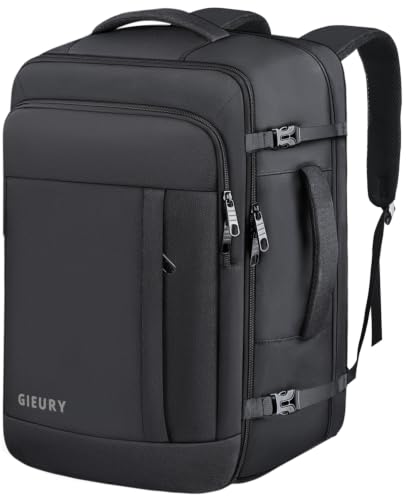


As an Amazon Associate we earn from qualifying purchases at no extra cost to you. Ratings are shown as listed on Amazon.
Best carry-on travel backpacks compared
| Backpack | Published size | Capacity | Weight | Laptop protection | Best for |
|---|---|---|---|---|---|
| Osprey Farpoint 40 | 22 × 14 × 9 in | 40 L | About 3.5 lb | Padded sleeve, best with a separate protective case | Long walking days and mixed travel |
| Patagonia Black Hole MLC 45L | 22 × 14 × 9 in | 45 L | About 3.5 lb | Padded computer compartment | Maximum space and suitcase-style packing |
| Cotopaxi Allpa 35L | 22 × 14 × 9 in | 35 L | About 3.2 lb | Padded laptop and tablet compartments | Open access and separated packing |
| Aer Travel Pack 3 | About 21.7 × 13.7 × 9 in | 35 L | About 3.8 lb | Suspended padded laptop compartment | Frequent business travel and electronics |
Dimensions and weights can vary slightly by generation, fabric, and regional model. Treat these figures as comparison points, then confirm the current manufacturer specification and your airline’s allowance before flying.
Which backpack should you choose?
Choose the Osprey Farpoint 40 for comfort over long distances
The Farpoint 40 is the strongest choice when your trip includes train stations, uneven sidewalks, or a long walk between terminals. Its adjustable harness and hip belt transfer more weight to your hips than the thin straps on a typical travel duffel. The harness also stows behind a zippered panel, keeping it protected when the bag is checked or placed on a luggage rack.
Its rectangular main compartment opens widely and works well with packing cubes. The trade-off is organization: compared with the Allpa or Aer, it provides fewer dedicated pockets. The laptop sleeve is useful, but a padded computer case adds protection because the compartment is not a rigid frame.
Choose the Patagonia Black Hole MLC 45L for the most usable space
The Black Hole MLC is closer to a soft suitcase than a hiking pack. At 45 liters, it has enough room for a longer trip, bulkier clothing, or a second pair of shoes. A clamshell opening makes it easy to pack flat, while backpack straps, a shoulder strap, and handles support different carrying styles.
The extra capacity is also the main risk. A fully stuffed 45-liter bag can become heavy before it becomes dimensionally oversized. Its backpack harness is adequate for airport transfers but less supportive than the Farpoint’s for extended walking. Choose it when you value packing volume and luggage flexibility more than technical carry comfort.
Choose the Cotopaxi Allpa 35L for the fastest access
The Allpa 35L is a practical middle ground for short and medium trips. Its suitcase-style opening divides the interior into two large sections, with a zippered compartment on one side and a mesh-covered section on the other. That layout makes it easier to find a shirt or cable without unpacking everything.
The built-in laptop and tablet sleeves are convenient, and the external compression system helps keep the bag within its listed depth. The harness is comfortable enough for normal city travel, although travelers carrying a heavy load over several miles may prefer the Farpoint. The lack of a large expandable section also encourages disciplined packing.
Choose the Aer Travel Pack 3 for laptops and business gear
The Aer Travel Pack 3 favors protection and compartmentalization. Its suspended laptop area, structured body, quick-access pockets, and separate storage for chargers make it particularly effective for commuting directly from an airport to a meeting. The wide-opening main compartment still supports packing cubes, but the internal organization can consume space compared with a simple open cavity.
At roughly 3.8 pounds empty, it is not the lightest option. That weight is easier to justify when you carry a laptop, tablet, power adapter, headphones, and work accessories every day. For a minimalist holiday pack, the Farpoint or Allpa usually leaves more of your airline weight allowance for clothing.
Decision matrix: match the bag to the trip
| Your situation | Best fit | Why | What to watch |
|---|---|---|---|
| First one-bag trip | Cotopaxi Allpa 35L | Simple clamshell access and manageable capacity | Less room for bulky shoes or cold-weather layers |
| Frequent walking or public transport | Osprey Farpoint 40 | Most supportive harness and hip-belt system | Fewer built-in organizer pockets |
| One to two weeks with light clothing | Patagonia Black Hole MLC 45L | Largest useful interior and suitcase-like packing | Easy to overpack and exceed airline weight limits |
| Daily laptop and business travel | Aer Travel Pack 3 | Strong structure and purpose-built tech storage | Heavier empty and less flexible inside |
| Strict low-cost airline allowance | A compact 20–30L travel backpack | More likely to fit under-seat or personal-item rules | Check the exact fare’s dimensions; 35–45L bags may not qualify |
What matters more than the headline capacity
Airline fit
Capacity ratings are not directly comparable. A 35-liter bag with a rigid frame may hold less usable clothing than a soft 40-liter bag, while an overfilled bag can fail a sizing box regardless of its advertised volume. For a standard overhead carry-on, prioritize a listed depth around 9 inches or less and use compression straps rather than forcing the zipper closed.
Laptop protection
Look for a sleeve that is padded on the bottom and separated from the outer panel. A suspended compartment reduces the chance of a direct impact when the bag is set down. For expensive laptops, use a slim sleeve even when the backpack has padding; a soft backpack does not provide the same protection as a hard case.
Harness comfort
For occasional airport use, padded shoulder straps may be sufficient. For walking more than 30 minutes with a heavy load, an adjustable sternum strap, shaped back panel, and usable hip belt become more important. Load the heaviest items close to your back and high enough that the bag does not pull backward.
Luggage pass-throughs
A trolley sleeve lets the backpack slide over a rolling suitcase handle. This feature matters on connection days because it frees one shoulder and reduces fatigue. Check whether the sleeve is wide enough for your suitcase handle and whether it doubles as an external pocket; some pass-throughs are narrow, shallow, or positioned too low for stable stacking.
How much can you really pack?
A useful planning estimate is to reserve approximately 8–10 liters for shoes, toiletries, and empty space around irregular items. In a 35-liter backpack, that leaves roughly 25–27 liters for clothing and accessories. For example, a compact packing cube may hold four shirts, two pairs of trousers, underwear, and socks, while a second cube can hold a light layer. Packing one pair of shoes inside the bag can consume 5–8 liters, so wearing your bulkiest shoes often matters more than upgrading from 35L to 40L.
Weight is equally important. A 3.5-pound backpack loaded with 15 pounds of contents weighs 18.5 pounds before water or souvenirs. If your airline limit is 10 kg, you have only about 5.5 kg for everything inside. A lighter 2.5-pound bag would give you roughly 1 pound more usable allowance, which can be more valuable than several extra liters.
Durability and ownership details
The first parts to wear are usually zipper pulls, shoulder-strap edges, bottom corners, and the trolley sleeve—not the main fabric. Do not drag the bag by a loose strap, and avoid overstuffing zippers around corners. After a trip, empty every pocket, shake out grit, and wipe coated fabric with a damp cloth and mild soap. Avoid bleach, solvents, and machine washing unless the manufacturer specifically permits it.
Keep laptops and liquids in separate compartments. A leaking toiletry bottle can damage electronics and stain a fabric-lined organizer. Store the backpack loosely filled or completely empty rather than compressed under heavy luggage, and let it dry fully before closing it for long-term storage.
Bottom line
For most travelers, the Osprey Farpoint 40 offers the best balance of carry comfort, overhead-bin dimensions, and capacity. Pick the Patagonia Black Hole MLC 45L when maximum space matters, the Cotopaxi Allpa 35L when organization and quick access matter most, and the Aer Travel Pack 3 when laptop protection and business-oriented storage justify its extra weight. If your fare includes only a personal item, skip these larger designs and choose a genuinely compact backpack based on the airline’s exact measurements.