Key takeaways
- Visual observing: an accurate two- or three-star alignment and a level, stable tripod are usually more important than sub-arcsecond tracking.
- Planetary video: tracking helps keep the planet centered, but exposures are short and the requirements are less demanding than deep-sky imaging.
- Long-exposure imaging: use a guide camera and guide scope or off-axis guider unless the focal length and exposure time are very modest. Even premium mounts benefit from guiding.
- Long optical tubes: judge leverage, not only weight. A 12 lb refractor with a long moment arm can be harder to control than a compact 16 lb SCT.
The best GoTo telescope mounts for most buyers are the Sky-Watcher EQ6-R Pro for heavier astrophotography rigs, the ZWO AM5 for portable imaging, the Celestron Advanced VX for affordable visual use, and the Sky-Watcher Star Adventurer GTi for small telescopes and travel.
A GoTo mount is only a good match when its payload rating, tracking behavior, setup demands, and database meet your telescope’s actual use. Manufacturer payload figures are usually optimistic for long-exposure imaging: a practical imaging load is often about 50–70% of the advertised capacity, especially with a long optical tube, guide scope, camera, filter wheel, and dew equipment attached.
Our top picks

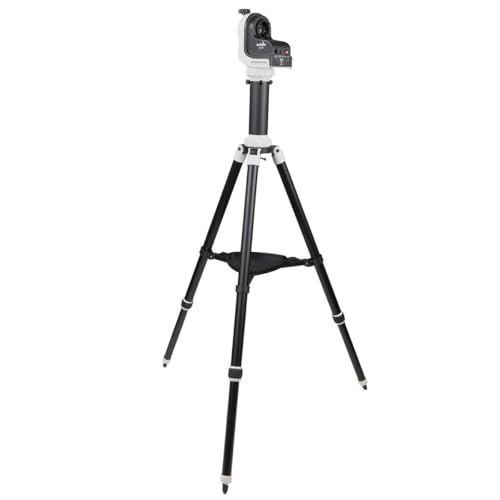

As an Amazon Associate we earn from qualifying purchases at no extra cost to you. Ratings are shown as listed on Amazon.
Best GoTo telescope mounts compared
| Mount | Advertised payload | Mount type | Tracking and imaging suitability | Alignment and database highlights | Typical market range in 2026 |
|---|---|---|---|---|---|
| Sky-Watcher Star Adventurer GTi | 11 lb / 5 kg | Portable dual-axis equatorial | Good for small refractors and cameras; limited with long tubes | Wi-Fi control, polar alignment required in EQ mode, GoTo database | $600–$800 with tripod |
| Celestron Advanced VX | 30 lb / 13.6 kg | German equatorial | Strong visual platform; reasonable entry-level imaging at moderate loads | All-Star Polar Alignment, hand-controller database of more than 40,000 objects | $1,200–$1,600 with tripod |
| iOptron CEM26 | 26 lb / 11.8 kg | Center-balanced equatorial | Efficient, relatively light imaging mount; best below roughly 15–18 lb for imaging | Go2Nova controller, built-in GPS on some versions, polar scope options | $1,400–$1,900 with tripod |
| ZWO AM5 | 28.7 lb / 13 kg without counterweight; up to 44 lb / 20 kg with one | Harmonic-drive equatorial/alt-az | Excellent portability; guiding is recommended for serious long exposures | ASIAIR and app control, no traditional counterweight required for light loads | $2,000–$2,500 before tripod |
| Sky-Watcher EQ6-R Pro | 44 lb / 20 kg | German equatorial | Very capable long-exposure platform for medium and large OTAs | SynScan GoTo, polar scope, belt-driven axes, broad object database | $2,000–$2,500 with tripod |
| Celestron CGX | 55 lb / 25 kg | German equatorial | Stable for substantial imaging systems; heavy and less travel-friendly | All-Star Polar Alignment, more than 40,000-object database, USB and Wi-Fi options depending on configuration | $2,500–$3,500 with tripod |
Prices are broad 2026 market ranges for new or commonly bundled configurations and vary with tripod, controller, sales, and regional availability. Payload figures are manufacturer ratings, not guaranteed imaging limits.
Which mount fits your situation?
| Your situation | Best starting choice | Why | What to accept |
|---|---|---|---|
| Camera lens or small refractor, frequent travel | Star Adventurer GTi | Compact, battery-capable, and substantially more automated than a basic star tracker | Shorter focal lengths and lighter imaging trains |
| Visual observing with an 80–120 mm refractor or 6–8 inch SCT | Advanced VX | Affordable GoTo, a large object database, and useful alignment assistance | More setup and periodic-error limitations than premium imaging mounts |
| Portable deep-sky imaging with a modern mini-computer | ZWO AM5 | Low transport weight and fast electronic control through an imaging workflow | Higher purchase price, harmonic-drive behavior, and the need for careful balance and guiding |
| Balanced price and imaging capacity | iOptron CEM26 | Good payload-to-mount-weight ratio and conventional equatorial operation | A more involved setup experience and less ecosystem simplicity than an ASIAIR-centered system |
| Large refractor, 8–11 inch SCT, or upgrade headroom | EQ6-R Pro | High capacity, belt-driven transmission, and a strong long-exposure reputation | It is heavy: the mount head alone is about 38 lb / 17.3 kg |
| Permanent pier or substantial observatory setup | Celestron CGX | Extra capacity and a sturdy tripod for larger optical tubes | Transporting and setting it up casually is impractical for many owners |
Head-to-head: portable harmonic drive versus conventional equatorial
The ZWO AM5 is easier to carry than the EQ6-R Pro, but the comparison is not simply “newer versus older.” The AM5’s harmonic drive makes it compact and removes the need for a counterweight with lighter OTAs. That makes a complete imaging kit quicker to move from storage to the backyard. Its periodic tracking error still benefits from autoguiding, and a long, heavy telescope can require the optional counterweight and a very solid tripod.
The EQ6-R Pro is roughly twice as heavy at the mount-head level, yet that mass works in its favor. It resists vibration better with long tubes, offers more useful payload margin, and uses a conventional belt-driven equatorial system familiar to astrophotographers. If the mount will live on a pier or be carried only a few meters, the EQ6-R Pro is usually the more economical choice. If stairs, car travel, or remote observing dominate, the AM5’s lower transport burden can be worth the premium.
Tracking accuracy: what the specifications do not tell you
GoTo accuracy and tracking accuracy are different. GoTo determines whether the mount points an object into the field of view. Tracking determines whether that object stays there. A large database does not compensate for poor polar alignment, tripod vibration, backlash, wind, or an overloaded optical tube.
- Visual observing: an accurate two- or three-star alignment and a level, stable tripod are usually more important than sub-arcsecond tracking.
- Planetary video: tracking helps keep the planet centered, but exposures are short and the requirements are less demanding than deep-sky imaging.
- Long-exposure imaging: use a guide camera and guide scope or off-axis guider unless the focal length and exposure time are very modest. Even premium mounts benefit from guiding.
- Long optical tubes: judge leverage, not only weight. A 12 lb refractor with a long moment arm can be harder to control than a compact 16 lb SCT.
Alignment time and database size
For a first-time user, a realistic backyard workflow takes about 10–20 minutes with a conventional German equatorial mount: level the tripod, attach the head and counterweight, polar-align, connect power, and perform a star alignment. A portable harmonic mount can reduce the mechanical work to roughly 5–15 minutes, but accurate polar alignment and date, time, and location data still matter for imaging.
Celestron’s Advanced VX and CGX are attractive for visual users because their hand controllers include databases exceeding 40,000 objects and provide All-Star Polar Alignment. Sky-Watcher’s SynScan system also covers a very large catalog and supports alignment routines across its equatorial mounts. In practice, most observers repeatedly visit fewer than 100 objects, so database size should not outweigh stability, control software, or payload margin. A large catalog is most useful when you enjoy browsing double stars, variable stars, minor planets, and less familiar deep-sky targets.
A payload calculation before you buy
Suppose your imaging setup contains a 9 lb optical tube, 2 lb guide scope and camera, 1.5 lb imaging camera, 1.5 lb filter wheel and filters, and 1 lb of rings, dovetail, and cables:
Total payload = 9 + 2 + 1.5 + 1.5 + 1 = 15 lb.
For imaging, applying a conservative 60% working-load target means choosing a mount rated for about 15 ÷ 0.60 = 25 lb or more. That points toward an iOptron CEM26 or Celestron Advanced VX at the edge of comfortable range, while an EQ6-R Pro provides substantially more headroom. The same 15 lb setup may be perfectly satisfactory for visual use on a 30 lb-rated mount, because visual observing is less sensitive to small tracking errors.
Ownership realities and common mistakes
The parts most likely to cause trouble are not usually the GoTo electronics. Tripod spreaders and knobs get lost, power connectors loosen, gear mesh becomes noisy after rough transport, and batteries discharge faster in cold weather. A mount drawing several amps during slews can drain a small 12 V battery surprisingly quickly, so use a regulated supply with enough current capacity rather than relying on a phone power bank.
- Keep the mount covered and dry before storage. Do not seal damp equipment in a case.
- Inspect dovetail clamps, tripod bolts, and counterweight shafts before every session.
- Route cables with a little slack but keep them away from the RA and declination axes.
- Do not exceed the counterweight shaft’s safe position or use improvised weights.
- Balance east-heavy when appropriate for a conventional equatorial mount, but follow the manufacturer’s guidance for harmonic mounts.
- Do not regrease or adjust worm gears casually; incorrect mesh can make tracking worse. Use the service procedure for the specific mount.
Bottom line
Choose the Star Adventurer GTi for a small, travel-friendly setup; the Advanced VX for economical GoTo visual observing; the CEM26 for a lighter conventional imaging mount; the AM5 when portability and software control matter most; and the EQ6-R Pro when tracking stability and future payload capacity matter more than carrying weight. Buy for the complete OTA-and-accessory load, not the telescope’s bare weight, and reserve at least 30–40% of the advertised payload for demanding astrophotography.