Key takeaways
- You usually pack one suit or dress.
- You want the lowest empty weight, commonly about 1.5 to 3.5 pounds.
- You frequently carry the bag rather than roll it.
- You want the least complicated setup at security and hotel check-in.
The best garment bags for wrinkle-free travel depend on how many outfits you carry: choose a bi-fold for one suit and easy carry-on storage, a tri-fold for maximum compression in a smaller footprint, or a rolling garment bag for frequent trips and heavier loads.
A garment bag cannot prevent every crease, but the right fold pattern, hanger support, compression, and fabric make a noticeable difference. The comparison below focuses on the details that matter after the first trip: carry-on dimensions, realistic suit capacity, empty weight, durability, and how each design handles airports and hotel rooms.
Our top picks



As an Amazon Associate we earn from qualifying purchases at no extra cost to you. Ratings are shown as listed on Amazon.
Best garment bags by travel situation
| Traveler or trip | Best design | Why it fits | Watch out for |
|---|---|---|---|
| One suit, blazer, or dress for a 1–3 day trip | Bi-fold | Fast packing, fewer fold lines, and usually the simplest carry-on format | Limited room for shoes and thick clothing |
| One formal outfit plus several casual changes | Tri-fold | More compression and organization in a compact vertical package | Extra fold can create a crease if the bag is overfilled |
| Weekly business travel or two suits | Rolling garment bag | Wheels support heavier loads and reduce shoulder strain | Often too deep or heavy for some airline carry-on limits |
| Low-cost occasional use | Lightweight bi-fold | Lower purchase price and easy storage at home | Zippers, handles, and thin fabric may wear quickly |
| Frequent flights with premium clothing | Reinforced rolling or structured tri-fold | Better frame support, protection, and load distribution | Higher price and greater empty weight |
Bi-fold garment bags: the best balance for most carry-on travelers
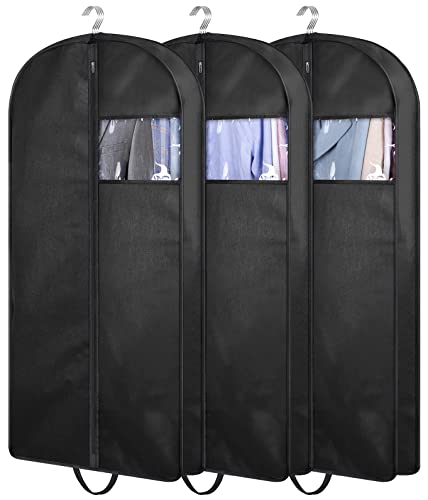
A bi-fold garment bag folds once across the middle, usually keeping a suit jacket or dress relatively flat. It is the safest starting point for travelers who carry one primary outfit and want to place the bag in an airplane closet or overhead bin.
Look for a hanging length of at least 40 inches, a removable or secure hanger hook, and a folded size near 22 by 14 by 9 inches. Those dimensions are not automatically airline-compliant, because carriers measure bags differently and wheels or external pockets may count toward the total. Verify the current limit for your ticket before buying.
A typical bi-fold holds one suit, one dress, or one sport coat with trousers, plus two to four shirts and a few thin accessories. A gusseted shoe pocket is useful, but shoes quickly consume the space that keeps clothing flat. For a one- or two-night trip, a 600D polyester or ballistic nylon exterior gives a better durability-to-weight balance than very thin fabric.
Choose a bi-fold if:
- You usually pack one suit or dress.
- You want the lowest empty weight, commonly about 1.5 to 3.5 pounds.
- You frequently carry the bag rather than roll it.
- You want the least complicated setup at security and hotel check-in.
Tri-fold garment bags: compact capacity with a packing trade-off
A tri-fold garment bag folds twice. Its advantage is capacity: the extra panels commonly provide more compartments for shirts, underwear, toiletries, and accessories without making the bag as wide as a large suitcase. It is particularly useful when a traveler needs a polished outfit plus several casual changes.
The compromise is wrinkle risk. A tri-fold creates another bend, and overpacking makes that bend sharper. The best designs use a wide fold zone, interior compression straps, and a suspended hanger system that keeps the jacket shoulders from collapsing. Do not fill every pocket simply because it exists; bulky shoes, jeans, and chargers can press directly against formalwear.
Typical folded dimensions are about 21 to 24 inches high, 12 to 15 inches wide, and 8 to 10 inches deep. Empty weight usually ranges from 2 to 4.5 pounds. A well-designed tri-fold can carry one suit or dress, two jackets made from lightweight fabric, or one formal outfit and four to six days of mixed clothing, depending on fabric thickness.
How to reduce tri-fold creasing
- Place the jacket or dress in the hanger compartment before adding anything else.
- Close the interior restraint straps without pulling them so tightly that they compress the shoulders.
- Put soft, light garments near the fold points and shoes in a separate compartment.
- Fold the bag along its intended lines rather than forcing it around a full packing cube.
- Hang the garment as soon as you arrive and let bathroom steam or a handheld steamer relax minor creases.
Rolling garment bags: the practical choice for heavy weekly trips
A rolling garment bag is the best garment bag style when clothing weight matters more than minimum size. Wheels and a telescoping handle make two suits, several shirts, and work shoes manageable through terminals, although they also add weight and failure points.
Most rolling designs fall between 20 and 24 inches tall when closed, with empty weights of roughly 6 to 10 pounds. A compact carry-on model may hold one or two suits; larger versions can hold two suits, a dress, five to eight shirts, shoes, and accessories. Capacity depends heavily on the wheel housing and the depth of the main compartment.
Before buying, measure the bag with the handle retracted and wheels included. A bag advertised as “carry-on” may exceed a particular airline’s height or depth limit. A 22-inch bag that is 14 inches wide and 9 inches deep has a nominal external volume of:
22 × 14 × 9 = 2,772 cubic inches
Usable capacity will be lower because wheels, frame pieces, pockets, and curved corners occupy space. Treat advertised volume as a comparison tool, not a guarantee that the bag will fit in an overhead compartment when fully packed.
Head-to-head: bi-fold vs. tri-fold vs. rolling
| Feature | Bi-fold | Tri-fold | Rolling |
|---|---|---|---|
| Typical empty weight | 1.5–3.5 lb | 2–4.5 lb | 6–10 lb |
| Typical suit capacity | 1 suit | 1 suit, sometimes 2 lightweight suits | 1–2 suits |
| Fold points | 1 | 2 | Usually 1–2, depending on construction |
| Carry-on suitability | Generally strongest | Generally good | Model- and airline-dependent |
| Shoulder comfort | Good at light loads | Fair to good | Best for heavy loads on smooth surfaces |
| Typical general-market price | $30–$180 | $50–$220 | $120–$500+ |
Fabric, hardware, and durability: what matters after the first year
Fabric denier is only one durability clue. A tightly woven 600D polyester can outlast a poorly finished heavier fabric, while ballistic nylon usually offers better abrasion resistance at a higher price and weight. For occasional travel, 300D to 600D polyester is usually adequate. Frequent flyers should prioritize 800D to 1680D nylon or reinforced ballistic panels around corners, handles, and wheel wells.
- Zippers: Look for large coil or metal-tooth zippers with covered seams. Zipper failure is common when a full bag is forced shut.
- Handles: Stitching and reinforcement patches matter more than a padded grip. Lift the loaded bag by the handle only if the handle is designed for it.
- Wheels: Two-wheel bags often have larger wheels and better curb clearance; four-wheel spinners maneuver more easily but reduce interior depth.
- Hanger hardware: A hook that swivels or slips out of its mount can let the garment sag. A fixed, reinforced hanger bar is preferable for frequent use.
- Interior lining: A smooth, light-colored lining makes loose threads and stains easier to see and reduces snagging.
For a simple ownership calculation, suppose a $180 rolling garment bag lasts six years and is used for 12 work trips annually. Its purchase cost is about $2.50 per trip before repairs: $180 divided by 72 uses. A $45 lightweight bag used for only five trips has a cost of $9 per use. The cheaper bag wins only if its lighter construction survives the intended frequency.
How to pack for fewer wrinkles
- Use a sturdy suit hanger and fasten the jacket’s top button or the dress’s closure.
- Empty pockets and remove belts, heavy jewelry, and other items that create pressure marks.
- Place tissue paper or a thin breathable garment sleeve between delicate layers; avoid plastic dry-cleaning bags for long storage.
- Put trousers along their natural crease and align jacket shoulders rather than flattening them randomly.
- Fill empty spaces with soft shirts, but keep dense objects away from the chest, shoulders, and fold lines.
- Close zippers gently and stop when resistance increases. Forcing the final inch is a common cause of broken teeth and split seams.
- At the destination, unpack immediately and hang the garment. Brush off surface lint and air the bag fully before storing it.
Which garment bag should you buy?
Choose a bi-fold if your priority is one suit, low weight, and the best chance of fitting airline carry-on rules. Choose a tri-fold if you need more organization for a short weekly trip but still want a soft, carryable bag. Choose a rolling garment bag if you regularly carry two formal outfits, shoes, and several days of clothing, and you are willing to confirm the airline’s size and weight limits.
Whichever style you select, prioritize a reliable hanger system, reinforced stress points, smooth zippers, and dimensions measured with all hardware included. Those features do more to protect clothing and reduce travel frustration than a long list of small pockets.