Key takeaways
- What wears first: the fabric or Lycra top, which picks up skin oil and darkens where palms rest, followed by edges that fray or peel.
- Cleaning: wipe with a cloth dampened with water and a little mild soap, then air dry. Do not soak or machine-wash a gel rest; water can get under the cover.
- Grip: rubberized bases lose grip when dusty. Wiping the base and the desk restores most of it.
- Leaks: keep sharp objects, pens and craft knives away. A pinhole can let gel seep out slowly, which is usually the end of that rest.
- Heat: avoid leaving gel rests in a hot car or direct sun near a window, which can deform them.
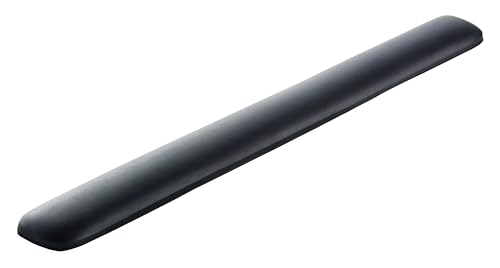
A gel wrist rest for a keyboard works best when its length matches your keyboard and its height sits level with the keyboard’s front edge, so your wrists stay roughly straight — a rest that is too tall bends your hands down, and one that is too low does almost nothing. Get those two numbers right and the brand matters far less than the box suggests.
Our top picks


As an Amazon Associate we earn from qualifying purchases at no extra cost to you. Ratings are shown as listed on Amazon.
Match the length to your keyboard
Keyboard layouts vary widely in width, and a wrist rest that hangs past the edge of a compact board, or stops short of a full-size one, puts uneven pressure under one hand.
| Keyboard layout | Typical keyboard width | Wrist rest length to look for |
|---|---|---|
| 60% or 65% compact | 11–13 in | 11–13 in |
| 75% | 12.5–13.5 in | 12.5–14 in |
| Tenkeyless (TKL) | 14–14.5 in | 14–15 in |
| Full size with numeric pad | 17–18 in | 17–19 in |
| Low-profile laptop-style keyboard (e.g. Apple Magic Keyboard without numeric pad) | about 11 in | Compact rest, 11–13 in, very low height |
Most generic gel rests are sold in the 17–19 inch full-size length. If you use a compact or TKL board, look specifically for a shorter size rather than trimming one, since cutting a gel rest exposes the gel.
Height is the number most people get wrong
Measure from the desk to the top of your keyboard’s front row of keys (the space bar row). Then choose a rest that sits at, or just slightly below, that height.
| Keyboard type | Typical front-edge height | Wrist rest height |
|---|---|---|
| Ultra-low-profile (Apple Magic Keyboard style) | 0.3–0.5 in | Thin pad, 0.3–0.5 in, or none |
| Low-profile membrane or scissor-switch | 0.6–0.9 in | 0.6–0.8 in |
| Low-profile mechanical | 0.8–1.0 in | 0.7–0.9 in |
| Standard mechanical (typical keycaps) | 1.2–1.6 in | 0.9–1.2 in |
| Mechanical with tall SA-style keycaps | 1.6–2.0 in | 1.1–1.4 in, often wood or firm foam |
Most gel wrist rests are about 0.7–1 inch tall, which suits standard office and low-profile keyboards but can be too low for tall mechanical boards. Gel also compresses a little under weight, so a rest that measures 1 inch will sit closer to 0.8 inch once your palms are on it.
Gel vs memory foam vs wood
| Material | Feel | Warmth | Typical lifespan | Main weakness | Typical price |
|---|---|---|---|---|---|
| Gel (fabric or Lycra covered) | Soft, molds to the hand, springs back quickly | Stays cooler than foam | 1–3 years | Cover wears and stains; gel can leak if punctured | $10–$30 |
| Gel with smooth polyurethane top | Slightly firmer, easy to wipe | Cool at first, can feel tacky in heat | 1–3 years | Surface can crack or peel at the edges | $10–$25 |
| Memory foam | Sinks in slowly, very soft | Warmer | 1–2 years | Flattens permanently, absorbs sweat | $10–$30 |
| Wood or resin | Hard, no give | Neutral | Many years | Pressure points on long sessions | $20–$60 |
Well-known office brands such as Fellowes and 3M both sell gel wrist rests in keyboard and mouse sizes, and Kensington’s ErgoSoft line is a common memory-foam alternative. Differences between mainstream gel rests come down mostly to cover fabric, base grip and exact height.
Gel wrist rest for a mouse
A gel wrist rest for a mouse usually comes either as a small separate pillow, about 3–4 inches wide, or built into a mouse pad. It suits people who move the mouse mostly with the wrist. If you move with the whole forearm, a fixed wrist bump can get in the way, and a larger flat pad with no rest may be more comfortable. Keep the pillow positioned under the heel of the palm, not under the crease of the wrist.
How to use a wrist rest without making things worse
A wrist rest is mainly a place to rest your palms during pauses in typing, rather than an anchor while you type. Many ergonomic guidelines suggest keeping wrists floating while actively typing so the fingers, not bent wrists, reach the keys.
- Rest the heel of your palm, not the wrist crease: pressure on the inner wrist sits over sensitive tendons and nerves.
- Keep wrists straight: your hand, wrist and forearm should form a roughly flat line. If your hands bend upward, the rest is too low or the keyboard feet are raised too high; fold the keyboard feet away first.
- Set chair and desk height first: elbows near 90 degrees, shoulders relaxed. A wrist rest cannot fix a desk that is too high.
- Leave a small gap: about 0.5–1 inch between the rest and the keyboard edge prevents knuckles from bumping the rest and lets you adjust.
A wrist rest is a comfort accessory, not a treatment. If you have ongoing numbness, tingling, or pain in the hands or wrists, see a doctor or physical therapist rather than relying on desk accessories.
Durability and cleaning realities
- What wears first: the fabric or Lycra top, which picks up skin oil and darkens where palms rest, followed by edges that fray or peel.
- Cleaning: wipe with a cloth dampened with water and a little mild soap, then air dry. Do not soak or machine-wash a gel rest; water can get under the cover.
- Grip: rubberized bases lose grip when dusty. Wiping the base and the desk restores most of it.
- Leaks: keep sharp objects, pens and craft knives away. A pinhole can let gel seep out slowly, which is usually the end of that rest.
- Heat: avoid leaving gel rests in a hot car or direct sun near a window, which can deform them.
Cost per year
A $15 gel rest that lasts 18 months works out to roughly $10 per year. A $45 wooden rest that lasts five years or more costs under $9 per year but offers no cushioning. For most office keyboards, a mid-priced gel rest replaced when the cover wears is the practical choice; for tall mechanical boards, a firmer and taller rest usually fits better.
Quick picks by situation
| Your setup | Best choice |
|---|---|
| Full-size office keyboard | 17–19 in gel rest, about 0.8–1 in tall |
| TKL mechanical keyboard | 14–15 in rest, 1–1.2 in tall, gel or firm foam |
| Compact 60–75% board | 12–13 in rest matched to board width |
| Thin laptop-style keyboard | Very low pad or no rest at all |
| Warm room or sweaty palms | Gel with smooth wipe-clean top |
| Wrist-driven mouse use | Small gel mouse pillow under the palm heel |