Key takeaways
- Under 150W continuous: Enough for laptop bricks, phone and camera chargers, LED lights, routers, portable monitors. Best for air travel carry-on size and light packs. Example type: Omni 20+, Yeti 200X.
- 300W continuous: The sweet spot for travel and backup. Runs most laptops, Starlink Mini/router setups, mini fans, CPAPs with heated humidifier off, and small TVs for a short time. Example type: River 2, Explorer 300 Plus, Solix C300.
- 600W continuous: Adds small kitchen gear, power tools on low, larger monitors, and mini-fridges at startup. Heavier and louder under load. Example type: EB3A.
The best power banks with AC outlet in 2026 are the EcoFlow River 2 for most travelers, the Bluetti EB3A for higher-wattage backup, and the OmniCharge Omni 20+ for true pocketable AC power, because real continuous AC output and usable laptop recharges matter more than headline capacity.
- Best power banks with AC outlet at a glance
- How to choose: continuous watts beats peak watts
- Worked calculation: how many laptop charges and how long will it run?
- Which one fits your situation?
- Decision matrix: match use frequency and space to chemistry and size
- Ownership realities: what wears out and common mistakes
- Final pick by need
These are not standard USB power banks. Any model with an AC outlet is technically a portable power station, with an inverter, fan, and larger battery. That means more weight, slower recharge, and efficiency losses you do not get with USB-C PD. Buy one only if you need to plug in a device that has no USB-C charging option, such as a camera battery charger, CPAP without DC adapter, lamp, router, or older laptop brick.
As an Amazon Associate we earn from qualifying purchases at no extra cost to you.



Best power banks with AC outlet at a glance
| Model | Capacity | Rated AC output | Weight | Battery type | AC recharge time |
|---|---|---|---|---|---|
| EcoFlow River 2 | 256Wh | 300W continuous, 600W surge | 3.5 kg / 7.7 lbs | LiFePO4, 3,000 cycles to 80% | ~60 min |
| Bluetti EB3A | 268Wh | 600W continuous, 1,200W surge | 4.6 kg / 10.2 lbs | LiFePO4, 2,500 cycles to 80% | ~70-80 min |
| Jackery Explorer 300 Plus | 288Wh | 300W continuous, 600W surge | 3.75 kg / 8.3 lbs | LiFePO4, 2,000 cycles to 80% | ~2 hours |
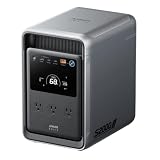
| Anker Solix C300 | 288Wh | 300W continuous, 600W surge | 3.9 kg / 8.6 lbs | LiFePO4, 3,000 cycles to 80% | ~90 min |
| Goal Zero Yeti 200X | 187Wh | 120W continuous, 200W surge | 2.3 kg / 5.0 lbs | Li-ion NMC, 500 cycles to 80% | ~2 hours |
| OmniCharge Omni 20+ | 71Wh / 20,000mAh | 100W AC, pure sine wave | 0.6 kg / 1.3 lbs | Li-ion, 500 cycles | ~3 hours via USB-C |
General market pricing in 2026: compact 70-190Wh AC models typically sit in the $150 to $280 range, 250-300Wh models in the $220 to $380 range, and 600W-class models like the EB3A often $280 to $420 depending on sales and solar bundles.
How to choose: continuous watts beats peak watts
Manufacturers advertise surge watts prominently. Ignore that for buying. What runs your gear is continuous AC output.
- Under 150W continuous: Enough for laptop bricks, phone and camera chargers, LED lights, routers, portable monitors. Best for air travel carry-on size and light packs. Example type: Omni 20+, Yeti 200X.
- 300W continuous: The sweet spot for travel and backup. Runs most laptops, Starlink Mini/router setups, mini fans, CPAPs with heated humidifier off, and small TVs for a short time. Example type: River 2, Explorer 300 Plus, Solix C300.
- 600W continuous: Adds small kitchen gear, power tools on low, larger monitors, and mini-fridges at startup. Heavier and louder under load. Example type: EB3A.
Also check inverter type. All models listed above use pure sine wave AC, which is required for sensitive electronics, laptop power supplies, and medical devices. Avoid modified sine wave units for anything except simple resistive loads.
Worked calculation: how many laptop charges and how long will it run?
You cannot divide station Wh by laptop Wh directly. AC inversion loses 10-20%, plus the laptop brick loses another 5-10%. Use 0.82 as a realistic efficiency factor for AC charging:
Usable AC energy = Rated Wh x 0.82
Recharges = Usable AC energy / Laptop battery Wh
Runtime hours = Usable AC energy / Device watts
Example for a 70Wh thin-and-light laptop and a 60W work load:
- EcoFlow River 2 (256Wh): 256 x 0.82 = 210Wh usable. That is 3.0 full recharges, or about 3.5 hours running a 60W load continuously.
- Bluetti EB3A (268Wh): 268 x 0.82 = 220Wh usable. That is 3.1 recharges, or 3.6 hours at 60W, or about 27 minutes at a full 480W load.
- OmniCharge Omni 20+ (71Wh): 71 x 0.82 = 58Wh usable. That is 0.8 recharges – enough to add 70-80% to most 13-14 inch laptops once, or run a 25W camera charger and mirrorless batteries for about 2.3 hours.
If you plan to charge via USB-C PD instead of AC, efficiency rises to about 0.90-0.92. A 256Wh station can add 15-20% more laptop runtime over USB-C than over AC. Whenever your laptop supports USB-C charging, use it and save the AC outlet for devices that truly need it.
Do not forget airline limits
The Omni 20+ at 71Wh is under the 100Wh FAA/TSA carry-on limit without airline approval. All 187Wh to 288Wh models above exceed carry-on limits for lithium batteries and cannot go on passenger aircraft. They are car, train, and home backup products, not flight products. If you fly frequently, the sub-100Wh class is your only AC option.
Which one fits your situation?
Best for travel by car and remote work: EcoFlow River 2
The River 2 wins for most buyers because it combines 300W of usable AC, very fast 1-hour wall recharge, and LiFePO4 longevity in a 3.5 kg package. It will recharge a MacBook Air/Windows ultrabook 2.5-3 times over AC, or run a router + laptop for 3-4 hours. It also supports pass-through and UPS-style switching under 30ms, useful for keeping a router alive during short outages.
Limitation: 300W will not start most heating elements, kettles, or full-size power tools.
Best for home backup and higher loads: Bluetti EB3A
Choose the EB3A if you need to run a 400-500W device briefly, such as a mini-fridge compressor startup, desktop PC with monitor, or CPAP with humidifier on. The 600W inverter is twice as capable as other models in this weight class, and it retains LiFePO4 chemistry. The tradeoff is weight at 4.6 kg and more fan noise at high load.
Best lightweight all-rounder: Jackery Explorer 300 Plus and Anker Solix C300
Both offer around 288Wh and 300W AC with LiFePO4 cells. Pick the Jackery if you want a simpler interface and broad solar panel support for camping. Pick the Anker Solix C300 if you want faster combined USB-C output for charging multiple laptops and phones alongside AC, plus a slightly more compact rectangular form for packing in a car trunk.
Neither is flight-legal, so choose based on port layout and recharge speed rather than capacity alone.
Best ultra-portable AC power: OmniCharge Omni 20+
The Omni 20+ is the only true power-bank-sized option here with a real 100W AC outlet. It fits in a jacket pocket and is flight-legal. It is ideal for photographers who need to charge proprietary camera batteries, drone batteries, or a laptop brick where USB-C is not available. Expect one partial laptop charge, not multiple. The small fan runs during AC use and the unit gets warm, which is normal.
Best for minimal weight with low-power AC: Goal Zero Yeti 200X
The Yeti 200X provides 120W AC at only 2.3 kg, lighter than any 300W station. It suits CPAP users without heated humidity, field monitors, and lighting kits. Its older NMC chemistry is rated for about 500 cycles versus 2,000-3,000 for LiFePO4 models, so it is better for occasional use than daily cycling.
Decision matrix: match use frequency and space to chemistry and size
| Your situation | What to prioritize | Best fit |
|---|---|---|
| Fly often, need AC for cameras or laptop brick | Under 100Wh, weight under 700g | OmniCharge Omni 20+ |
| Work from car, cafe backup, weekend trips | 250-300Wh, fast wall recharge, LiFePO4 | EcoFlow River 2 or Anker Solix C300 |
| Short home outages: router, laptop, phones, lamp | UPS mode, 300W+, quiet fan | EcoFlow River 2, Jackery 300 Plus |
| Need to run mini-fridge, desktop, or 500W gear | 600W continuous inverter | Bluetti EB3A |
| Occasional light use, lowest carry weight | 2-2.5 kg, 120W enough | Goal Zero Yeti 200X |
Ownership realities: what wears out and common mistakes
AC power stations fail differently than USB banks. The battery usually outlasts the inverter fan and ports if you use LiFePO4 models daily.
- Fan and vents clog first. Lint and car dust reduce cooling, forcing louder fan speeds. Vacuum vents monthly and never run AC output inside a closed bag. Overheating triggers throttling from 300W down to 150-200W.
- Do not store at 100%. LiFePO4 tolerates it better than NMC, but for storage over 2 weeks, leave at 50-60% and top up every 3 months. Storing full and hot is the fastest way to lose capacity.
- Avoid tiny loads on AC. Running a 5W phone charger from the AC outlet can waste 8-12W in inverter overhead. Use USB-C for anything under 20W to double runtime.
- Pass-through limits. Charging the station while running AC is convenient, but sustained pass-through at high watts generates heat. For daily desk backup, use the dedicated UPS mode if available and keep loads under 70% of rated watts.
- Cables matter. The included AC cable and wall brick are sized for fast recharge. Using a thin extension cord or underrated car inverter to recharge can double recharge time or trip thermal protection.
For maintenance, cycle LiFePO4 models from 100% to 0% to 100% once every 3 months to recalibrate the battery meter. If the display shows 30% then suddenly drops to 0% under load, calibration is overdue, not battery failure.
Final pick by need
If you want one portable outlet for travel and backup in 2026, get a 256-288Wh LiFePO4 model with 300W AC, such as the EcoFlow River 2 or Anker Solix C300. Step up to the Bluetti EB3A only if you have a specific 400-600W device to run. Choose the OmniCharge Omni 20+ only if you must fly with AC power or carry it on foot all day, and accept one partial laptop charge as the tradeoff.