Key takeaways
- Choose basic surge-only if: you always camp at newer resorts with stable power and just want spike insurance. Example type: Progressive Industries SSP-30XL, Camco 55301 Power Defender.
- Choose EMS + surge if: you camp anywhere with brownouts, old pedestals, or miswired 30-amp outlets. Example type: Hughes PWD30-EPO, Progressive EMS-PT30X, Southwire 34930.
- Choose hardwired EMS if: you worry about theft and want always-on protection. Example type: Progressive Industries EMS-HW30C, Southwire 35530 hardwire.
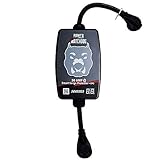
The best 30 amp RV surge protector for most campers in 2026 is the Hughes Autoformers Power Watchdog PWD30-EPO with Bluetooth, because it pairs a high 4,900-joule rating with full EMS shutoff for low voltage, high voltage, open neutral and reverse polarity, plus a replaceable surge board. If you want maximum pedestal diagnostics without Bluetooth, the Progressive Industries EMS-PT30X remains the best EMS surge protector for RV purists, while the Southwire Surge Guard 34930 is the best set-and-forget option for full-time weather exposure.
As an Amazon Associate we earn from qualifying purchases at no extra cost to you.


How to choose: Surge protector vs. EMS
Top rated RV surge protectors fall into two categories, and mixing them up is the most common buying mistake. A basic surge protector only diverts voltage spikes. An EMS (Electrical Management System) does that plus it disconnects you from bad power.
For 30-amp service — which is 120V single-phase, 3,600 watts max — you want EMS protection if you camp at older state parks, rural campgrounds, or during summer heat waves. Low voltage below 104V will overheat and kill an air conditioner compressor faster than a lightning strike. A basic 825 to 2,100-joule plug will not save you from that.
- Choose basic surge-only if: you always camp at newer resorts with stable power and just want spike insurance. Example type: Progressive Industries SSP-30XL, Camco 55301 Power Defender.
- Choose EMS + surge if: you camp anywhere with brownouts, old pedestals, or miswired 30-amp outlets. Example type: Hughes PWD30-EPO, Progressive EMS-PT30X, Southwire 34930.
- Choose hardwired EMS if: you worry about theft and want always-on protection. Example type: Progressive Industries EMS-HW30C, Southwire 35530 hardwire.
Best 30 amp RV surge protectors compared
Joule rating is not the whole story, but for campground use it predicts how many small spikes a unit can absorb before the MOVs wear out. Under 1,000 joules is light-duty. Over 3,000 joules is durable for seasonal use.
| Model | Type | Rated Joules | Clamp / Shutoff | Weather Housing | Size / Weight |
|---|---|---|---|---|---|
| Hughes Power Watchdog PWD30-EPO | Portable EMS + Bluetooth | 4,900 J | 132V clamp, disconnect at <104V / >132V, 3-mode + EPO | IP65-style sealed, replaceable face | 7.5 x 5.5 x 4.2 in / 3.2 lb |
| Progressive Industries EMS-PT30X | Portable EMS | 1,790 J absorbed / L-N protection | Disconnect at <104V / >132V, open ground/neutral, reverse polarity | All-weather shield, outdoor rated | 7.75 x 5.25 x 4.0 in / 3.6 lb |
| Southwire Surge Guard 34930 (30A Bluetooth) | Portable EMS + Bluetooth | 4,200 J | Disconnect at <102V / >132V, 10 fault modes | Rainproof, lock ring + lanyard | 9.8 x 4.5 x 4.1 in / 3.8 lb |
| Camco Power Defender 55301 | Portable circuit analyzer + surge | 2,800 J | Surge + wiring fault lights, auto disconnect on 102V / 132V | Flame-retardant ABS, rain cover | 6.5 x 5.0 x 3.8 in / 2.4 lb |
| Progressive Industries SSP-30XL | Basic smart surge | 825 J (1,790 J max absorbed in some listings) | Surge only + miswire lights, no low-voltage disconnect | Potted outdoor housing | 5.1 x 4.3 x 3.0 in / 1.5 lb |
Why the joule gap matters: a brushed-motor air conditioner startup, nearby transformer switching, and pedestal arcing all create 400V to 600V transients. A 4,200 to 4,900-joule unit can absorb dozens of those events. An 825-joule unit can absorb only a few before it becomes a sacrificial plug that still passes power with no protection left.
Our picks by situation
Best overall: Hughes Power Watchdog PWD30-EPO
This is the easiest recommendation for 30-amp travel trailers and Class Cs because of three practical advantages: the surge board is field-replaceable for about the cost of a basic plug, the app shows live amps, volts and watts so you can see when you are near the 3,600-watt ceiling, and the plug head is slimmer than Southwire models so it fits crowded pedestals with a flip lid. It also auto-resets after a fault with a 90-second delay to protect compressor restart.
Downside: the Bluetooth must pair within about 30 feet and the white housing shows campground grime fast. Wipe the blades monthly and keep dielectric grease off the contact faces.
Best EMS surge protector for RV without app dependence: Progressive Industries EMS-PT30X
If you do not want to rely on a phone, Progressive’s scrolling LED display shows voltage, amperage, frequency and error codes like E1 for reverse polarity or E2 for open ground directly on the unit. Its contactor-based disconnect is fast and it has a lifetime-minded service policy that Hughes and Southwire compete with, but Progressive’s U.S. support network for board repair is well established.
Tradeoff: lower published joule number and a bulkier plug that can be tight on pedestals where the 30-amp outlet sits low to the ground. Use a short 30-amp dogbone to relieve strain, not a 50-to-30 puck stacked sideways.
Best for full-time weather exposure: Southwire Surge Guard 34930
Southwire’s housing and locking lanyard handle weeks of rain better than most. It monitors for 10 conditions including high neutral current and overheating plug, and it will lock out power until faults clear. The Bluetooth app logs pedestal history, which helps if you need to show a campground host that site 14 is wired backward.
Tradeoff: it is the longest unit here at nearly 10 inches, so on short pedestals it hangs low. Secure it with a cable through the security ring, not around the cord.
Best budget upgrade from basic: Camco 55301 Power Defender
Camco moved beyond simple lights with this model to include automatic disconnect for high/low voltage. At 2.4 lb it is the lightest EMS-type here and a good step up if you previously used a best 20 amp surge protector puck for a pop-up or converted van and are moving to 30-amp service. Do not use a 20-amp household protector on a 30-amp RV inlet — it is under-rated for 3,600W continuous and lacks TT-30 fault detection.
Decision matrix: which one matches how you camp
| If you… | Pick this type | Why |
|---|---|---|
| Camp 20+ nights/year, run A/C + microwave | Hughes PWD30-EPO or Southwire 34930 | High joules + low-voltage EPO saves compressor |
| Boondock mostly, occasional hookups | Progressive SSP-30XL or Camco 55301 | Lighter, cheaper, spike + miswire check is enough |
| Leave RV plugged in storage | Hardwired EMS-HW30C / 35530 | No theft risk, protects converter from surges |
| Hate phone apps | Progressive EMS-PT30X | On-unit display, no pairing needed |
| Camp in rain / coastal salt | Southwire 34930 | Best rainproofing and overheat sensor |
Fit check: will it fit the pedestal?
Pedestal plug fit is where portable 30-amp units fail in real life. A TT-30P plug with a straight head needs 5 inches of clearance below the outlet door. Many older pedestals have only 3 to 4 inches.
Do this 30-second calculation before you buy: measure from the center of your RV inlet to the ground, then subtract 12 inches for cord droop. If your power cord is short and the inlet is high, a 3.6 to 3.8 lb EMS hanging off the pedestal will lever sideways and loosen the blades. Solution is a 18-inch 30-amp extension or 90-degree dogbone so the EMS hangs vertically. Never let the full weight hang from a worn pedestal outlet — that arcing causes the melted plug photos you see in forums.
General market range in 2026: basic 30-amp surge plugs run low-cost, EMS portables run mid-range to premium, with Hughes and Progressive at the top and Southwire close behind. Hardwired versions cost slightly more plus install. A replaceable $40 to $70 surge module is far cheaper than replacing a whole EMS after one big hit.
Setup that actually protects you
EMS units need 10 to 136 seconds to analyze power before they pass it through. That delay is protection, not a defect.
- 1. Test before backing in: Plug EMS into pedestal with breaker OFF, then turn breaker ON. Wait for clean code (E0 on Progressive, no fault light on others).
- 2. Check volts under load: Turn on A/C. If voltage sags from 118V to under 104V, the EMS should cut off. Do not bypass it — move sites or drop to fan-only.
- 3. Lock and elevate: Loop cable through security tab and keep unit 4+ inches off wet ground. Do not wrap in a plastic bag; trapped heat trips the thermal sensor.
- 4. After a storm code: Turn pedestal breaker OFF, unplug, inspect blades for pitting. If you saw a surge-fail light, replace the module.
Durability: what wears out first
MOVs (metal oxide varistors) degrade with every absorbed spike — they are consumable. Signs of end-of-life are a persistent surge-fault LED, Bluetooth voltage reads 8 to 10V lower than a multimeter at the pedestal, or discolored / loose TT-30 blades. Second failure point is the plug contacts themselves from pulling under load. Always switch the pedestal breaker off before plugging or unplugging.
Clean blades with electrical contact cleaner and a nylon brush twice a season. Do not file them bright — you remove nickel plating and accelerate corrosion. In salt air, apply a thin film of dielectric grease to the plug body, not the flat contact surfaces. Store portables indoors in winter; freeze-thaw cracks gaskets.
Common mistake: stacking a 50-to-30 adapter on top of an EMS and then a 30-to-20 reducer for a home outlet. Each adapter adds voltage drop. If you must plug a 30-amp RV into a best 20 amp surge protector setup at home (15/20A garage outlet), use a single high-quality TT-30 to 5-20 dogbone after the EMS, limit to 1,800 watts, and expect low-voltage trips when the converter bulk-charges.