The best drones with cameras for most buyers are the DJI Mini 4 Pro for portability, the DJI Air 3S for a stronger all-round camera system, and the DJI Mavic 3 Pro for serious still photography and three-lens flexibility.
Our top picks
 Drone with Camera for Adults 4K
- Fly Without Your Phone: Equipped with a convenient…
- Capture Every Adventure in 4K: Featuring a 90-degree…
- GPS Flight with Smart Return: This GPS drone…
 Drone with 1080P Camera
- 📷【Drone with Camera】 Equipped with a 1080P HD…
- 👍【Long Flying Time and Safer】 The upgraded FPV…
- 📣【Easier to Use】 This mini drone is an…
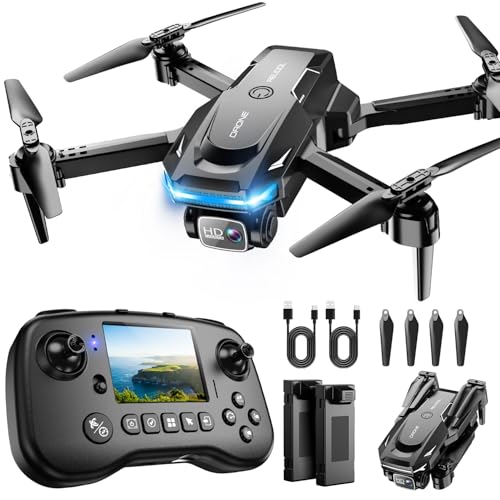 Drone with Camera
- The PK01 drone's remote comes with a super…
- 📷【Drone with Camera】 Equipped with a 1080P HD…
- 🕹️【More Fun to Fly】 This foldable drone has…
| Product | Key specs | |
|---|---|---|
| Drone with Camera for Adults 4K | Fly Without Your Phone: Equipped with a convenient… Capture Every Adventure in 4K: Featuring a 90-degree… GPS Flight with Smart Return: This GPS drone… | Check price |
| Drone with 1080P Camera | 📷【Drone with Camera】 Equipped with a 1080P HD… 👍【Long Flying Time and Safer】 The upgraded FPV… 📣【Easier to Use】 This mini drone is an… | Check price |
| Drone with Camera | The PK01 drone's remote comes with a super… 📷【Drone with Camera】 Equipped with a 1080P HD… 🕹️【More Fun to Fly】 This foldable drone has… | Check price |
 Drone with Camera for Adults | 【2K Ultra HD Camera】Loiley drone features a high-quality… 【User-friendly & Optical Flow Positioning】 The Loiley drone… 【Take it with you】 Loiley drone with camera… | Check price |
As an Amazon Associate we earn from qualifying purchases at no extra cost to you.
Best camera drones by situation
| Best for | Recommended drone | Why it fits | Typical market range in 2026 |
|---|---|---|---|
| Travel and casual aerial photos | DJI Mini 4 Pro | Under-249-g weight, folding design, strong obstacle sensing, vertical shooting | About $700–$1,100, depending on controller and battery bundle |
| Landscape, property and outdoor video | DJI Air 3S | One-inch main camera, useful telephoto camera, long flight time and robust sensing | About $1,000–$1,500 |
| Professional-looking stills | DJI Mavic 3 Pro | Four Thirds Hasselblad main camera plus two telephoto cameras | About $1,500–$2,500 |
| Low-cost learning | A small camera drone in the $300–$600 class | Lower replacement cost, but usually weaker stabilization, sensing and transmission | About $300–$600 |
DJI Mini 4 Pro: the best portable camera drone
The DJI Mini 4 Pro is the easiest recommendation for travelers and first-time owners who want serious image quality without carrying a large aircraft. Its takeoff weight is below 249 g with the standard battery, which makes it easier to transport and may place it in a simpler regulatory category in some countries. That weight does not automatically exempt the pilot from registration, safety rules or operator competency requirements, however.
Its camera captures 48-megapixel still images and up to 4K video at high frame rates, while the three-axis mechanical gimbal keeps footage smooth when the drone moves or turns. The camera can rotate for true vertical video, useful for social platforms and narrow subjects such as buildings or waterfalls.
Flight time is rated at up to about 34 minutes with the standard battery. Wind, cold weather, rapid acceleration and reserve-battery rules reduce usable time. A practical planning figure is around 22–27 minutes per battery if you leave a safe return reserve. The Mini 4 Pro also provides omnidirectional obstacle sensing, but sensors cannot reliably detect every thin wire, branch, glass surface or poorly lit object.
Choose the Mini 4 Pro if:
- You frequently travel by plane, train or backpack.
- You want vertical video as well as conventional landscape footage.
- You prefer a quieter, less imposing drone for occasional photography.
- You are willing to accept a smaller sensor than the Air 3S or Mavic 3 Pro.
DJI Air 3S: the best balance of image quality and flight capability
The DJI Air 3S is the better choice when image quality, wind resistance and flight endurance matter more than minimum size. Its main camera uses a one-inch sensor, which generally gives it an advantage over smaller sensors in dim scenes and helps produce cleaner detail at sunrise, sunset and during interiors. A second camera provides a tighter perspective without requiring the drone to fly as close to the subject.
The two-camera arrangement is more useful than a specification-sheet megapixel count suggests. A telephoto view can compress a mountain ridge, isolate a person from a landscape or photograph a building while keeping the aircraft farther away. That can improve composition and reduce the temptation to fly close to obstacles.
Its advertised flight time is up to approximately 45 minutes, although a working sortie should still be planned around wind, temperature and a return reserve. The Air 3S includes advanced obstacle detection and long-range digital transmission, but the stated maximum transmission distance is a laboratory or regulatory limit rather than a promise of reliable operation in every neighborhood. Trees, buildings, radio interference and local power limits can reduce range substantially.
Use the Air 3S when you shoot several times per month, work in open countryside, need better low-light performance, or want a drone that remains capable as your skills improve.
DJI Mavic 3 Pro: the camera-first option
The DJI Mavic 3 Pro is aimed at photographers and filmmakers who will make deliberate use of multiple focal lengths. Its main Hasselblad camera uses a Four Thirds sensor, while its medium and longer telephoto cameras offer different framing options. The larger main sensor is particularly valuable for detailed stills, controlled exposure work and scenes with challenging light.
This drone is heavier and more expensive than the Mini 4 Pro, and its folded body occupies more room in a bag. It is also more conspicuous in the air. Its advertised maximum flight time is about 43 minutes, but carrying multiple batteries and a suitable charger is important for a full shooting day.
The Mavic 3 Pro makes sense when photographs are the primary output and you will use interchangeable perspectives rather than simply cropping a wide image. For occasional holiday clips, the smaller Mini 4 Pro is usually easier to justify.
What camera specifications actually matter?
Resolution
More megapixels help with cropping and large prints, but sensor size, lens quality, dynamic range and exposure control often matter more. A 48MP mode may combine pixels or use a computational imaging process; it does not automatically outperform a larger sensor at night. For video, 4K is sufficient for most online work. High frame rates are useful for slow motion, but they may reduce dynamic range or require more light.
Stabilization
Look for a three-axis mechanical gimbal rather than relying only on electronic stabilization. A gimbal corrects pitch, roll and yaw movement before the image reaches the sensor. Check whether the camera supports a true vertical position if short-form portrait video is important.
Obstacle avoidance
Obstacle sensors reduce risk during automated flight, but they are not an insurance policy. They may struggle with fine branches, cables, reflective surfaces, fog, darkness and objects outside their sensing directions. Keep visual contact where required, fly slowly near structures and avoid assuming that “return to home” can clear every obstacle.
Transmission and controller requirements
Most current DJI camera drones require a compatible DJI remote controller or a smartphone-connected controller. Controllers with an integrated screen are convenient because they avoid draining a phone and reduce setup time. Phone-based controllers can be cheaper, but confirm that your phone fits the clamp, supports the required app and has adequate battery life.
Transmission-range figures should be treated as best-case limits. In practice, maintaining a clear line of sight is more important than buying the drone with the largest advertised number. A drone that can transmit several miles in an unobstructed test environment may have a much shorter dependable range around buildings or trees.
Decision matrix: which level suits you?
| Your situation | Best fit | Main compromise |
|---|---|---|
| First drone, limited storage, fewer than 10 flights per year | DJI Mini 4 Pro | Smaller sensor and lower wind margin |
| Monthly outdoor photography and property work | DJI Air 3S | Larger bag and more regulatory weight considerations |
| Frequent paid or high-value photography | DJI Mavic 3 Pro | Higher purchase, transport and insurance costs |
| Indoor practice or low-risk learning | Small enclosed or inexpensive camera drone | Usually inferior image quality and stabilization |
Calculate how many batteries you need
Suppose a drone gives you 24 minutes of practical usable time per battery after reserving power for the return flight. A 90-minute location shoot needs:
90 ÷ 24 = 3.75, so plan on four batteries, not two or three. Add time for takeoff, framing, landing, battery changes and wind-related delays. A charging hub and spare propellers are often more useful than paying extra for a marginal increase in advertised transmission range.
Portability, maintenance and ownership costs
A folding drone is easier to carry, but the gimbal, propellers and battery contacts still need care. Inspect propellers after every rough landing and replace them if they are nicked, bent or visibly warped. Clean dust from the camera glass with an air blower and a suitable lens cloth rather than rubbing grit across it. Keep batteries at the manufacturer-recommended storage charge, avoid leaving them in a hot car, and retire any pack that is swollen, damaged or unusually hot.
Common beginner mistakes include launching with a low phone or controller battery, forgetting to check the home-point location, flying directly over people, and trusting an automated route without checking its surroundings. Download maps and update firmware before visiting a remote location, then test the aircraft in an open area after major software or propeller changes.
Legal considerations before your first flight
Drone rules depend on the country, aircraft weight, camera use and whether the flight is recreational or commercial. Check the aviation authority where you will fly for registration, remote-identification requirements, pilot exams, altitude limits, no-fly zones and rules near airports, emergency scenes, national parks and government buildings. A sub-249-g drone can still be regulated because it has a camera.
Do not fly over uninvolved people or crowds unless local rules specifically permit it, respect privacy and property boundaries, and maintain the required visual line of sight. Commercial work may require additional certification, insurance or operating approval. Confirm restrictions before travel rather than relying on an app alone, because temporary flight limits can change quickly.
Final recommendation
Choose the DJI Mini 4 Pro if portability and simple ownership are your priorities. Choose the DJI Air 3S for the strongest all-round combination of camera quality, flight time and obstacle awareness. Choose the DJI Mavic 3 Pro when you will exploit its larger sensor and multiple focal lengths for serious still photography. Whatever you buy, budget for batteries, a charger, replacement propellers and the time needed to learn safe, legal operation.
More from Amazon
Programs that pair well with the guide above. Offers and eligibility are set by Amazon and may change.
Free shipping on eligible items, Prime Video and more. Eligible new members can start with a free trial.
Start a Prime free trialAd-free music streaming. Eligible new subscribers can start with a free trial.
Try Music Unlimited freeA Prime membership for ages 18-24 with a trial period. Eligibility is set by Amazon.
See Prime for Young AdultsAudiobooks and podcasts to listen to on the go. Eligible new members can start with a free trial.
Try Audible freeAs an Amazon Associate we earn from qualifying purchases.