Key takeaways
- Compare the best dethatchers by power source, working width, and tine type to lift thatch, moss, and debris so air and water reach your lawn roots.
As an Amazon Associate we earn from qualifying purchases.
Thatch is the tight mat of dead stems, roots, and clippings that builds up between the grass blades and the soil. A thin layer is harmless, but once it passes about half an inch, it starts acting like a roof: water runs off instead of soaking in, fertilizer sits on top, and roots grow into the mat instead of down into the soil. A dethatcher breaks that mat up and pulls it to the surface so air, water, and seed can reach the ground again. The five machines and tools below cover the main ways to do the job — a corded electric walk-behind, a cordless battery model, a tow-behind unit for a lawn tractor, a manual thatch rake for small areas, and a wider, stronger corded model for bigger lawns. Every figure here comes from the maker’s own listing or documentation.


Disclosure: This article contains affiliate links. If you make a purchase through these links, we may earn a commission at no extra cost to you.
Our top picks
How to Choose
Start by measuring what you actually have. Push a trowel into the turf and look at the brown, spongy layer between the green growth and the soil. Under half an inch thick, most lawns do fine without dethatching. Between half an inch and an inch, a pass with spring tines will open the surface up. Much beyond an inch, expect two passes and a surprising volume of debris. Thatch depth drives everything else: how aggressive a tool you need, how low you set it, and how much bag capacity matters.
Next, understand the two kinds of working heads, because listings use the words loosely. A dethatcher reel carries spring tines — rows of stiff wire fingers that comb through the turf and flick loose thatch upward. Tines are the gentler option, right for routine maintenance on grass you want to keep. A scarifier reel carries fixed blades that slice into the mat and the top of the soil, cutting runners and opening slits for seed — the heavier intervention, meant for lawns being renovated or overseeded. Many electric models ship with both reels, which is why so many listings lead with dethatching but mention scarifying in the same breath.
Depth adjustment is where the two head types meet. Powered models offer a lever or knob with several positions, usually expressed in fractions of an inch or in millimeters above and below soil level. For tine work you generally want the fingers just grazing the soil surface; for blade work you set the reel slightly lower so the knives nick the ground. Start high, make a short test pass, and check what comes up — mostly dead material means the setting is right, while torn green crowns mean it is too deep. Manual rakes have no dial: pressure and head angle do the same job.
Then look honestly at collection. Dethatching a neglected lawn produces far more debris than most people expect, and bag size decides how often you stop. The powered picks below carry bags of 8 gallons, about 12 gallons (45 liters), and 13.2 gallons, and even the largest fills quickly on a thick mat — many owners run a powered unit without its bag and pick the loosened thatch up afterward with a mower or leaf rake. Tow-behind dethatchers and manual rakes collect nothing by design; they leave debris in rows on the surface for a second cleanup pass.
Finally, match the power source and working width to the lawn. Corded electrics run as long as you need and suit small to mid-sized yards within reach of an outdoor outlet and a suitable extension cord. Cordless models trade runtime for freedom of movement on lots where a cord would snag on beds and trees. A tow-behind needs a lawn tractor or ATV with a hitch pin and covers ground in 40-inch passes. A manual rake makes sense for a small patch or spot work where a machine cannot go.
1. Sun Joe AJ801E — Corded Electric Dethatcher and Scarifier, 13-Inch
The AJ801E is the straightforward corded option: plug it in, pick a depth, and walk. Its 12-amp motor turns a 12.6-inch working path — Sun Joe markets the machine in the 13-inch class — and the listing describes AirBoost technology, in which the spring steel tines are shaped to lift more thatch per pass and hold their edge longer. A five-position depth knob adjusts the working height from 0.4 inch below the soil surface to 0.4 inch above it, so the same machine handles a light combing and a deeper working-over without tools.
What makes the AJ801E flexible is the pair of interchangeable cylinders in the box. The spring-tine reel does the dethatching; swap in the blade reel and the machine scarifies, slicing the mat and nicking the soil ahead of overseeding. The detachable collection bag holds 8 gallons, the smallest bag in this guide — on a lawn with real buildup it fills fast, and many owners run bag-free and rake up behind the machine. At 27 pounds with a collapsible handle, it stores easily on a garage wall or shelf. Sun Joe backs it with a two-year warranty.
Specs
- Model: AJ801E; corded electric, 12-amp motor
- Working width: 12.6 in. (13-inch class)
- Depth control: 5 positions, from −0.4 in. to +0.4 in. relative to soil level
- Reels included: spring-tine dethatcher cylinder and scarifier blade cylinder, with AirBoost tine design
- Collection bag: 8-gallon detachable
- No-load speed: 2,990 rpm; weight 27 lb; 2-year warranty
See the Sun Joe AJ801E on Amazon
2. Greenworks 40V (2-In-1) Dethatcher / Scarifier, DT40B510 — Cordless
Greenworks’ DT40B510 cuts the cord entirely. It runs on the Greenworks 40V platform, and this listing includes a 5.0Ah battery and a rapid charger in the box, so it arrives ready to work. The battery also carries a USB port, letting it double as a power bank for a phone while you work. Greenworks states a runtime of up to 45 minutes on the included pack, suiting the small to mid-sized lawns a 14-inch machine is aimed at.
The working head covers a 14-inch path with stainless steel tines, and like the Sun Joe above it is a genuine two-in-one: a dethatcher reel for combing out thatch and a scarifier reel for cutting into the mat before seeding. Depth adjusts across five positions from a single control, and the rear collection bag is the roomiest of the walk-behind electrics here at 45 liters, so stops to empty come less often. Push-button starting replaces a pull cord, the handle folds for storage, and Greenworks lists a three-year warranty on the tool. For a yard where an extension cord would constantly snag, this is the natural pick of the five.
Specs
- Model: DT40B510; Greenworks 40V cordless platform
- Included: 5.0Ah USB battery and rapid charger; maker-stated runtime up to 45 minutes
- Working width: 14 in.
- Reels included: dethatcher reel with stainless steel tines and scarifier reel
- Depth control: 5 positions
- Collection bag: 45 L; push-button start; folding handle; 3-year tool warranty per the listing
See the Greenworks 40V Dethatcher / Scarifier on Amazon
3. Agri-Fab 45-0294 — 40-Inch Tine Tow Dethatcher
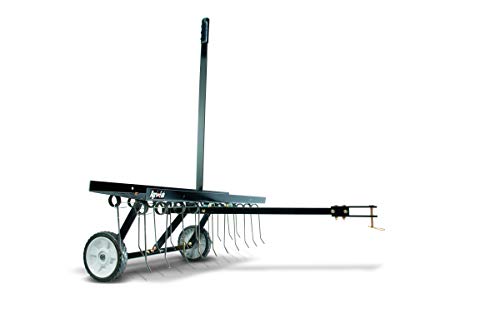
If the lawn is measured in acres and a lawn tractor already lives in the shed, a tow-behind dethatcher does in one pass what a walk-behind does in three. The Agri-Fab 45-0294 pulls a 40-inch working width behind any tractor or ATV with a standard hitch pin. Twenty heat-treated spring tines, each 3/16 inch in diameter, ride on a heavy-gauge steel deck and comb the mat loose as you drive, bringing thatch and clippings to the surface for collection on a follow-up pass.
The detail that decides how well a tow unit works is downward pressure, and Agri-Fab answers it with a weight tray over the tine bar built to hold up to 70 pounds of ballast — concrete blocks or sandbags — so the tines keep biting on hard, dry ground instead of skating over it. The 7 by 1.5-inch semi-pneumatic wheels roll over ruts, and a lift handle raises the tines clear of the ground for transport across drives and paths. There is no motor, no bag, and nothing to charge: assembly, a hitch pin, and ballast are the whole setup. For large, open turf, this is the efficient route.
Specs
- Model: 45-0294; tow-behind for lawn tractors and ATVs with a hitch pin
- Working width: 40 in.
- Tines: 20 heat-treated spring tines, 3/16 in. diameter
- Weight tray: holds up to 70 lb of added ballast for tine pressure
- Wheels: 7 x 1.5 in. semi-pneumatic
- Deck: heavy-gauge steel with drawbar; lift handle raises tines for transport
See the Agri-Fab 45-0294 on Amazon
4. Walensee Thatch Rake — 15-Inch Manual Dethatching Rake

Not every thatch problem needs a motor. For a small lawn, a mossy shaded patch, or the strip beside a fence, a manual thatch rake does the job with nothing to plug in or fuel. The Walensee pairs a 15-inch head with 19 curved steel tines on two working faces: one side pulls thatch up and out, and the reverse side loosens and cultivates the topsoil, handy for preparing a bare patch for seed once the dead material is gone.
The head angle adjusts and locks with a wing-nut fitting, so you can set how aggressively the tines engage — shallow for a maintenance comb-through, steeper for a heavy mat. The steel handle assembles from sections to working lengths of about 40, 55, or 70 inches, letting shorter and taller users keep a comfortable pulling posture, and the hollow steel construction keeps the tool light for long sessions. The steel carries an anti-rust, anti-corrosion coating for shed storage. There is no collection: the rake leaves loosened thatch on the surface to be gathered with a leaf rake. Within its limits — patience and elbow grease — it is the simplest tool in this guide, and the only one that works one square foot at a time with full control.
Specs
- Type: manual thatch rake; no motor or power source
- Head: 15 in. wide, dual-sided; 19 curved steel tines
- Functions: dethatching face plus a reverse face for loosening topsoil
- Handle: sectional steel, assembles to about 40, 55, or 70 in.
- Head angle: adjustable, locks with a wing-nut fitting
- Finish: anti-rust, anti-corrosion coating on the steel
See the Walensee Thatch Rake on Amazon
5. Sun Joe AJ805E — Corded Electric Dethatcher and Scarifier, 15-Inch
The AJ805E is the step up within Sun Joe’s own line for lawns that outgrow the 13-inch machine. A 13-amp motor drives a full 15-inch raking path, trimming pass after pass off a mid-sized lawn, and the AirBoost spring steel tines carry over from the smaller model. The five-position depth control is split by function: the dethatcher settings run from soil level to 0.4 inch above it, while the scarifier settings run from 0.4 inch below the surface up to soil level — a clear, listing-stated separation that makes it harder to set the blade reel too deep by accident.
Like its sibling, the AJ805E ships with both a dethatching cylinder and a scarifying cylinder, so it covers spring cleanup and autumn renovation with one machine. Cleanup is where it pulls furthest ahead of the AJ801E: the detachable collection bag holds 13.2 gallons, the largest on any walk-behind here, stretching the interval between emptying stops on a heavy cleanout. The maker lists a net weight of 23.4 pounds; the unit is ETL listed and backed by a two-year warranty. If the lawn is a quarter acre or more and an outlet is within cord reach, this is the corded model built for it.
Specs
- Model: AJ805E; corded electric, 13-amp motor
- Working width: 15 in.
- Depth control: 5 positions — dethatcher 0 to +0.4 in.; scarifier −0.4 to 0 in.
- Reels included: dethatching cylinder and scarifying cylinder, AirBoost spring steel tines
- Collection bag: 13.2-gallon detachable
- No-load speed: 3,000 rpm; net weight 23.4 lb; ETL listed; 2-year warranty
See the Sun Joe AJ805E on Amazon
Frequently Asked Questions
How do I know if my lawn actually needs dethatching?
Cut a small wedge of turf or push a trowel in and measure the brown layer between the green blades and the soil. Under half an inch is normal and even useful as mulch. Once that layer passes half an inch and water starts pooling or running off, dethatching will help. Lawns fed heavily and watered often, especially creeping types like Bermuda, zoysia, and Kentucky bluegrass, build thatch fastest.
What is the difference between a dethatcher and a scarifier?
A dethatcher uses spring tines to comb dead material out of the turf without cutting into the soil — it is the maintenance tool. A scarifier uses blades to slice through the mat and into the top of the soil — the renovation tool, usually paired with overseeding. Many electric models, including three picks in this guide, include both reels so one machine covers both jobs.
When is the best time of year to dethatch?
Dethatch when the grass is actively growing and can recover quickly: early spring or early fall for cool-season grasses, late spring into early summer for warm-season grasses. Avoid peak summer heat and frozen or waterlogged ground. Mow a little shorter than usual first, and water lightly a day or two before if the soil is bone dry, so the tines pull thatch rather than tearing turf.
What should I do with the debris a dethatcher pulls up?
Expect a lot of it — a neglected lawn can fill bags far faster than the collection figures suggest. Rake or mow over the loosened material to gather it, then compost it if the lawn has not been treated with weed killers recently, or bag it as yard waste. Follow with overseeding on thin areas and a thorough watering; the opened surface is the best seed bed the lawn will have all year.
Conclusion: Which Dethatcher Fits Your Lawn?
For most small to mid-sized lawns near an outlet, the Sun Joe AJ801E covers both dethatching and scarifying in one compact corded machine. If a cord will not work around your beds and trees, the Greenworks DT40B510 brings the same two-in-one design on a 40V battery with the largest bag of the walk-behinds. Owners of large properties with a lawn tractor should look at the Agri-Fab 45-0294, whose 40-inch width and ballast tray turn dethatching into a towing job. For a small patch or precise spot work, the Walensee thatch rake needs nothing but effort and stores on a hook. And if the lawn is big but still cord-reachable, the Sun Joe AJ805E adds width, motor strength, and a 13.2-gallon bag to finish in fewer passes and fewer stops.
More from Amazon
Programs that pair well with the guide above. Offers and eligibility are set by Amazon and may change.
Free shipping on eligible items, Prime Video and more. Eligible new members can start with a free trial.
Start a Prime free trialAd-free music streaming. Eligible new subscribers can start with a free trial.
Try Music Unlimited freeA Prime membership for ages 18-24 with a trial period. Eligibility is set by Amazon.
See Prime for Young AdultsAudiobooks and podcasts to listen to on the go. Eligible new members can start with a free trial.
Try Audible freeAs an Amazon Associate we earn from qualifying purchases.