Key takeaways
- Compare the best pour over coffee drippers by material, hole design, filter type and cup size, with brewing notes for consistent home coffee.
As an Amazon Associate we earn from qualifying purchases.
Pour over brewing looks simple — a cone, a paper filter, hot water — yet the dripper you choose quietly decides how forgiving your mornings are. The shape of the cone, the size and number of drain holes, and the way the paper sits against the walls govern how fast water moves through the coffee bed — and that flow decides whether an uneven pour still produces a sweet cup or a thin, sour one. The same beans and the same kettle technique can give noticeably different cups purely because one dripper drains freely while the other holds water back.

This guide compares five manual drippers that cover the main design families: a free-draining ceramic cone for people who enjoy dialing in technique, a flat-bottom metal brewer that steadies extraction for beginners, a classic single-cup porcelain cone, an insulated stainless kit built for small batches, and a one-piece glass brewer-carafe for serving several people at once. None of them needs electricity or a complicated routine. Read the How to Choose section first if the geometry terms are new; it explains which design details shape the cup.
Disclosure: This article contains affiliate links. If you make a purchase through these links, we may earn a commission at no extra cost to you.
How to Choose
Start with geometry: cone versus flat bottom. A cone-shaped dripper funnels all the water toward a single point at the bottom. That concentrates flow, so the pour pattern, the grind size, and the total pour time strongly influence extraction. Cones reward careful technique with clarity and brightness, and they punish sloppy pouring with uneven results. A flat-bottom dripper spreads the coffee into a shallower, wider bed with two or three small drain holes. The bed depth stays more uniform, the holes meter the flow, and the cup tends to come out sweeter and more consistent. Neither shape is better in absolute terms; the cone gives you more control, and the flat bottom gives you more margin for error.
Hole and rib design control drawdown. On a cone dripper, one large hole means almost nothing restricts the water except the coffee bed itself, so grind size becomes your main flow control. Smaller or multiple holes build restriction into the brewer, slowing drawdown and lengthening contact time. Ribs and grooves on the inner wall matter just as much: they hold the paper slightly away from the wall so air can escape and water can move down the sides instead of sealing against the surface. Deep ribs and a wide hole drain fast and clean; a smooth wall and a small hole drain slowly and can stall if the grind is too fine.
Match the filter before anything else. Every dripper in this guide uses its own paper shape, and the wrong paper simply will not fit. Cone drippers take pointed cone filters in numbered sizes. Flat-bottom brewers take pleated wave filters or basket-style papers. One-piece brewers take proprietary bonded filters that are thicker than standard paper. Check that the matching filters are easy to find through normal kitchen and coffee retailers, because you will reorder them for as long as you own the dripper. Metal mesh filters exist for some models, but they let fine sediment and more oils through, which changes the cup toward a heavier body.
Material decides heat behavior and durability. Ceramic and porcelain have real thermal mass: preheat one with hot water and it holds the slurry temperature steady through the brew. The trade-off is weight, and the fact that it can chip or crack if dropped. Glass behaves similarly with less mass, and it lets you watch the bed and the drawdown. Stainless steel is light, nearly unbreakable, and the natural choice for travel, though thin single-wall steel loses heat faster than ceramic; insulated double-wall steel closes that gap. Plastic drippers are light and forgiving of temperature shock, but they can pick up odors over time and lack the steady heat of ceramic.
Size the dripper to your daily batch. A small single-cup cone is perfect for one mug but frustrating when a guest arrives, because brewing twice through a small bed changes the recipe. A mid-size dripper sized for two to four cups handles a large mug or a small server and still behaves well at half capacity. Very large brewers need a minimum dose to form a proper bed; a single small cup in one usually comes out thin. Pick the size that matches an ordinary weekday, not the biggest gathering you host twice a year.
Technique tools that pair with any dripper. A gooseneck kettle is not mandatory, but its narrow spout delivers a slow, controlled stream that a standard kettle cannot match, and control over the pour is control over agitation and extraction. A simple kitchen scale matters just as much: weighing coffee and water turns a good cup into a repeatable one. Fresh water just off the boil, a consistent grind, and a short bloom pour complete a setup that makes any dripper below perform at its best.
The 5 Best Pour Over Coffee Drippers
1. Hario V60 Ceramic Coffee Dripper, Size 02 — The Technique Pick
The V60 is the reference cone dripper, and the ceramic size 02 version is the one most home brewers settle on. Its 60-degree cone ends in a single large drain hole, so almost nothing in the brewer itself slows the water down. Flow is governed by your grind and your pour: a steady spiral pour produces a bright, clean cup with clear separation between flavors, while a rushed pour shows up honestly in the mug. Spiral ribs run up the inner wall, lifting the paper away from the ceramic so air escapes upward and the drawdown stays even instead of choking at the tip.
Ceramic gives this version its character. The body has enough mass to hold heat through the whole brew once you preheat it with a rinse of hot water, which also washes any paper taste out of the filter. Size 02 covers the useful middle ground — one large mug, two ordinary cups, or a small server — and it takes Hario’s widely stocked size 02 cone filters. If you enjoy adjusting grind and pour to chase a better cup, this is the dripper that responds most directly to what you do.
Specs
- Material: ceramic with a white finish
- Model V60-02W, size 02 for 1 to 4 cups
- 60-degree cone with a single large drain hole
- Spiral inner ribs for airflow and even drawdown
- Uses Hario V60 size 02 paper filters
- Includes a measuring spoon; dishwasher safe
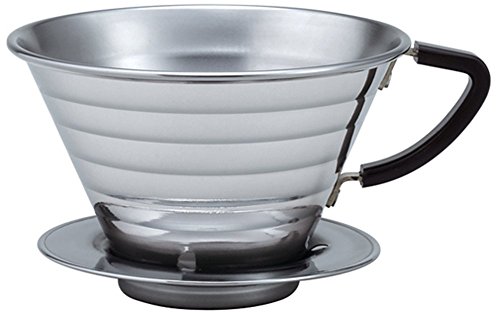
2. Kalita Wave 185 Stainless Steel Dripper — The Forgiving Pick
The Kalita Wave takes the opposite approach to flow control. Its flat bottom holds the coffee in a shallow, even bed, and three small holes in the base meter the water out at a measured pace. Because the brewer itself restricts flow, small mistakes in pouring speed or grind matter far less than in a free-draining cone. The result is a consistently sweet, balanced cup that tastes similar on a careful Sunday and a hurried weekday, which is why so many people recommend it as a first dripper.
The pleated Wave filters are part of the system: their wavy walls hold the paper away from the dripper walls, keeping the bed draining evenly and reducing the channeling that can leave part of the grounds under-extracted. This stainless steel 185 model is the larger size, suited to two to four servings, and the metal body shrugs off drops, travels in a bag without worry, and rinses clean in seconds. It has less thermal mass than ceramic, so a hot-water preheat is worth the few seconds it takes. For dependable results without studying pour technique, this is the easiest brewer here to live with.
Specs
- Material: stainless steel
- Flat-bottom bed with three drain holes
- Uses Kalita Wave 185 pleated paper filters
- Sized for roughly 2 to 4 servings per brew
- Dishwasher safe
- Made in Japan, model 05033
3. Melitta 1 Cup Porcelain Pour-Over Cone — The Single-Cup Classic
Melitta invented the paper-filter coffee cone, and this porcelain one-cup version keeps that original idea in its simplest form. The wedge-shaped cone sits directly on a mug and brews one serving straight into the cup you will drink from — no server, no second vessel to wash, and a footprint small enough for a crowded counter. A restricted drip opening at the base slows the flow through the bed, which makes the little cone tolerant of an imperfect pour and a slightly uneven grind.
Porcelain suits the single-cup routine well: it holds heat better than thin plastic cones, so a small brew keeps its temperature, and the glossy surface rinses clean without holding old flavors. The cone takes Melitta number 2 paper filters, the most widely stocked filter size in ordinary grocery stores, so restocking never requires a specialty order. Ribs inside the cone support the paper and keep it from sealing against the wall. If your household drinks coffee one mug at a time, this is the classic way to do it.
Specs
- Material: porcelain with a glossy white finish
- Uses Melitta #2 cone paper filters
- Brews a single cup directly over a mug
- Ribbed interior walls support the paper filter
- Dishwasher safe
- Model 63274
4. Fellow Stagg [XF] Pour-Over Dripper and Carafe Kit — The Insulated Batch Pick

The Stagg [XF] is a flat-bottom dripper engineered around temperature stability and clog resistance. The dripper itself is vacuum-insulated stainless steel with a double wall, so the slurry stays hot through the brew without any preheating ritual, and its steep walls keep the bed deep enough for even extraction at small doses. At the base, a pattern of holes and raised bumps keeps fine particles from sealing the drainage path, addressing the stalled drawdowns flat-bottom brewers can suffer with finer grinds.
Fellow adds a practical detail most drippers skip: the dripper’s funnel doubles as a measuring aid, with markings that guide the coffee dose for the water you plan to pour. This listing is a complete kit — the dripper, a 20-ounce double-wall glass carafe, and a starter supply of the matching paper filters — so it covers brewing for two people in one box. The flat-bottom bed and metered drainage keep it forgiving, in the same spirit as the Kalita, while the insulation and carafe make it the strongest choice here for a shared morning pot.
Specs
- Dripper material: vacuum-insulated stainless steel, matte black
- Flat-bottom bed with a clog-resistant hole and bump pattern
- Built-in ratio aid markings on the dripper funnel
- Includes a 20 oz double-wall glass carafe and paper filters
- Uses Fellow Stagg paper filters
- Brew capacity up to 20 oz
5. Chemex Classic Series 6-Cup Coffeemaker — The Brewer-Carafe Pick

The Chemex needs one honest clarification up front: it is not a dripper that sits on a separate server. The cone and the carafe are a single piece of glass, and you brew directly into the vessel you pour from. That one-piece design is its strength at the table — nothing to assemble, and the finished coffee stays in an elegant server. The trade-off is commitment: it works best at its intended batch size, and it takes Chemex’s own bonded filters rather than any standard paper.
Those filters define the cup. Chemex bonded paper is noticeably thicker than ordinary filter paper, and it holds back fine sediment and a large share of the coffee oils, producing an exceptionally clean, sweet, almost tea-like brew. The vessel is non-porous borosilicate glass with a polished wood collar and leather tie that serve as the handle, and its 30-ounce capacity — six cups by the maker’s five-ounce measure — suits two to four ordinary mugs. A grooved spout vents air while you brew. Choose it for a shared pot with a notably clean profile, and keep the right filters on hand, because nothing else fits.
Specs
- One-piece brewer and carafe in borosilicate glass
- Capacity: 30 oz (six 5 oz cups), model CM-6A
- Polished wood collar with a leather tie as the handle
- Uses Chemex Bonded paper filters
- Non-porous glass that rinses clean without holding flavors
- Dishwasher safe once the collar is removed
FAQ
What grind size should I use for pour over coffee?
Start with a medium grind, roughly the texture of coarse sand, for flat-bottom drippers, and a touch finer for free-draining cones like the V60. Then adjust by drawdown: if the water runs through fast and the cup tastes thin or sour, grind finer; if the brew stalls and tastes harsh, grind coarser. Change one step at a time so you can taste what the adjustment did.
Do I really need a gooseneck kettle?
No dripper here requires one; a standard kettle works if you pour slowly in small circles. A gooseneck simply makes that control easier, because its narrow spout delivers a thin, steady stream that does not blast the coffee bed apart. If you brew pour over daily, it is the first accessory worth adding; a scale is a close second.
Should I choose paper or metal filters?
Paper gives the cleaner cup: it traps fine sediment and most of the oils, which is why the Chemex and the cone drippers taste so bright. A reusable metal filter lets those elements through, producing a heavier body closer to a press pot, and removes the need to reorder paper. The catch is fit — a metal filter must match your dripper’s exact shape, and not every model here has one made for it.
Why does my pour over taste sour one day and bitter the next?
Sour usually means under-extraction: the water passed through too quickly, the grind was too coarse, or the water was not hot enough. Bitter usually means over-extraction: too fine a grind, or a drawdown that stalled. Keep the dose, ratio, and water temperature steady, then adjust only the grind until the cup lands in the sweet middle ground.
Conclusion
Each of these five brewers earns its place by solving a different problem. Pick the Hario V60 Ceramic 02 if you enjoy the craft of brewing and want a cone that answers every adjustment you make. Pick the Kalita Wave 185 for the most forgiving route to a sweet, consistent cup, especially as a first dripper. The Melitta Porcelain Cone is the right answer for one mug at a time, with the simplest routine and the easiest filters to find. The Fellow Stagg [XF] kit suits households brewing for two, with insulation and a carafe handling temperature for you. And the Chemex Classic is the choice for serving several people a notably clean pot from a single piece of glass. Match the geometry to your habits, keep the correct filters stocked, and any of them will make home brewing noticeably better.
More from Amazon
Programs that pair well with the guide above. Offers and eligibility are set by Amazon and may change.
Free shipping on eligible items, Prime Video and more. Eligible new members can start with a free trial.
Start a Prime free trialAd-free music streaming. Eligible new subscribers can start with a free trial.
Try Music Unlimited freeA Prime membership for ages 18-24 with a trial period. Eligibility is set by Amazon.
See Prime for Young AdultsAudiobooks and podcasts to listen to on the go. Eligible new members can start with a free trial.
Try Audible freeAs an Amazon Associate we earn from qualifying purchases.