Our Short List of 3

- Tank: 4 gallons, high-density polyethylene, 4.25-inch fill opening with integrated strainer
- Pump: manual piston pump, up to 90 PSI (maker’s figure)
- Wand and hose: 20-inch wand; 48-inch nylon-reinforced high-pressure hose
- Nozzles: adjustable, fan spray, hollow cone, and jet stream included; TeeJet compatible
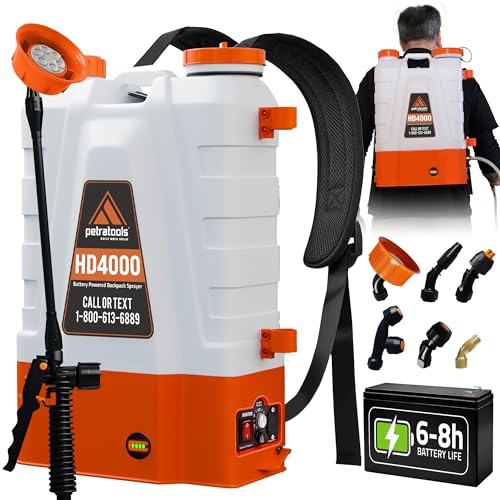
- Tank: 4 gallons, translucent with gallon markers, wide-mouth lid and screen filter
- Battery: 12V 8Ah lead-acid, pre-installed; maker quotes 6–8 hours of runtime per charge
- Pressure: adjustable 40–90 PSI via the pressure knob (maker’s figures)
- Wand and hose: 34.5-inch extendable wand; 48-inch hose
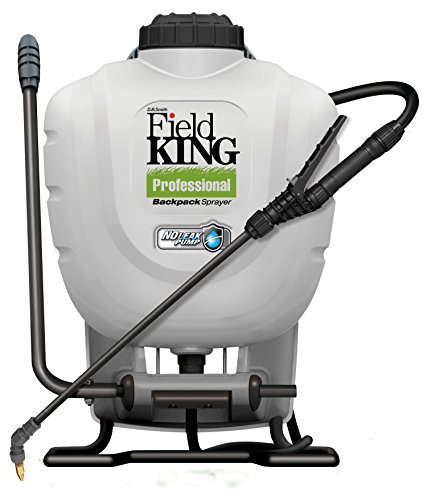
- Tank: 4 gallons, with internal agitator paddles driven by the pump handle
- Pump: internal piston No Leak design, up to 150 PSI (maker’s figure)
- Pressure control: built-in regulator maintains a continuous 25 PSI
- Wand and shut-off: 21-inch poly wand; premium shut-off with brass components and in-line filter
All 5 Picks at a Glance
| Product | Specs | Action |
|---|---|---|
| SOLO 425 4-Gallon Piston Backpack Sprayer |
| Check price on Amazon |
| PetraTools HD4000 Battery Powered Backpack Sprayer |
| Check price on Amazon |
| Field King Professional 190328 Backpack Sprayer |
| Check price on Amazon |
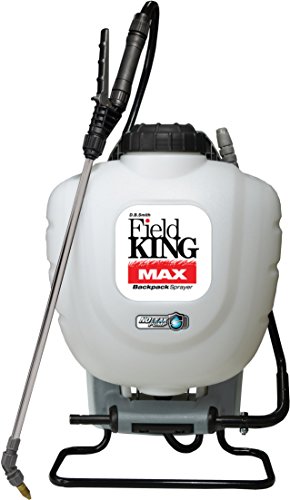 Field King Max 190348 Backpack Sprayer |
| Check price on Amazon |
 Chapin 61900 Tree and Turf Pro Commercial Backpack Sprayer |
| Check price on Amazon |
Our Top Picks
- PetraTools HD4000 Battery Powered Backpack SprayerHD40009.2 x 9.2 x 20.8 inches16.5 PoundsCheck on Amazon
As an Amazon Associate we earn from qualifying purchases.
A backpack sprayer puts a full four gallons of mix on your shoulders and a wand in your hand, so you can treat a whole lawn, orchard row, or fence line without dragging a hose or refilling a small tank every few minutes. The five sprayers in this guide are all 4-gallon backpacks, but they pressurize that tank in very different ways: a classic hand-pumped piston design, a battery-powered pump that needs no pumping at all, an internal piston pump built for high pressure, a no-leak design its maker positions as doing the work of both piston and diaphragm sprayers, and a commercial model built around a stainless steel wand and a reinforced hose. Every specification below comes from the makers’ own listings and manuals, and every pressure figure is the maker’s figure for that model.
Disclosure: This article contains affiliate links. If you make a purchase through these links, we may earn a commission at no extra cost to you.
How to Choose a Backpack Sprayer
Pump type. Piston pumps are the traditional choice for liquid herbicides, insecticides, and fertilizers: they build comparatively high pressure, but their seals prefer clean liquids. Diaphragm pumps run at lower pressure and tolerate wettable powders and mildly abrasive mixes better. Internal pumps, like the Field King designs below, move the pump inside the tank so liquid cannot leak down your back. Battery models replace pumping with a motor-driven pump and a pressure knob, trading arm work for a battery to keep charged.
Pressure. Makers quote maximum pressure in PSI; the figures below are maker figures, not measurements. Higher pressure pushes spray higher into shrubs and small trees. For herbicide work, steady low pressure matters more than reach, because it limits drift: two of the manual sprayers here include a regulator that holds a continuous 25 PSI for exactly that job. Treat maximum PSI as headroom, not a working setting.
Tank, weight, and harness. Four gallons of water weighs a little over 33 pounds, and the sprayers themselves add roughly 10 to 16 pounds, so a full backpack lands in the mid-40-pound range. Padded shoulder straps are the minimum worth accepting; a waist belt and chest strap move part of the load to your hips and stop the tank shifting as you walk. Translucent tanks with gallon markings make mixing simpler, and a wide mouth speeds up filling and cleaning.
Wands, hoses, and nozzles. Poly wands are light and immune to corrosion; stainless steel wands shrug off knocks against trunks, posts, and masonry. A reinforced hose resists kinking and splitting at the fittings. Nozzle assortments matter because pattern shapes the job: flat fans for even lawn coverage, a cone for shrubs and spot work, a jet stream for distance, and a foaming nozzle that marks treated ground. TeeJet compatibility, offered by several makers here, opens up a wide range of standard tips.
Seals and chemical compatibility. Seals are the wear item that decides how a sprayer ages. Viton seals, fitted to several models below, are the makers’ choice for harsher chemical mixes, while standard elastomer seals suit common fertilizers and general cleaning solutions. Whatever you spray, the chemical label is the authority: follow its directions for mixing rates, application method, protective equipment, and disposal before you fill the tank.
Rinsing and maintenance. The makers’ manuals give the same routine: after each use, empty any remaining mix following the label’s disposal directions, rinse the tank thoroughly with clean water, and spray clean water through the hose, wand, and nozzle for a few minutes to flush residue out of the pump and lines. Clean the fill strainer and any in-line filters, inspect seals and O-rings for wear, and store the sprayer depressurized, empty, and out of freezing temperatures. Five minutes of rinsing after a job is what keeps nozzles unclogged and seals alive for the next one.
SOLO 425 4-Gallon Piston Backpack Sprayer
- Tank: 4 gallons, high-density polyethylene, 4.25-inch fill opening with integrated strainer
- Pump: manual piston pump, up to 90 PSI (maker’s figure)
- Wand and hose: 20-inch wand; 48-inch nylon-reinforced high-pressure hose
- Nozzles: adjustable, fan spray, hollow cone, and jet stream included; TeeJet compatible
The SOLO 425 is the classic manual piston backpack sprayer, built around a high-performance piston pump that Solo specifies for pressures up to 90 PSI. That range covers everyday liquid work — herbicides along fence lines, insecticides on shrubs, liquid fertilizer on beds — with headroom to reach into small trees. The 4-gallon tank is high-density polyethylene with a 4.25-inch filling opening and an integrated strainer that keeps debris out while you pour. Solo pairs the pump with a 20-inch wand the maker describes as unbreakable and a 48-inch nylon-reinforced high-pressure hose, so the reach is there for spraying under decks and across wide beds. Four commercial-grade nozzles are in the box — adjustable, fan spray, hollow cone, and jet stream — and the wand accepts TeeJet tips as well. A commercial shut-off valve locks in the on or off position to reduce hand fatigue during long passes, the pump handle mounts on either side for left- or right-handed pumping, and Viton seals sit in the key locations Solo names for durability. At 10.34 pounds empty, it is also the lightest manual sprayer in this guide.
PetraTools HD4000 Battery Powered Backpack Sprayer
- Tank: 4 gallons, translucent with gallon markers, wide-mouth lid and screen filter
- Battery: 12V 8Ah lead-acid, pre-installed; maker quotes 6–8 hours of runtime per charge
- Pressure: adjustable 40–90 PSI via the pressure knob (maker’s figures)
- Wand and hose: 34.5-inch extendable wand; 48-inch hose
The PetraTools HD4000 removes pumping from the job entirely. A 12V 8Ah lead-acid battery, pre-installed in the unit, drives the pump, and PetraTools quotes 6 to 8 hours of runtime and more than 200 gallons sprayed per charge — maker figures that point it at large lawns, acreage, and long fence lines where hand pumping wears you out. Working pressure is set with an adjustable knob anywhere in the maker’s 40 to 90 PSI range, so you dial down for drift-sensitive herbicide passes and up for reaching into shrubs. The 4-gallon tank is translucent with gallon markers and a wide-mouth lid over a screen filter. An extendable wand reaches 34.5 inches and connects through a 48-inch hose, and the valve handle locks on for continuous spraying. Six nozzles come in the box, covering shower, misting, fan, and stream patterns, including a brass nozzle for distance work. Padded straps and a back pad carry the load, and the package adds small but useful extras: a measuring cup, spare O-rings, and a spare fuse. At 16.46 pounds empty it is the heaviest sprayer here, but the trade is a full day of spraying with no pumping at all.
Field King Professional 190328 Backpack Sprayer
- Tank: 4 gallons, with internal agitator paddles driven by the pump handle
- Pump: internal piston No Leak design, up to 150 PSI (maker’s figure)
- Pressure control: built-in regulator maintains a continuous 25 PSI
- Wand and shut-off: 21-inch poly wand; premium shut-off with brass components and in-line filter
The Field King 190328 moves the pump inside the tank. Its internal piston pump is the maker’s No Leak design, built so chemicals cannot drip down your back, and Field King specifies it for pressures up to 150 PSI — the highest maker figure in this guide and the reason this model reaches high branches and tall shrubs that lower-pressure sprayers cannot. For ground-level herbicide work, a built-in pressure regulator holds a continuous 25 PSI, keeping the pattern steady while you walk. Paddles inside the tank turn with the pump handle and keep liquids and water-soluble powders mixed instead of settling. The seals are Viton, the pump is easy to access, and the maker notes that seals can be changed in minutes with no tools. A premium shut-off with brass components and an in-line filter feeds a 21-inch poly wand, the trigger locks on for long passes, and six nozzles are included: adjustable brass, two flat fans, a high-volume wide fan, a jet stream, and a foaming nozzle, with TeeJet tips also accepted. Padded straps, a waist belt, and a chest cinch strap carry the 12.8-pound unit.
Field King Max 190348 Backpack Sprayer
- Tank: 4 gallons, translucent with volume markings and built-in carry handle
- Pump: internal No Leak design; maker positions it as doing the work of both piston and diaphragm sprayers
- Pressure: up to 150 PSI, with regulator for a continuous 25 PSI (maker’s figures)
- Wand and hose: 21-inch stainless steel wand with poly lining; 50-inch hose
The Field King Max 190348 is the maker’s step-up model, and its headline is versatility: Field King positions the Max’s internal No Leak pump as doing the work of a piston or diaphragm backpack sprayer, so one machine covers clean liquids at high pressure and wettable powder mixes that would normally push you toward a diaphragm design. The pressure story matches the 190328 — up to 150 PSI at the top end, with a regulator that holds a continuous 25 PSI for herbicide application. What the Max adds is hardware and comfort. The wand is 21 inches of stainless steel with a chemical-resistant poly lining, a 50-inch hose gives the wand room to work, and the premium shut-off carries a comfort grip, a lockable trigger, and an in-line filter. The harness is a deluxe setup with a full back pad, a wide support waist belt, and a chest cinch strap. The fold-away pump handle reverses for left- or right-handed use, the pump allows seal changes with no tools, and the same six-nozzle assortment as the standard model is in the box, TeeJet tips included. Choose the Max if one backpack has to cover both liquids and powders across a big property.
Chapin 61900 Tree and Turf Pro Commercial Backpack Sprayer
- Tank: 4 gallons, translucent poly, 5-inch mouth opening with filter cap
- Pump: manual piston pump; operating pressure 40–60 PSI (maker’s specifications)
- Wand and hose: 20-inch stainless steel extension wand; 48-inch reinforced PVC hose
- Filtration: 3-stage system — cap, in-tank, and shut-off filters, all removable and cleanable
The Chapin 61900 is the commercial entry in this guide, a Tree and Turf Pro model Chapin builds for landscape and turf professionals. Its piston pump works in a 40 to 60 PSI operating range per Chapin’s specifications — lower than the Field King figures, but squarely in the band where lawn and tree work happens; the cushion-grip shut-off carries a pressure gauge so you can watch working pressure at the handle. The hardware is the story here: a 20-inch stainless steel extension wand and a 48-inch reinforced PVC hose, mounted on a powder-coated frame. Filtration runs three stages — a basket filter in the cap, a filter inside the tank near the pump, and a filter in the shut-off — each one removable and cleanable. Three nozzles are included: an adjustable brass nozzle, an adjustable poly cone, and a poly fan. Chemical-resistant elastomer seals handle professional fertilizers and pest and weed control products, padded straps and lumbar support carry the 4-gallon tank, and the pump handle mounts on either side. Chapin makes the 61900 in the USA with global materials and backs it with a 5-year limited warranty.
Frequently Asked Questions
What is the difference between a piston and a diaphragm backpack sprayer?
A piston pump pressurizes liquid with a reciprocating piston and typically reaches higher pressures, which suits clean liquid herbicides, insecticides, and fertilizers. A diaphragm pump flexes a membrane instead, runs at lower pressure, and tolerates wettable powders and abrasive mixes that wear piston seals faster. Internal no-leak designs like the two Field King models move the pump inside the tank, and the Max is positioned by its maker as covering both roles.
How heavy is a full 4-gallon backpack sprayer?
Water weighs about 8.3 pounds per gallon, so a full tank carries roughly 33 pounds of liquid on top of the sprayer itself. The five models here run from about 10 to 16.5 pounds empty, putting a full backpack in the mid-40-pound range. That is why harness design matters: waist belts and chest straps, fitted to the Field King models and the Chapin, shift part of the load to your hips instead of leaving it all on your shoulders.
Can I spray wettable powders in a piston backpack sprayer?
Check both the chemical label and the sprayer maker’s guidance first, because powders are hard on pump seals. Agitation helps: the Field King models stir the tank contents with paddles as you pump, keeping powders in suspension, and Field King positions its internal pump for wettable powders as well as liquids. Whatever you spray, mix only what you will use, keep the tank agitated, and rinse the whole system thoroughly as soon as the job is done.
How should I clean a backpack sprayer after spraying?
Follow the chemical label’s directions for disposing of leftover mix, then rinse the tank with clean water and spray clean water through the hose, wand, and nozzle for a few minutes, as the makers’ manuals direct. Remove and clean the fill strainer and any in-line or shut-off filters, check the seals, and store the sprayer empty and depressurized, indoors and away from freezing temperatures. Cleaning right after use is what prevents residue from clogging nozzles or attacking seals before the next job.
Conclusion: Which Backpack Sprayer Fits Your Work?
For straightforward manual spraying of liquid herbicides and fertilizers, the SOLO 425 is the classic pick: light, simple, and built around a proven piston pump. If your property is large enough that pumping becomes the work itself, the PetraTools HD4000 replaces the pump handle with a battery and an adjustable pressure knob. For maximum reach into trees plus a regulated 25 PSI for careful herbicide passes, the Field King 190328 pairs the highest maker-quoted pressure here with an internal no-leak pump. If one sprayer has to cover both liquids and wettable powders, the Field King Max 190348 adds that dual-role pump positioning to a stainless wand and a deluxe harness. And for daily professional use where hardware takes the beating, the Chapin 61900 brings a stainless steel wand, a reinforced hose, three-stage filtration, and a pressure gauge at the handle. Match the pump to your chemicals and the harness to your hours, and rinse after every job.
More from Amazon
Programs that pair well with the guide above. Offers and eligibility are set by Amazon and may change.
Free shipping on eligible items, Prime Video and more. Eligible new members can start with a free trial.
Start a Prime free trialAd-free music streaming. Eligible new subscribers can start with a free trial.
Try Music Unlimited freeA Prime membership for ages 18-24 with a trial period. Eligibility is set by Amazon.
See Prime for Young AdultsAudiobooks and podcasts to listen to on the go. Eligible new members can start with a free trial.
Try Audible freeAs an Amazon Associate we earn from qualifying purchases.