Our Short List of 3

- Head width: folding fan head adjusts from 8 to 23 inches
- Handle: telescopic, extends to 63 inches
- Tines: steel fan tines
- Storage: head collapses flat for compact storage

- Head: 16-inch steel bow head with flat leveling edge
- Tines: 16 steel tines
- Handle: triple-wall fiberglass with rubber grip, 58 inches overall
- Weight: about 3.45 lb
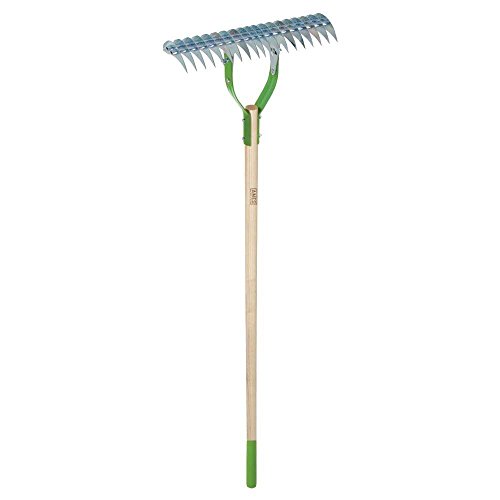
- Head width: 15 inches, adjustable angle
- Tines: 19 curved steel tines
- Action: works on push and pull strokes; self-cleaning head design
- Handle: hardwood with cushioned grip
All 5 Picks at a Glance
| Product | Specs | Action |
|---|---|---|
| TABOR TOOLS J16A Adjustable Metal Rake: One Head for Lawn and Beds |
| Check price on Amazon |
| Bully Tools 92309 Bow Rake: Built for Soil, Gravel and Leveling |
| Check price on Amazon |
| AMES 2915100 Dethatching Rake: For Lawns With a Thatch Layer |
| Check price on Amazon |
 Corona RK 62060 Fixed Tine Shrub Rake: Compact Steel Head for Tight Beds |
| Check price on Amazon |
 Feblomst 9-Inch Shrub Rake: Long-Reach Cleanup Under Shrubs |
| Check price on Amazon |
Our Top Picks
As an Amazon Associate we earn from qualifying purchases.
A rake looks like one of the simplest tools in the shed, yet the head shapes sold under that single name do very different work. A wide fan of springy tines gathers dry leaves without tearing turf. A bow rake drags a rigid steel bar through soil, gravel and mulch. A thatch rake pulls dead material out of a lawn, and a narrow shrub rake reaches under plants where a full-size head cannot fit. Buying the wrong family for the job makes cleanup slower and harder on your back, no matter how well the tool itself is built.
This guide compares five rakes across those families: an adjustable-width leaf rake, a fiberglass bow rake, a dethatching rake, and two shrub rakes with different handle designs. Each pick is matched to the work its head was shaped for, using the head width, tine material, handle length and weight published by its maker. The buying notes below explain how to match a rake family to a job, how head width trades coverage against control in planted beds, and how handle length and tine spacing change the way a rake handles wet leaves versus dry ones.
Disclosure: This article contains affiliate links. If you make a purchase through these links, we may earn a commission at no extra cost to you.
How to Choose the Right Rake
Match the Rake Family to the Job
A bow rake is not a leaf rake, and using one in place of the other is the most common buying mistake in this category. Leaf and fan rakes spread a wide head of flexible tines across the ground; they skim the surface, gather loose material and flex over bumps. Bow rakes carry a straight steel bar with short, rigid teeth on one side and a flat edge on the other, built for moving and leveling soil, gravel, sand and mulch. Thatch rakes use curved blades or looped tines that slice into the lawn surface and lift the dead layer hiding under the grass. Shrub rakes shrink the leaf-rake shape down to a narrow head that fits between plants. Begin by naming the job you repeat most often, then buy the family shaped for it.
Head Width and Maneuverability
Width decides how much ground each pull covers and how easily the head fits into planted areas. Heads around 22 to 30 inches clear open lawn quickly but snag on stems and edging in beds. Mid-width heads near 18 to 20 inches balance coverage with control. Narrow heads of 8 or 9 inches reach under shrubs, between perennials and along fences without dragging mulch out of the bed. Adjustable heads split the difference: one rake opens wide for the lawn and closes down for the beds, which suits smaller yards where storage space is tight and one tool has to cover every cleanup job the seasons produce.
Handle Length and Grip
Handle length is a back-comfort decision. A rake that is too short forces a stoop; one that is too long feels clumsy in tight spaces. Handles in the mid-50-inch range suit most adults for open-ground work, while handles past 60 inches help taller users stay upright and reach under low branches without kneeling. Sectional and telescopic handles let one tool serve both open lawns and close bed work, and they pack down for transport. Grip material matters over a long session: rubber and cushioned grips reduce hand fatigue and stay secure with gloves, while smooth wood and aluminum handles are simple to clean and hold up well outdoors.
Tine Material and Spacing
Poly tines are light, quiet and gentle on decks and turf, and they never rust, but they can crack in cold weather and flex too much under wet loads. Steel tines spring back after bending, handle wet leaves and light thatch, and last for years with basic care. Bamboo tines are the lightest option and kind to delicate ground cover, though they wear faster than steel. Spacing matters as much as material: closely spaced tines catch small debris and pine needles, while wider spacing sheds dry leaves instead of clogging. Wet leaves are heavy and mat together, so a stiffer steel head with medium spacing pulls them without folding; dry leaves are bulky and light, so a wide, flexible fan moves the most volume per pull.
Storage
Long one-piece rakes store best hanging by a handle hole or grip end, head up so the tines stay straight. Adjustable heads fold or narrow down, and sectional handles break apart, so those designs fit small sheds, car trunks and apartment balconies. Whichever design you choose, keep steel heads dry and off concrete floors, and a rake stored with its head raised will hold its shape far longer than one left leaning on its tines.
TABOR TOOLS J16A Adjustable Metal Rake: One Head for Lawn and Beds
- Head width: folding fan head adjusts from 8 to 23 inches
- Handle: telescopic, extends to 63 inches
- Tines: steel fan tines
- Storage: head collapses flat for compact storage
The TABOR TOOLS J16A is the adjustable entry in this group, built around a folding fan head that opens from 8 inches to 23 inches wide. At its narrowest setting it works like a shrub rake between plants; opened fully, it covers open lawn at a pace close to a fixed fan rake. The telescopic handle extends to 63 inches, which helps taller users rake with a straighter back and lets the tool reach under low shrubs without kneeling.
The steel tines give the head more spring and durability than basic poly fans, and the whole head collapses for storage, so the rake hangs flat or slides into a narrow gap in the shed. TABOR TOOLS notes that the J16A is not intended for cement or heavy-duty debris work, and that guidance fits the design: this is a leaf and lawn cleanup tool, not a soil mover. For a single rake that has to handle the open yard in autumn and tidy-up work in planted beds through the rest of the year, the width adjustment is the deciding feature, and the J16A is the most flexible design in this guide.
Bully Tools 92309 Bow Rake: Built for Soil, Gravel and Leveling
- Head: 16-inch steel bow head with flat leveling edge
- Tines: 16 steel tines
- Handle: triple-wall fiberglass with rubber grip, 58 inches overall
- Weight: about 3.45 lb
The Bully Tools 92309 is the bow rake of the group, built for the heavy end of garden cleanup: spreading soil, leveling a gravel path, pulling mulch into place and clearing stones and roots from a new bed. Its 16-inch steel head carries 16 rigid tines on one side and a flat leveling edge on the other, so one tool both rakes material into rows and smooths it flat.
The triple-wall fiberglass handle runs 58 inches overall and ends in a rubber grip. Fiberglass shrugs off the weather that would swell or crack a wood handle, and at about 3.45 pounds the rake has enough weight to bite into packed soil without feeling tiring across a long session. Bully Tools backs the 92309 with a limited lifetime warranty, and the tool is made in the USA. It will not gather leaves efficiently, since the short, widely spaced tines let them slip straight through, but as the soil-and-gravel partner to a leaf rake, this is the strongest build in the guide.
AMES 2915100 Dethatching Rake: For Lawns With a Thatch Layer
- Head width: 15 inches, adjustable angle
- Tines: 19 curved steel tines
- Action: works on push and pull strokes; self-cleaning head design
- Handle: hardwood with cushioned grip
The AMES 2915100 is a dedicated dethatching rake for lawns that have built up a spongy layer of dead stems and roots. Its 15-inch head carries 19 curved steel tines that work on both the push and the pull stroke, slicing into the thatch layer and lifting it out so air and water can reach the soil again. The head angle adjusts, which changes how aggressively the tines bite, and the design is self-cleaning: flipping the head shakes loose the material packed between the tines.
The hardwood handle carries a cushioned grip section, and the overall size keeps the rake manageable across a full lawn without the weight of a powered machine. Dethatching is seasonal work, since most lawns need it once a year at most, so a manual rake like this one suits homeowners who would rather own a simple tool than rent equipment. It is not a leaf rake and will tear at turf if used as one; its place in the shed is next to the fan rake, brought out when the lawn feels thick underfoot and water begins pooling on the surface.
Corona RK 62060 Fixed Tine Shrub Rake: Compact Steel Head for Tight Beds
- Head width: 8 inches
- Tines: tempered spring steel, extra wide, double crimped in place
- Head design: bi-curved bow for even pressure across all tines
- Handle: aluminum
The Corona RK 62060 shrinks the fixed-tine leaf rake down to an 8-inch head for work under shrubs and between close plantings. The tines are tempered spring steel, so they flex around stems and spring back instead of bending out of shape, and the bi-curved bow behind the head spreads pressure evenly across all the tines for a consistent pull. The tines are extra wide, and double crimps hold each one firmly in place, which matters in a narrow head that gets twisted around roots and edging.
The aluminum handle keeps the tool light and will not rust or splinter in damp beds, and the fixed one-piece design has no joints to loosen over time. Corona builds this model in its MAX line, and replacement parts are listed for the range, which suits a tool meant to be kept for years. An 8-inch head will never clear an open lawn quickly, and it is not meant to; this is the rake that finishes the last strip under the hedge and pulls leaves out of the corners a full-size fan cannot reach.
Feblomst 9-Inch Shrub Rake: Long-Reach Cleanup Under Shrubs
- Head width: 9 inches
- Tines: 11 steel tines
- Handle: sectional design, adjusts to 37, 51 or 65 inches
- Build: coated steel with anti-rust finish
The Feblomst shrub rake pairs a 9-inch head with a sectional handle that adjusts to 37, 51 or 65 inches, the longest reach in this guide. That reach is the point of the tool: it pulls leaves and clippings out from under wide shrubs, behind planters and along fence lines while the user stands clear of the branches. Eleven steel tines form the head, and the coated steel build carries an anti-rust finish for work in damp beds.
At 2 pounds, the rake is easy to carry around a large garden, and the handle sections come apart so the tool stores in a short bundle. The trade-off in any sectional design is rigidity: the joints give the handle a little more flex than a one-piece shaft, so this rake suits leaf and debris work rather than heavy pulling. For gardeners whose cleanup is mostly reaching into planted areas rather than covering open ground, the adjustable length makes the Feblomst the most adaptable shrub rake here.
Frequently Asked Questions
What is the difference between a leaf rake and a bow rake?
A leaf rake has a wide fan of flexible tines that skims the surface and gathers loose, light material such as leaves and clippings. A bow rake has a straight steel head with short, rigid teeth for moving and leveling soil, gravel and mulch. The two are not interchangeable: a bow rake lets leaves slip through its teeth, and a leaf rake bends and clogs when dragged through soil.
Which rake width is best for garden beds?
Heads of 8 to 9 inches fit between plants and under shrubs without dragging mulch out of the bed. For mixed yards, an adjustable head that narrows for beds and opens past 20 inches for the lawn covers both jobs with one tool. Fixed heads wider than about 22 inches belong on open ground, where their coverage is an advantage instead of an obstacle.
How long should a rake handle be?
For most adults, a handle in the mid-50-inch range allows an upright stance on open ground. Taller users, or anyone raking under low branches, benefit from handles of 60 inches or more. Sectional and telescopic handles adjust between lengths, which helps when one rake serves both lawn work and close bed work in the same session.
When does a lawn need a thatch rake?
When a lawn feels spongy underfoot and water sits on the surface instead of soaking in, a layer of dead material has likely built up between the grass and the soil. A thatch rake with curved steel tines lifts that layer out so the lawn can breathe again. Once a year is enough for most lawns, timed for the grass’s active growing season.
Conclusion: Which Rake Fits Your Cleanup Jobs?
Match the family to the job first, and the rest of the choice follows. For one rake that covers lawn and beds, the TABOR TOOLS J16A, with its 8-to-23-inch adjustable head, is the most versatile pick here. For soil, gravel and leveling work, the Bully Tools 92309 is the heavy-duty choice. Lawns with a spongy thatch layer call for the AMES 2915100. For tight work under shrubs, the Corona RK 62060 offers a fixed, one-piece build, while the Feblomst adds the longest adjustable reach for deep beds and fence lines. A small shed can hold two of these, one fan rake and one bow rake, and cover nearly every cleanup job a garden produces across the seasons.
More from Amazon
Programs that pair well with the guide above. Offers and eligibility are set by Amazon and may change.
Free shipping on eligible items, Prime Video and more. Eligible new members can start with a free trial.
Start a Prime free trialAd-free music streaming. Eligible new subscribers can start with a free trial.
Try Music Unlimited freeA Prime membership for ages 18-24 with a trial period. Eligibility is set by Amazon.
See Prime for Young AdultsAudiobooks and podcasts to listen to on the go. Eligible new members can start with a free trial.
Try Audible freeAs an Amazon Associate we earn from qualifying purchases.