Key takeaways
- Best all-around: A two-panel bi-color LED kit with diffusion, barn doors, and metal stands. Choose this for talking-head videos, calls, and product demonstrations in a small room.
- Best for a tiny desk setup: One compact COB LED light with a 60–90 cm softbox. Its controlled, soft beam can light one person without filling the room with stands.
- Best for travel: A pair of battery-powered LED panels with built-in diffusion. They’re quick to position and don’t require a nearby outlet, though their output and runtime are limited.
- Best for a strict budget: A dimmable daylight LED panel with a diffuser. It’s simple and affordable, but less adaptable if you regularly film under warm indoor lights.
Best Budget Studio Lights for Creators: Which Setup Fits Your Room?
The best budget studio lights for most creators are a pair of bi-color LED panels with diffusion and sturdy stands: they’re more flexible than a single ring light, cover a small room more evenly, and let you match warm household lighting or cool daylight. If you film in a tight space, start with one compact COB light and a softbox; if you need a portable kit, choose battery-powered panels.
Quick picks by situation
- Best all-around: A two-panel bi-color LED kit with diffusion, barn doors, and metal stands. Choose this for talking-head videos, calls, and product demonstrations in a small room.
- Best for a tiny desk setup: One compact COB LED light with a 60–90 cm softbox. Its controlled, soft beam can light one person without filling the room with stands.
- Best for travel: A pair of battery-powered LED panels with built-in diffusion. They’re quick to position and don’t require a nearby outlet, though their output and runtime are limited.
- Best for a strict budget: A dimmable daylight LED panel with a diffuser. It’s simple and affordable, but less adaptable if you regularly film under warm indoor lights.
Prices vary by brightness, included stands, batteries, and modifiers. As a broad market guide, basic single panels often cost around $30–$80, two-panel kits roughly $70–$200, and entry-level COB light-and-softbox combinations about $100–$250. These are general ranges, not quotes for a particular retailer or bundle.
Our top picks

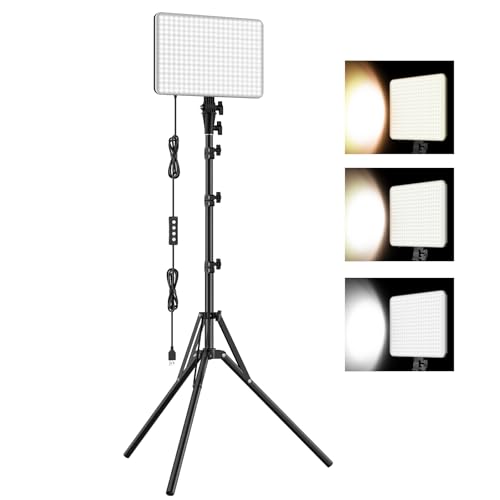
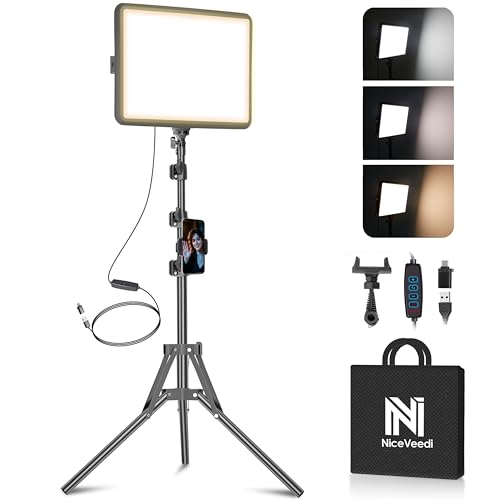

As an Amazon Associate we earn from qualifying purchases at no extra cost to you. Ratings are shown as listed on Amazon.
What matters more than the headline brightness
Budget-light specifications can be hard to compare. A lux figure is meaningful only when the manufacturer also states the measurement distance and whether a reflector or other modifier was attached. A light measured at 0.5 m can look far brighter on paper than one measured at 1 m. For a useful comparison, check whether figures share the same distance and setup.
For video, prioritize adjustable output, color consistency, and a useful beam over a large wattage number. A softbox spreads light broadly and softens shadows; a small reflector or fresnel-style lens sends more light toward a narrower area. Barn doors help limit spill, but do not make a panel’s beam as focused as a lens designed for that purpose.
| Light type | Typical power class | Color adjustment | Beam control | Practical coverage | Best use |
|---|---|---|---|---|---|
| Compact LED panel | 10–30 W | Often daylight-only; some models are bi-color | Wide, relatively flat beam; diffusion may be built in | One face or a small desk area at close range | Webcam, travel, fill light |
| Medium bi-color LED panel | 30–60 W | Commonly around 3200–5600 K | Wide beam; barn doors can reduce spill | One person in a small room; two panels can cover a wider shot | Talking-head video and general creator use |
| Compact COB LED with reflector | 60–100 W | Daylight or bi-color, depending on model | More directional; accepts compatible modifiers | One person or a defined background area, depending on modifier and distance | Small studios and controlled key lighting |
| Compact COB LED with softbox | 60–100 W | Daylight or bi-color, depending on model | Broad, soft beam with less spill than an uncovered panel | One seated person or a small product setup | Soft key light in a bedroom or office |
These wattage classes describe common budget categories, not a guarantee of equal brightness. LED efficiency, reflector design, diffusion, and distance all affect usable output. Treat the coverage descriptions as starting points: a dark wall, high ceiling, or wide camera frame can change what one light can cover.
Choose by room, experience, and how often you film
| Your situation | Good starting choice | Why it fits | Watch for |
|---|---|---|---|
| First setup, limited budget, occasional filming | One dimmable panel with a diffuser | Low setup complexity and enough light for a close desk shot | Harsh shadows if the panel is small or too far away |
| Regular videos in a small bedroom or office | Two bi-color panels with stands | One can serve as the key; the other can fill shadows or light the background | Light stands need floor space and a clear path around them |
| Very little floor space | One COB light with a compact softbox and a short stand | A single source avoids placing two stands around a desk | Check the modifier’s diameter and stand’s folded length before buying |
| Frequent location filming | Battery-powered panels or a COB light with compatible batteries | Faster placement where outlets are inconvenient | Battery capacity, charging method, and runtime at full power |
| Wide shots, multiple people, or a larger room | Two stronger COB lights or larger panels, with suitable modifiers | More output and flexible placement help cover a wider scene | Budget kits may need extra lights rather than simply being turned up |
Brightness, color, and heat: what to check before buying
Brightness and room coverage
Distance is the quickest way to improve a small light’s effect: moving it closer makes the subject brighter and the light softer relative to the subject. As a rough planning rule, a light placed about 0.7–1.2 m from one seated person can work well in a compact room. For a wider two-person frame, expect to need more output, a larger source, or a second light. A softbox reduces some of a COB light’s output, so allow room to raise brightness or move it closer.
Color accuracy and matching
Bi-color lights let you shift between warm and cool white, commonly near 3200 K and 5600 K. This is useful when matching household bulbs or window light. A high CRI or TLCI figure—often advertised as 95 or higher—can be a helpful screening measure for skin and product color, but it does not guarantee perfect color across every hue. If color-critical work matters, consistency between lights and your camera’s white balance matter too. Avoid mixing one warm light with one daylight light unless you intend the contrast.
Beam control and heat
Panels are convenient but usually spread light broadly, which can brighten a wall or spill into a monitor. Barn doors can help, although budget versions may not fully block light. A COB light offers more choices: use its reflector for a harder, brighter beam, or add a softbox for a wider, gentler source. Both panel and COB lights can warm up during long sessions. LED fixtures generally produce less radiant heat than traditional tungsten lamps, but vents still need clear airflow; don’t cover the fixture or leave fabric pressed against it.
Stands and ownership costs people overlook
Included stands are often the first compromise in a low-cost kit. Thin legs and lightweight tubing can wobble when extended, especially if a softbox catches a draft or someone bumps a cable. Check the stand’s maximum height, folded length, leg spread, and stated load capacity—not just the light’s weight. Keep legs fully spread, place a leg under the direction of the load where possible, and route cables so they cannot trip someone or pull the stand over.
Softboxes, diffusion cloths, and batteries need care. Dust diffusion fabric gently and let it dry before storage; don’t wipe LED emitters or lenses with household cleaners. Fold softboxes without forcing their rods, and store stands with their clamps loosened enough to avoid crushing tubing. On battery-powered models, confirm whether the battery is included, replaceable, and charged through a standard connection or a proprietary charger. A kit that looks cheaper may need a separate stand, battery, or softbox before it is ready to use.
A simple setup for a small room
-
Place the key light first. Position a diffused panel or softbox about 45 degrees to one side of the camera and slightly above eye level. Start roughly 0.7–1.2 m away; move it closer if the face looks dim.
-
Set exposure and color. Choose a consistent white balance on the camera, then match the light’s color temperature. Avoid changing light color to compensate for an incorrectly set camera.
-
Add fill only if needed. Put a second panel on the opposite side at lower output, or bounce light from a white wall. This softens shadows without making the face look flat.
-
Control the background. Turn the key light or barn doors so less light hits the wall. If the background still looks washed out, move the subject farther from it before buying another light.
-
Check the frame and stands. Look for reflections on glasses, uneven shadows, visible stands, and cables crossing walkways. Secure the setup before recording.
Bottom line
For most beginners, a two-panel bi-color kit is the most adaptable budget choice for a small room, while a compact COB light and softbox is better when you want a softer, more controlled single-source look. Pick a daylight panel for a simple, fixed setup, and pay extra for battery power only if you regularly film away from outlets. Before deciding, compare brightness at the same measurement distance, confirm what modifiers and stands are included, and make sure the kit fits both your frame and your floor space.