Key takeaways
- Identify the exact league and certification stamp before comparing performance.
- Choose the length that gives the hitter plate coverage without forcing late contact.
- Start with a balanced bat if control and bat speed are inconsistent.
- Move toward a heavier drop or end-loaded profile only when the player can maintain swing speed.
- Choose composite for tuned flex and a larger sweet-spot feel, alloy for direct feedback and practical durability, or hybrid for a compromise.
- Buy the specific size and version that is legal; model families can change certifications from one release to the next.
The best softball bats are the ones whose certification, weight drop, barrel length and construction match your league, swing speed and hitting style—not simply the most expensive model.
Quick picks: which softball bat fits your situation?
| Player or situation | Best starting choice | Why | Typical specification |
|---|---|---|---|
| Developing fastpitch player | Balanced alloy or composite | Easier to control and usually more forgiving on mishits | 31–32 inches, drop -10 or -11 |
| Strong high-school or travel hitter | Balanced or slightly end-loaded composite | More barrel performance without making the swing excessively heavy | 32–34 inches, drop -8 or -10 |
| Experienced power hitter | Two-piece composite or hybrid | Extra barrel mass and flex can increase drive through the ball | 33–34 inches, drop -8 or -9 |
| Contact hitter or smaller player | Light balanced alloy | Fast acceleration, simple feedback and strong control | 29–31 inches, drop -10 to -13 |
| Slowpitch league player | League-approved two-piece composite or alloy | Slowpitch bats use different barrel, stamp and performance rules | 32–34 inches, commonly 25–28 ounces |
Before comparing models, confirm whether you need a fastpitch bat or a slowpitch bat. They are not interchangeable. Fastpitch bats are commonly certified for USA Softball, USSSA, NSA or other governing bodies, while slowpitch bats have separate stamps and construction requirements. A bat that is legal in one association may be illegal in another.
Our top picks



As an Amazon Associate we earn from qualifying purchases at no extra cost to you. Ratings are shown as listed on Amazon.
Best softball bats by hitting style
Best for contact and control: a balanced alloy bat
A balanced bat places its mass closer to the hands, reducing the effort needed to start and stop the swing. That makes it a sensible choice for younger players, contact hitters and anyone who is late against faster pitching. Alloy barrels also provide immediate feedback: a clean hit feels crisp, while an off-center hit is easy to identify.
Models such as the Easton Sapphire and Easton Topaz illustrate the light, balanced alloy category, while many fastpitch alloy bats from Louisville Slugger and Marucci are available in similar profiles. The important specifications are not the name alone but the actual length, drop and balance point.
Alloy is also practical for players who hit frequently in colder weather or who share one bat among teammates. It can dent, but it does not develop the same gradual composite break-in pattern. A small flat spot is a warning to stop using the bat; continued use can make the damage worse.
Best for power with a smooth, fast swing: a composite barrel
Composite bats use layered carbon-fiber materials rather than a single metal barrel. They can offer a larger-feeling sweet spot, reduced vibration and a distinctive flex through contact. Two-piece composite designs separate the barrel from the handle, allowing the manufacturer to tune feel and vibration more precisely.
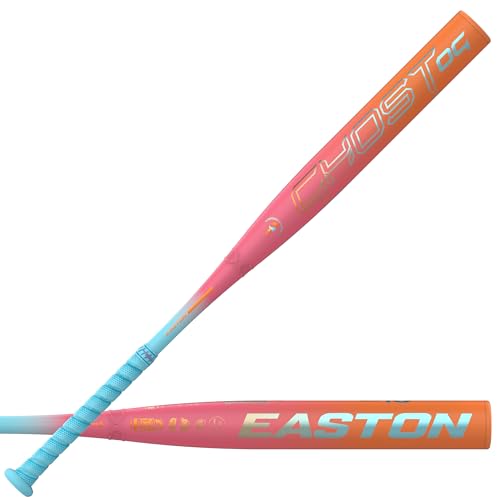
The Louisville Slugger LXT, DeMarini CF and Easton Ghost Unlimited are established examples of the fastpitch composite category. Exact versions and certifications vary by year, so check the stamp on the specific bat rather than relying on a general model name.
Composite bats normally need a controlled break-in period. Rotate the barrel while taking approximately 150–200 swings at gradually increasing intensity, following the manufacturer’s instructions. Do not use a composite bat in temperatures below the stated limit, and do not use it for batting practice with hard, waterlogged or damaged balls. Cold weather and poor-quality balls can increase the chance of cracking.
Best middle ground: a hybrid bat
Hybrid bats combine a composite handle with an alloy barrel, or use another mixture of materials. The alloy barrel gives a familiar, responsive feel and does not require the same break-in routine as a full composite barrel. The composite handle can reduce vibration and make the bat feel more comfortable on mishits.
The Louisville Slugger Xeno is a well-known two-piece hybrid-style fastpitch option. Hybrid construction suits hitters who want some of the comfort and flex associated with composite bats but prefer the durability, direct feedback and simpler maintenance of alloy at the barrel.
Weight drop: the number that changes swing feel
Weight drop is calculated by subtracting the bat’s weight in ounces from its length in inches. A 32-inch, 22-ounce bat is drop -10. A 33-inch, 25-ounce bat is drop -8.
| Bat length | Drop -13 | Drop -11 | Drop -10 | Drop -8 |
|---|---|---|---|---|
| 30 inches | 17 oz | 19 oz | 20 oz | 22 oz |
| 31 inches | 18 oz | 20 oz | 21 oz | 23 oz |
| 32 inches | 19 oz | 21 oz | 22 oz | 24 oz |
| 33 inches | 20 oz | 22 oz | 23 oz | 25 oz |
| 34 inches | 21 oz | 23 oz | 24 oz | 26 oz |
These are arithmetic examples, not a list of every available size. A larger negative drop means a lighter bat. Light bats are easier to accelerate, but a heavier bat can provide more mass behind the ball if the hitter can maintain bat speed.
For a practical test, have the player take several dry swings and then hit front-toss or tee balls. The correct bat should allow a full-speed swing without the barrel repeatedly dragging behind the hands. If contact quality declines after a short series, the bat is probably too heavy, too end-loaded or too long.
Barrel length and league rules
Fastpitch bats commonly have a 2¼-inch barrel, while many slowpitch bats use a 2¼-inch barrel with a different overall design and certification system. Some youth leagues impose maximum length, drop or barrel restrictions, and certain high-school associations require a specific certification mark. USA Softball, USSSA and NCAA/NAIA rules should be checked separately.
Do not assume that a bat marked “fastpitch” is legal everywhere. Look for the precise stamp required by the league, and confirm whether the competition allows a particular drop. In some youth divisions, a -10 bat may be legal while a -8 bat is not. In other divisions, the reverse may apply based on age and association rules.
As a general fit guide, shorter players often begin around 29–31 inches, average teenage players around 31–33 inches and stronger adult or collegiate players around 33–34 inches. Height alone is not enough: arm length, strength, swing mechanics and the league’s limits matter more than a generic height chart.
Alloy vs. composite vs. hybrid: head-to-head comparison
| Feature | Alloy | Composite | Hybrid |
|---|---|---|---|
| Typical feel | Firm and immediate | More flex and softer feedback | Firm barrel with a more comfortable handle |
| Break-in | Usually minimal | Usually required | Depends on barrel material; often minimal for alloy barrels |
| Cold-weather tolerance | Generally more practical, within manufacturer limits | More sensitive to cold | Usually better than full composite, but still check limits |
| Common failure | Dents or flat spots | Cracks or visible fractures | Barrel dents or handle connection damage |
| Best match | Contact, control and frequent practice | Power and hitters who value a large sweet spot | All-around performance and reduced vibration |
Ownership details that affect value
Storage matters. Keep a bat indoors rather than in a hot car, and avoid leaving it in a freezing garage. Inspect the barrel, end cap, knob and connection point before each season. Clean dirt with a soft cloth and mild soap; abrasive pads and solvents can damage the finish and obscure cracks.
Use the correct ball for the bat and competition. Batting cages may use unusually dense balls that accelerate wear, especially on composite barrels. Never roll a bat, throw it, hit rocks or use it to knock balls out of a bucket. These shortcuts can cause damage that may not be covered by the warranty.
Consider the cost per use rather than only the purchase price. For example, a $300 bat used for 150 team practices and 30 games over two seasons costs about $1.67 per session. A $180 bat used only 30 times costs $6 per session. The more often a player practices, the more valuable durability, a comfortable grip and a reliable warranty become.
How to make the final choice
- Identify the exact league and certification stamp before comparing performance.
- Choose the length that gives the hitter plate coverage without forcing late contact.
- Start with a balanced bat if control and bat speed are inconsistent.
- Move toward a heavier drop or end-loaded profile only when the player can maintain swing speed.
- Choose composite for tuned flex and a larger sweet-spot feel, alloy for direct feedback and practical durability, or hybrid for a compromise.
- Buy the specific size and version that is legal; model families can change certifications from one release to the next.
The best softball bat is therefore a measured fit: legal for the league, light enough to control, long enough to cover the zone and durable enough for the player’s practice schedule. A balanced -10 bat is a sensible starting point for many fastpitch players, while experienced power hitters may benefit from a -8 or -9 composite or hybrid—provided their swing speed stays high through contact.