A single USB-C cable plugs into your laptop, and everything else falls out of that one connection: external monitors, keyboard, mouse, ethernet, SD cards, and power. That is the promise of a computer docking station, and for anyone who opens and closes a laptop three or more times a day at a desk with two or more displays, the cable-management and time savings are immediate. Without a dock, you are plugging and unplugging five or six individual adapters every morning and every evening, and those adapters eventually fail or go missing.
The problem is that not all docks deliver on that promise equally. Some advertise dual 4K output but only achieve it at 30 Hz, which makes text rendering blurry and cursor movement feel sluggish. Others lack sufficient power delivery to charge a high-wattage laptop while simultaneously running displays, so the battery still drains during a workday. The best docks in this category balance real video bandwidth, reliable power passthrough, and a port layout that matches your peripheral set. The ones that cut corners on any of those three dimensions create more frustration than they solve.
Our top picks
 Anker USB C Hub
- 5-in-1 Connectivity: Equipped with a 4K HDMI port,…
- Powerful Pass-Through Charging: Supports up to 85W pass-through…
- Transfer Files in Seconds: Move files to and…
| Product | Key specs | |
|---|---|---|
 Anker Laptop Docking Station Dual Monitor Anker Laptop Docking Station Dual Monitor | Check price | |
 USB C Docking Station Dual Monitor for USB C Docking Station Dual Monitor for | Check price | |
| Anker USB C Hub | 5-in-1 Connectivity: Equipped with a 4K HDMI port,… Powerful Pass-Through Charging: Supports up to 85W pass-through… Transfer Files in Seconds: Move files to and… | Check price |
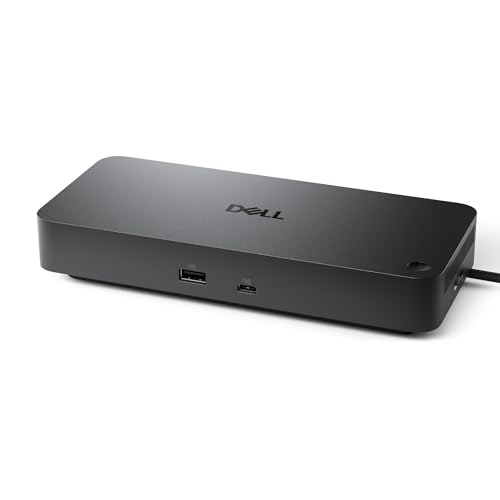 Dell Pro Laptop Docking Station WD25 Dell Pro Laptop Docking Station WD25 | Powerful compatibility: Power essential productivity across the AI… Modern manageability: The Dell Pro Dock is part… Thoughtful design: Configure your workspace with an ambidextrous… | Check price |
 USB C Laptop Docking Station Dual Monitor USB C Laptop Docking Station Dual Monitor | Docking Station 14 in 1:This usb c docking… Ultra High-definition 4K Dual Monitor Output and Triple… Super Speed Data Transfer: Laptop docking station equipped… | Check price |
 Anker Nano Laptop Docking Station Anker Nano Laptop Docking Station | Detachable 2-in-1 Design for Desk & Travel Triple Display with Flexible Monitor Setup All the Ports You Need in One Dock | Check price |
 Acer USB-C Docking Station Dual Monitor Acer USB-C Docking Station Dual Monitor | Check price | |
 MOKiN Laptop Docking Station Dual Monitor 4K MOKiN Laptop Docking Station Dual Monitor 4K | Check price |
As an Amazon Associate we earn from qualifying purchases at no extra cost to you.
Quick Picks
| Product | Best for | Price |
|---|---|---|
| Anker 8-in-1 Dual Monitor Dock | Most users wanting dual 4K under $40 | $39.99 |
| 3-Monitor USB-C Dock for HP | Triple-display setups on a budget | $37.99 |
| Anker 5-in-1 HDMI Splitter | Simple single-external-display needs | $19.99 |
| Dell Pro WD25 | Enterprise reliability and 100W power delivery | $152.49 |
| USB-C Multiport Dual Monitor Adapter | Travel users needing dual HDMI | $49.99 |
| Anker Nano 13-in-1 with Detachable Hub | Desktop-style expandability in one unit | $111.99 |
| Acer 9-in-1 Dual HDMI Dock | Users who need ethernet plus dual displays | $43.99 |
| MOKiN Dual 4K USB-C Hub | Dell, HP, and Mac users wanting compact design | $35.99 |
How We Picked
We compared published port configurations, maximum supported resolutions and refresh rates, USB-C Power Delivery wattage, and the breadth of owner feedback across retail listings. The decisive criteria were video output capability (whether dual 4K is genuinely supported at 60 Hz), power delivery headroom for the laptop you own, and port variety that maps to your actual desk setup rather than theoretical extras you will never use.
The 8 Best Computer Docking Station in 2026
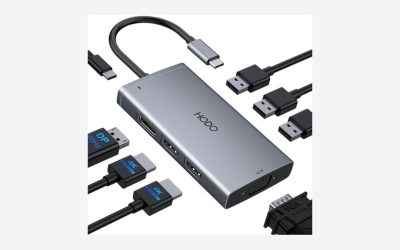
Anker 8-in-1 Dual Monitor Dock
This dock targets the largest segment of buyers: laptop users who want two 4K monitors without spending more than $40. Owner feedback consistently highlights the compact footprint and the fact that it draws bus power without needing a wall adapter for basic operation, which keeps your desk tidy. The HDMI ports handle 4K output, and the additional USB-A ports cover a keyboard and mouse without dongle chains. The main drawback reported across reviews is that simultaneous dual 4K output can require a DisplayPort Alt Mode signal that not every USB-C laptop provides, so some users see only one external display at full resolution. Skip this if your laptop does not support DisplayPort Alt Mode over USB-C or if you need more than 4K resolution per monitor.
- Pro: Compact bus-powered design with no external power brick needed for many setups.
- Pro: Eight ports in a $40 housing reduces adapter clutter effectively.
- Con: Dual 4K at 60 Hz may not be achievable on all laptops depending on USB-C implementation.
3-Monitor USB-C Dock for HP
For anyone running three external displays from a single laptop port, this dock offers the widest multi-monitor coverage in the budget bracket. Published specs indicate support for three independent monitor outputs, which positions it for spreadsheet-heavy or coding workflows where vertical real estate matters. Owners with compatible HP laptops report stable connections across all three screens. The trade-off is that this dock leans toward laptop brands with robust USB-C video implementations, and some non-HP users report partial functionality only. Build quality is described as functional but plasticky in owner reviews. Skip this if you run only one or two monitors, or if your laptop is not from the same brand ecosystem, since compatibility becomes less predictable.
- Pro: Three independent monitor outputs at a price under most dual-monitor docks.
- Pro: Proven compatibility with HP laptops across multiple model generations.
- Con: Limited or partial functionality reported on non-HP systems.
Anker 5-in-1 HDMI Splitter
This is the entry point for users who simply want one external 4K display added to their laptop screen without committing to a full dock. At $19.99, it removes the most common single pain point: connecting a monitor, projector, or TV via HDMI when your laptop lacks the port. Owner feedback praises its reliability and tiny form factor, with many noting it stays plugged in permanently without adding noticeable bulk. The limitation is obvious from the spec sheet: one HDMI output means no multi-monitor expansion path, and the remaining ports are limited to basic USB-A passthrough. Skip this the moment you consider a second external display or need ethernet, wired audio, or SD card readers in a single hub.
- Pro: Under-$20 price makes it a zero-risk accessory for single-display needs.
- Pro: Passes 4K to one external display reliably according to owner reports.
- Con: No path to multi-monitor expansion and minimal port variety.
Dell Pro Laptop Docking Station WD25
This is the professional-grade option for buyers who want a dock that handles everything a workstation-class laptop needs. With 100W Power Delivery, it charges high-performance laptops while driving both DisplayPort and HDMI outputs simultaneously. Owner feedback from enterprise users highlights long-term reliability, consistent firmware updates, and the fact that it maintains stable connections through sleep-wake cycles better than budget alternatives. The price reflects that focus on durability and brand-supported driver integration. The downside is that non-Dell laptop users may not get the same level of feature completeness, since some advanced functions like specific power states depend on Dell’s software ecosystem. Skip this if you do not own a Dell or Alienware laptop, or if your display setup does not require DisplayPort alongside HDMI.
- Pro: 100W power delivery supports charging while running dual displays.
- Pro: Enterprise-grade build and firmware support rated highly by long-term owners.
- Con: Highest price in this roundup and best experience is Dell-ecosystem-dependent.
USB-C Multiport Dual Monitor Adapter
Designed for mobile professionals who need dual HDMI outputs in a form factor that fits a laptop sleeve. This adapter is slightly larger than a dongle but smaller than a desktop dock, and owner feedback notes it works well for hotel desks and client-site presentations where two external screens are needed on short notice. The dual HDMI outputs support 4K on each, and the multiport layout includes USB-A for peripherals. Some owners report that thermal management under sustained use causes the casing to run warm, which is common in compact adapters that push video bandwidth without active cooling. Skip this if you need a permanent desk setup with ethernet, SD card readers, or audio outputs beyond what USB provides.
- Pro: Dual 4K HDMI in a portable, sleeve-friendly form factor.
- Pro: USB-A passthrough covers keyboard and mouse without a second hub.
- Con: Runs warm under sustained dual-monitor load with no active cooling.
Anker Nano 13-in-1 with Detachable Hub
This dock occupies the upper-middle price tier and justifies it with the most extensive port list in this roundup: thirteen total connections split between the main dock body and a removable six-port USB-C hub you can unplug and carry separately. Owner feedback frequently calls it a “desk hub and travel hub in one purchase.” The main body supports dual monitor output, ethernet, SD and microSD card readers, audio, and multiple USB-A ports. The detachable portion handles the bare-minimum travel loadout. The trade-off is complexity: more internal routing means more potential failure points, and some owners report that one specific USB-A port on the base unit becomes intermittent over time. Skip this if a simpler two-or-three-port solution covers your needs, or if the detachable mechanism feels unnecessary for your workflow.
- Pro: Thirteen ports eliminate the need for any secondary adapter in desk use.
- Pro: Detachable hub converts the dock into a travel-friendly mini-hub.
- Con: More moving parts and internal connections increase long-term reliability risk.
Acer 9-in-1 Dual HDMI Dock
Acer’s dock covers the full desk-setup basics: dual HDMI outputs for two monitors, gigabit ethernet for reliable wired networking, and USB-A ports for legacy peripherals. At $43.99, it sits between the budget options and the premium tier, and owner feedback notes it delivers stable dual-display output on Acer, Lenovo, and Dell laptops alike. The ethernet port is a meaningful differentiator over competitors in this price range that omit wired networking entirely. The main criticism from reviewers is that the power delivery wattage is lower than what some high-draw laptops need, meaning you may still need the laptop’s own charger alongside the dock. Skip this if your laptop requires more than the dock’s provided wattage for charging while running dual displays.
- Pro: Built-in gigabit ethernet saves a separate USB-A to RJ45 adapter.
- Pro: Cross-brand compatibility reported across Acer, Lenovo, and Dell laptops.
- Con: Lower power delivery may not fully charge high-wattage laptops while in use.
MOKiN Dual 4K USB-C Hub
MOKiN’s dock aims at users who want a compact, low-profile computer docking station that stays out of sight under a monitor stand while delivering dual 4K HDMI and basic peripheral ports. At $35.99, it undercuts most dual-monitor competitors while maintaining a slim design that owner reviews describe as unobtrusive on a desk. The compatibility list explicitly mentions Dell, HP, and Mac systems, and feedback confirms it works across that breadth. The limitation is port variety: there is no SD card reader, no ethernet, and the USB-A selection is minimal, so this dock handles displays and a keyboard/mouse but nothing more. Skip this if you need card readers, wired networking, or audio jack passthrough from the dock itself.
- Pro: Slim, low-profile design hides under a monitor stand without visual clutter.
- Pro: Broad cross-brand compatibility including Mac support at under $36.
- Con: No SD card reader, ethernet, or audio output limits its role to displays and USB peripherals.
Buying Guide
Video Output: Resolution, Refresh Rate, and Simultaneity
The most common buyer mistake is reading “4K HDMI” on a box and assuming dual 4K at 60 Hz is guaranteed. Many budget docks support 4K only at 30 Hz when both HDMI ports are active simultaneously, which is fine for static spreadsheets but painful for anything involving cursor movement or video. Check whether the dock’s specification sheet explicitly states per-port refresh rates under simultaneous use. If your laptop’s USB-C port only provides a single DisplayPort lane, dual 4K at 60 Hz may be impossible regardless of what the dock advertises.
Power Delivery: Matching Wattage to Your Laptop
A dock that cannot pass enough power forces you to keep your laptop charger plugged in alongside the dock, negating the one-cable simplicity. Most modern ultrabooks need 60W to 65W under load; high-performance laptops may need 90W to 100W. A dock rated at 15W or 20W of passthrough is essentially a display adapter with a charging trickle, not a true dock. The Dell WD25 in this list stands out at 100W, which covers the widest range of laptop power requirements without compromise.
Port Layout: What You Will Actually Plug In
A “13-in-1” marketing number is only useful if those ports match your peripherals. If you have a wired keyboard, mouse, and an ethernet connection to a network switch, you need two USB-A ports and one RJ45. If you transfer camera files, you need an SD or microSD reader. Before buying, list the physical devices on your desk and confirm the dock covers each one. A dock with three fewer ports but perfect coverage of your actual gear beats a feature-maximal dock with two slots you will never fill.
Our Verdict
The Anker 8-in-1 Dual Monitor Dock is the top pick for most buyers: it handles dual external displays, covers peripheral basics, and costs under $40. The Anker 5-in-1 HDMI Splitter is the budget pick for anyone who only needs one external display and wants the least expensive path to that outcome. The Dell Pro WD25 wins outright if you are on a Dell laptop and require 100W charging plus DisplayPort alongside HDMI; no other option in this list matches that power delivery specification.
FAQ
Do all USB-C laptops work with any docking station?
No. A dock requires your laptop’s USB-C port to support DisplayPort Alt Mode for video output and USB-C Power Delivery passthrough for charging. Some older or budget laptops have USB-C ports that handle data only. Check your laptop’s specifications or port iconography before purchasing.
Can a computer docking station replace my laptop charger?
Only if the dock’s power delivery wattage meets or exceeds your laptop’s requirements under full load. A 65W dock can replace a 65W charger, but a 20W dock cannot fully power a laptop that draws 90W under sustained workloads, and you will see battery drain despite being plugged in.
Is a dock with more ports always better?
No. Excess ports add cost and potential failure points. Choose a dock whose port selection maps to your actual peripherals. A six-port dock that covers your two monitors, keyboard, mouse, and ethernet connection is better than a thirteen-port dock where five slots remain empty.
Can I daisy-chain two docks from one laptop?
In practice, no. Most laptops have a single USB-C or Thunderbolt port with one video output lane, and connecting two docks simultaneously exceeds the available bandwidth. Some Thunderbolt 4 laptops with multiple ports can drive two independent docks, but each must connect to its own port, and total power delivery may be split or reduced.