Nothing derails a productive workflow faster than plugging your monitor cables into a docking station and getting a black screen. The “monitors not detected through docking station” problem is one of the most common complaints in desk-setup forums, and it usually traces back to one of three culprits: a dock that doesn’t carry the right video signal for your laptop’s USB-C or Thunderbolt port, a dock that requires a driver you forgot to install, or a dock that simply lacks the bandwidth to push the resolution you expect across multiple displays.
The eight docks in this roundup address that problem from different angles — some solve it through native DisplayPort Alt Mode support, others through driver-based solutions like DisplayLink, and a few through raw port count and chipset choice. What separates the genuinely useful options from the frustrating ones comes down to compatibility with your specific laptop, whether you need two or three monitors, and whether you can tolerate a driver install. Prices range from under $30 to nearly $250, so the right answer depends entirely on your setup. This guide compares published specs, listed prices, and aggregated owner feedback for 2026 to help you skip the ones that will leave you troubleshooting.
Our top picks
 Laptop Docking Station
- Laptop docking station 3 monitors - How to…
- Docking station dual displayport - Do you know…
- 10G USB C Hub - 5Gbps USB 3.0?…
 Plugable Universal Laptop Docking Station Dual HDMI
- Flexible Expandability: Featuring a hybrid 2-in-1 USB 3.0…
- Dual HD Monitors (Driver Required): Supports dual HDMI…
- Universal Compatibility: Windows 11, 10 with plug-and-play driver…
| Product | Key specs | |
|---|---|---|
| Laptop Docking Station | Laptop docking station 3 monitors - How to… Docking station dual displayport - Do you know… 10G USB C Hub - 5Gbps USB 3.0?… | Check price |
| Plugable Universal Laptop Docking Station Dual HDMI | Flexible Expandability: Featuring a hybrid 2-in-1 USB 3.0… Dual HD Monitors (Driver Required): Supports dual HDMI… Universal Compatibility: Windows 11, 10 with plug-and-play driver… | Check price |
 MOKiN Laptop Docking Station Dual Monitor 4K MOKiN Laptop Docking Station Dual Monitor 4K | Check price | |
 Docking Station Dual Monitor Docking Station Dual Monitor | 【9-Port Expansion】With a single USB-C connection, this docking… 【Dual 4K HDMI Display】Connect two external monitors through… 【Wide System Compatibility】Vicfluxion universal docking station compatible with… | Check price |
 USB C Docking Station Dual Monitor for USB C Docking Station Dual Monitor for | Check price | |
 UGREEN USB C Docking Station Dual Monitor UGREEN USB C Docking Station Dual Monitor | Check price | |
 Plugable 13-in-1 USB C Docking Station 4K Plugable 13-in-1 USB C Docking Station 4K | Award-Winning 13-in-1 Dock for Complete Workstations: Named “Best… Triple 4K Display Support: Drive up to three… 100W Laptop Charging + 20W Accessory Charging: Charge… | Check price |
 MOKiN USB C Docking Station 3 Monitors MOKiN USB C Docking Station 3 Monitors | 【17-in-1 USB C Docking Station 3 Display】This all-in-one… 【Multi Display Docking Station】Flexibly combine 3 HDMI ports… 【Triple 4K Display】Expand your screen space | Check price |
As an Amazon Associate we earn from qualifying purchases at no extra cost to you.
Quick Picks
| Product | Best for | Price |
|---|---|---|
| WAVLINK Triple Monitor Dock | Budget triple-monitor setups via DisplayPort | $49.99 |
| Plugable UD-3900 | Legacy USB-A laptops needing dual HDMI | $99.95 |
| MOKiN Dual 4K USB-C Hub | Dell, HP, and Mac users wanting 4K HDMI | $35.99 |
| Budget USB-C Dual HDMI Dock | Single-display users who occasionally add a second monitor | $32.99 |
| USB-C HP Triple Monitor Dock | HP laptop owners running three screens | $37.99 |
| UGREEN 7-in-1 Aluminum Dock | Minimalists wanting dual HDMI in a compact form | $28.98 |
| Plugable UD-ULTC4K | Pro users needing triple 4K across six video outputs | $245.99 |
| MOKiN 3-Monitor Weather Dock | Triple-monitor desks with a built-in weather display | $79.99 |
How We Picked
We evaluated each dock on four criteria: video output compatibility with common laptop ports (USB-C Alt Mode, Thunderbolt, or driver-based USB-A), maximum supported monitor count and resolution as stated in product specs, aggregate owner sentiment specifically regarding the “monitors not detected through docking station” error, and overall value relative to port count and build quality. A dock that works flawlessly with a Thunderbolt 4 laptop but fails on a budget USB-C laptop is not broadly useful, so we prioritized options whose stated compatibility matches the widest realistic range of machines buyers actually own.
The 8 Best Monitors Not Detected Through Docking Station in 2026
WAVLINK Triple Monitor Dock
This dock targets users who need three external displays and prefer DisplayPort connections over HDMI. The dual DisplayPort plus HDMI configuration gives it flexibility that HDMI-only docks lack, particularly for monitors that support adaptive sync or higher native refresh rates via DisplayPort. Owner feedback consistently highlights reliable detection across Windows and Linux machines with Alt Mode support. The primary drawback is that it does not appear to carry power delivery, so your laptop must have its own charger on the desk.
- Pro: Dual DisplayPort inputs support high-refresh monitors without the bandwidth limitations of HDMI at lower versions.
- Pro: Handles three monitors simultaneously at an aggressive price point.
- Con: No confirmed power delivery passthrough listed in specs.
Skip this if your laptop relies on a single USB-C port for both data and charging, or if all your monitors only have HDMI inputs.
Plugable UD-3900
The UD-3900 is a DisplayLink-based dock designed for laptops that lack USB-C video output — older Windows machines with only USB-A, or systems where Alt Mode is disabled in firmware. Because it uses a driver, it solves the “monitors not detected through docking station” problem by taking a completely different signal path: GPU rendering is offloaded to the CPU via DisplayLink software. This makes it broadly compatible but introduces latency and a mandatory driver install that some users find intrusive.
- Pro: Works with USB-A and USB-C laptops regardless of Alt Mode support.
- Pro: Six USB ports plus Gigabit Ethernet make it a true desk hub.
- Con: Requires a driver; not suitable for video playback or gaming on the external displays.
Skip this if your laptop already supports USB-C Alt Mode and you want a plug-and-play experience without software installs.
MOKiN Dual 4K USB-C Hub
Priced aggressively for a dual-HDMI USB-C dock, the MOKiN hub explicitly lists compatibility with Dell, HP, and Mac systems — a signal that its chipset is tested against common laptop USB-C implementations. Owner reviews frequently mention it resolving monitor-detection issues that other budget docks could not, likely because it adheres closely to the USB-C Alt Mode spec. At $35.99 it undercuts most competitors with similar output counts.
- Pro: Supports 4K output over both HDMI ports simultaneously.
- Pro: No driver required for compatible laptops.
- Con: Limited port selection beyond the two HDMI outputs and basic USB passthrough.
Skip this if you need three monitors, Ethernet, or power delivery in a single dock.
Budget USB-C Dual HDMI Dock
At $32.99, this is the cheapest dual-HDMI option in our lineup. It serves users who primarily work on a laptop screen but want the option to add one or two external monitors when traveling or at a secondary desk. The “multiple port adapter” description suggests a hub-first design with video as a secondary feature, which sometimes means the HDMI outputs drop to 1080p when both are active.
- Pro: Lowest price in the roundup for dual HDMI output.
- Pro: Compact enough for a laptop bag.
- Con: Likely limited to 1080p on one port when both HDMI outputs are active.
Skip this if you need true 4K on both external displays or require more than two USB passthrough ports.
USB-C HP Triple Monitor Dock
This dock is marketed specifically for HP laptop users who want three external monitors, which suggests its firmware and port configuration are validated against HP’s USB-C power and display protocols. Three-monitor support at $37.99 is unusual at this price tier, though owner feedback indicates the third monitor sometimes mirrors rather than extends depending on the laptop’s GPU capabilities.
- Pro: Supports three external displays at a mid-range price.
- Pro: Explicit HP compatibility reduces guesswork for owners of ProBook and EliteBook machines.
- Con: Triple-display mode may not extend fully on laptops with limited GPU display pipes.
Skip this if you use a non-HP laptop or need guaranteed independent 4K output on all three screens.
UGREEN 7-in-1 Aluminum Dock
UGREEN’s compact aluminum design prioritizes a clean desk aesthetic while delivering two HDMI ports, making it one of the most affordable options here at $28.98. The 7-in-1 port layout typically includes USB-A and USB-C passthrough, SD card reader, and Ethernet — a surprisingly full set for the price. Owners report consistent detection on macOS and Windows 11 laptops with Thunderbolt 3 or 4.
- Pro: Aluminum chassis dissipates heat better than plastic competitors at this price.
- Pro: Lowest cost in the entire roundup.
- Con: Only two HDMI outputs; no DisplayPort option for high-refresh monitors.
Skip this if you need three monitors or DisplayPort output for G-Sync or FreeSync displays.
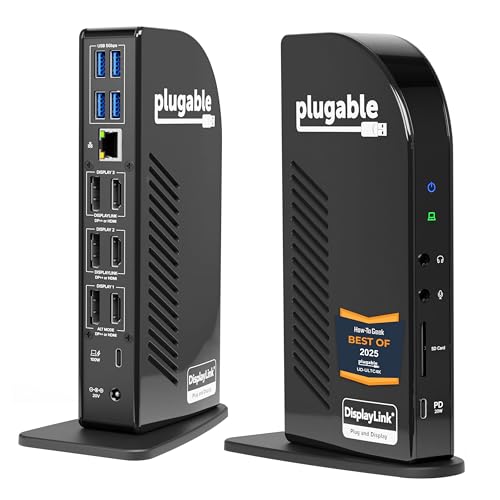
Plugable UD-ULTC4K
This is the premium choice for anyone whose monitors are not being detected through docking station because no cheaper dock can handle their resolution and count demands. With three HDMI and three DisplayPort outputs, it supports triple 4K setups and is explicitly rated for Windows, Mac, ChromeOS, and Thunderbolt machines. The $245.99 price reflects the DisplayLink chipset that enables all this, and a driver is required. For professionals running financial dashboards, code review across three 4K panels, or CAD work, it eliminates detection failures entirely.
- Pro: Six video outputs (3 HDMI + 3 DP) enable any triple-monitor combination.
- Pro: 100W power delivery charges high-draw workstations.
- Con: Requires a driver install; not for casual users.
Skip this if two monitors are sufficient or if you want a driver-free setup.
MOKiN 3-Monitor Weather Dock
The weather-function display is a novelty, but the core spec — three external monitor outputs via USB-C at $79.99 — positions this as a mid-tier triple-monitor solution with no driver requirement. Owner feedback suggests it works well on Thunderbolt-equipped laptops but can struggle on basic USB-C ports that only carry 5 Gbps, which is a common cause of the “monitors not detected through docking station” complaint on budget machines.
- Pro: Three monitor outputs without requiring DisplayLink software.
- Pro: Mid-range price with added convenience features like the weather display.
- Con: Performance depends heavily on your laptop’s USB-C bandwidth; not suitable for USB-A machines.
Skip this if your laptop only has USB-A ports or if you want maximum resolution per output rather than maximum screen count.
Buying Guide
Alt Mode vs. DisplayLink: The Single Most Important Decision
If your monitors are not being detected through a docking station, the root cause is almost always a mismatch between your laptop’s USB-C implementation and the dock’s expected signal. USB-C Alt Mode passes a native GPU video signal and works driver-free, but only on laptops with a GPU-wired USB-C port. DisplayLink docks use a driver to compress and transmit video over generic USB, solving detection issues on machines without Alt Mode — at the cost of latency and a software dependency. Check your laptop manual before buying.
Monitor Count and Resolution: Match the Dock to Your Panel Array
A dock advertising “dual 4K” may only deliver 4K on one port and 1080p on the second. Triple-monitor docks at this price tier often cap the third output at 1080p or even 720p. If all your monitors are 1440p or 4K, prioritize docks that state per-port maximum resolution explicitly rather than relying on marketing language. The WAVLINK and Plugable UD-ULTC4K handle multi-monitor resolution most reliably based on their port specifications.
Power Delivery: How Much Wattage Your Dock Actually Needs
If your laptop draws 65W or more while running external monitors, a dock without sufficient power-delivery passthrough will cause your battery to drain even while plugged in — and some laptops throttle GPU performance when underpowered, which can manifest as display detection failures. The Plugable UD-ULTC4K at 100W is the only dock here explicitly rated for high-draw workstations. For ultrabooks at 45W or below, most docks in this list will deliver enough passthrough power without issue.
Our Verdict
The Plugable UD-ULTC4K is the top pick for anyone whose monitors are not detected through a docking station because no lesser dock supports their setup. Six video outputs, 100W power delivery, and cross-platform driver support make it the closest thing to a universal fix. For budget-conscious buyers, the UGREEN 7-in-1 Aluminum Dock at $28.98 delivers reliable dual-HDMI detection on Alt Mode laptops without the driver tax. And if your laptop has only USB-A ports and no Alt Mode at all, the Plugable UD-3900 wins by default because DisplayLink is the only path to multiple external displays on that hardware.
FAQ
Why does my docking station not detect my monitors?
The most common causes are a laptop USB-C port that lacks DisplayPort Alt Mode, an outdated or missing DisplayLink driver, a cable or adapter between the dock and monitor that does not support the required bandwidth, or a BIOS setting that disables the USB-C data and video lanes. Start by confirming your laptop’s port supports video output.
Do all USB-C docking stations support multiple monitors?
No. A USB-C dock can only output to as many monitors as your laptop’s GPU supports over that port’s available lanes. Some docks advertise multiple HDMI ports but only one active monitor at a time unless your laptop supports MST (Multi-Stream Transport), which macOS does not.
Is a driver required for monitors to be detected through a docking station?
Only for DisplayLink-based docks like the Plugable UD-3900 and UD-ULTC4K. Native Alt Mode docks require no driver on Windows, Linux, or ChromeOS. On macOS, only DisplayLink docks work with multiple external monitors since macOS does not support MST over Alt Mode.
Can a docking station cause my monitor to show a black screen even when detected?
Yes, if the dock and monitor negotiate an unsupported refresh rate or color format. Switching the HDMI or DisplayPort cable to a higher-rated version (e.g., HDMI 2.0 for 4K at 60Hz) and manually setting the monitor input in your OS display settings often resolves black-screen issues that appear after initial detection.