Key takeaways
- Compare the best wood routers by power, collet size and base type, with guidance on compact trim routers, mid-size and plunge models for woodworking.
As an Amazon Associate we earn from qualifying purchases.
A wood router does the shaping work that saws and chisels cannot: it rounds and profiles edges, cuts dadoes and grooves, hollows mortises, and follows templates to copy a shape exactly. Sizes spread widely, from palm routers guided with one hand to heavy plunge machines built for large panel-raising bits. The five picks below cover the main classes — a corded compact trim router, a cordless trim router, a mid-size fixed-base model, a fixed-and-plunge combo kit, and a heavy-duty plunge router. These are woodworking routers; the same word is used for home networking gear, a different product entirely. Every figure here comes from the maker’s published specifications.
Disclosure: This article contains affiliate links. If you make a purchase through these links, we may earn a commission at no extra cost to you.
How to Choose the Right Wood Router
Match the Base Type to the Cut
A fixed-base router holds the bit at a set depth, which suits edge profiles, dadoes run from an edge, and most router-table work. A plunge router lets the motor slide down on spring-loaded columns, so the bit can enter the middle of a panel under control — the right action for stopped grooves, mortises, and inlays. Compact trim routers are small fixed-base machines built for light edge work, laminate trimming, and shallow joinery cuts. A combo kit pairs one motor with both base types, and for most workshops it is the most flexible single purchase. Heavy-duty plunge routers add the power and stroke for deep mortises and the largest bits.
Collet Size Decides Your Bit Library
The collet is the clamp that grips the bit shank, and shank diameter is the first compatibility check. Compact routers take 1/4-inch shanks only; mid-size and heavy routers commonly include both collet sizes. A 1/2-inch shank is stiffer, runs with less vibration and deflection, and opens up the large profiles — panel raisers and big roundovers are mostly made on 1/2-inch shanks. If you already own bits, match the collet set to them first.
Variable Speed Is About Bit Diameter
A router bit’s rim moves far faster than its center, and the bigger the bit, the faster the edge travels at a given spindle speed. Small bits — under an inch across — can run at a compact router’s full speed. Mid-size bits in the 1- to 2-inch range belong in the middle of the dial. Large bits over 2 inches, and panel raisers over 3 inches, must run at the slow end of a big router’s range, which is why heavy machines offer speeds down near 8,000 RPM and compact routers, spinning small bits only, do not need to. Constant-response circuitry matters as much as the dial: it adds power as the cut loads the motor, holding the set speed instead of letting the bit slow and burn the wood.
Soft Start, Brakes, and Depth Control
Soft start brings the motor up to speed gradually instead of with a jerk of torque reaction in your hands — a real handling benefit on larger routers. An electronic brake, found on some models, stops the bit quickly after switch-off. Depth systems differ by class: trim routers use a simple clamp or rack-and-pinion adjustment, mid-size fixed bases add microfine knobs, and plunge bases use a depth rod with a rotating turret stop so stepped cuts repeat exactly. Above-table height adjustment, offered on some fixed bases and the Triton below, lets a table-mounted router be set from above the tabletop.
Dust Ports and Template Guides
Routers make chips faster than almost any other shop tool, and makers handle extraction differently. Many plunge bases and combo kits include a dust port or hood; compact trim routers often need an accessory nozzle, and port diameters vary by brand, so check what adapter your vacuum hose needs. Template guides — the bushings that let a router follow a pattern — come in two broad systems: screw-in guides in the long-established pattern used by many brands, and maker-specific quick-change systems such as Bosch’s. Confirm which system a base accepts before buying a guide set, because the two do not interchange.
Safety Rules That Come Before Every Cut
Four habits are not optional with this tool class. First, unplug a corded router or remove the battery from a cordless one before every bit change, and let the bit stop completely before setting the tool down. Second, wear eye protection and hearing protection; routers are loud and throw chips at speed. Third, feed the router against the bit’s rotation: viewed from above, the bit spins clockwise, so move the tool so the cutter edge meets the wood rather than trying to climb along it — on an outside edge that generally means working left to right, and reversing for inside edges. Fourth, never switch the router on with the bit touching the workpiece; start it clear, let it reach full speed, then enter the cut. Clamp the work and take deep cuts in several shallow passes.
Makita RT0701C: The Compact Trim Router Benchmark

The RT0701C is the reference compact router: a 1-1/4 HP, 6.5-amp motor in an aluminum housing, light enough at 3.9 pounds for one-handed edge work yet strong enough for hinge mortises, shallow dadoes, and laminate trimming. Its variable-speed dial runs from 10,000 to 30,000 RPM with soft start and electronic speed control, so small bits stay at the set speed under load. Depth is set with a rack-and-pinion fine adjustment that is quicker and more repeatable than twist-and-clamp systems, and the flat motor top lets the tool stand upside down for bit changes.
The 1/4-inch collet defines its limits: this is a small-bit machine, and large profiles belong on the bigger routers below. Makita’s plunge and tilt bases for the same motor are sold separately for owners who later want plunge cuts. A shaft lock speeds bit swaps, though the tool must be unplugged first, as with every pick here. For edge profiles, roundovers, and trim work in a small shop, this remains the pattern other compact routers are measured against.
Specs
- Model: RT0701C
- Motor: 1-1/4 HP max, 6.5 A
- Speed: variable 10,000–30,000 RPM, soft start
- Collet: 1/4 in
- Depth adjustment: rack-and-pinion fine adjustment
- Housing and base: aluminum
- Bit changes: shaft lock, wrenches included
- Included: straight guide, 1/4 in collet, wrenches
- Weight: 3.9 lb (1.8 kg)
DEWALT DCW600B: Cordless Trim Router for 20V MAX Owners

The DCW600B takes the trim router off the cord. Its brushless motor runs on DEWALT’s 20V MAX platform and turns in variable speeds from 16,000 to 25,500 RPM — a range matched to the 1/4-inch bits a trim router uses. For anyone already holding 20V MAX batteries, it removes the cord drag that matters most on edge work, where a trailing cable can pull a light router off its line at the end of a pass. Dual LED lights ring the base opening and light the cut line, a genuine help when following a pencil line or a template edge.
Depth is set with an adjustment ring on the fixed base, and an electronic brake stops the bit quickly when the switch is released — still wait for a full stop and remove the battery before changing bits. This listing is the tool-only configuration: battery and charger are sold separately, and DEWALT’s plunge base is a separate accessory. As a second router for site work and quick edge profiles, it is the natural pick for the platform’s owners.
Specs
- Model: DCW600B
- Motor: brushless, DEWALT 20V MAX platform
- Configuration: tool only — battery and charger sold separately
- Speed: variable 16,000–25,500 RPM
- Collet: 1/4 in
- Depth adjustment: adjustment ring on fixed base
- Brake: electronic motor brake
- Lighting: dual LED work lights
- Bases: fixed base included; plunge base sold separately
Bosch 1617EVS: The Mid-Size Fixed-Base Standard

The 1617EVS is the mid-size router many workshops are built around. Its 12-amp motor is sized at 2.25 HP and runs variable speeds from 8,000 to 25,000 RPM with soft start and constant-response circuitry that holds speed as the bit loads up. Both 1/4-inch and 1/2-inch self-releasing collets are included, so it swings everything from small edge bits to mid-size panel profiles. The RA1161 fixed base offers microfine depth adjustment, and its above-table adjustment capability makes it a common choice under a router table as well as in hand.
At 7.7 pounds it is a two-handed tool, and that weight works in its favor on long edge cuts, keeping the base planted. The base accepts Bosch’s quick-change template guide system with the maker’s adapter — worth confirming if you plan template work with bushings you already own. It has no plunge action; stopped cuts in the middle of a panel are the combo kit’s job below. For a single corded router covering edge work, joinery, and table duty, this is the established answer.
Specs
- Model: 1617EVS
- Motor: 12 A, 2.25 HP max
- Speed: variable 8,000–25,000 RPM, soft start, constant-response circuitry
- Collets: 1/4 in and 1/2 in self-releasing, both included
- Base: RA1161 fixed base, microfine depth adjustment
- Template guides: accepts Bosch quick-change template guide adapter system
- Table use: above-table height adjustment capability
- Weight: 7.7 lb (3.5 kg)
Bosch 1617EVSPK: One Motor, Fixed and Plunge Bases

The 1617EVSPK wraps the same 1617EVS motor unit in a two-base kit: the RA1161 fixed base for edge work and table mounting, and the RA1166 plunge base for stopped grooves, mortises, and inlay work. Swapping the motor between bases takes seconds, so the kit behaves like two routers sharing one set of collets and wrenches. The plunge base gives 2 inches of stroke with a turret depth stop for stepped cuts, and both bases include chip shields.
The kit includes both collets, forged 16 mm and 24 mm wrenches, the T-handle hex wrench used for above-table height changes, and a carrying case. Speed range, soft start, and constant-response electronics match the fixed-base model above. Choose this kit over the standalone 1617EVS if mortises, stopped dadoes, or plunge template work are on your project list — the plunge base is the difference. It remains a corded, two-handed, mid-size machine, sized for furniture work rather than the largest raised-panel bits.
Specs
- Model: 1617EVSPK
- Motor: 12 A, 2.25 HP max (1617EVS motor unit)
- Speed: variable 8,000–25,000 RPM, soft start, constant-response circuitry
- Collets: 1/4 in and 1/2 in self-releasing, both included
- Bases: RA1161 fixed base and RA1166 plunge base
- Plunge stroke: 2 in, turret depth stop
- Included: chip shields for both bases, 16 mm and 24 mm wrenches, T-handle hex wrench, carrying case
- Dust: extraction port on plunge base
Triton TRA001: Heavy-Duty Plunge Power for Big Bits and Tables
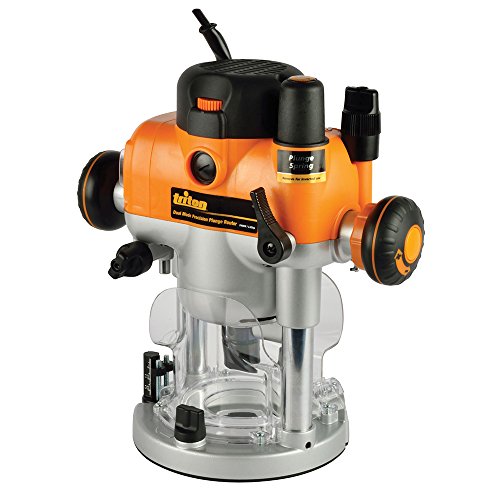
The TRA001 is the heavy end of this guide: a 15-amp motor sized at 3-1/4 HP, variable from 8,000 to 21,000 RPM with soft start. That slow bottom end and full-size frame are what large bits demand — panel raisers and wide profiles on 1/2-inch shanks need exactly this combination of power and low speed. Its plunge capacity runs to 68 mm, about 2-11/16 inches, with a turret stop for repeatable stepped cuts in deep mortises.
What sets the Triton apart is its dual-mode design. It works as a free-plunge router in hand, and switches to a rack-and-pinion fixed mode for table mounting, where height is wound from above the table with the included handle. Raised fully in the table, an automatic spindle lock engages so bits can be changed from above the tabletop with a single wrench — still with the tool unplugged. A multi-function fence for edge-guided work and a dust port are included. At roughly 13 pounds it is a committed two-handed machine, happiest in a table or on substantial workpieces.
Specs
- Model: TRA001
- Motor: 15 A, 3-1/4 HP max
- Speed: variable 8,000–21,000 RPM, soft start
- Collets: 1/2 in collet fitted, 1/4 in reducer included
- Modes: dual mode — free plunge and rack-and-pinion fixed mode
- Plunge capacity: 0–68 mm (about 2-11/16 in), turret depth stop
- Bit changes: automatic spindle lock; above-table bit changes when table-mounted
- Included: multi-function fence, height winder handle, dust port
- Weight: about 13.2 lb (6.0 kg)
Frequently Asked Questions
Is a compact trim router enough for joinery?
For light joinery, yes: hinge and lock mortises, shallow dadoes, and small box joints sit comfortably within a trim router’s power, especially with a guide or template. Its limits are bit size and depth per pass — it takes only 1/4-inch shank bits and needs several shallow passes where a mid-size router needs two. For furniture-scale dovetails, deep mortises, or any large profile bit, step up to a mid-size model with a 1/2-inch collet.
Should I choose a router with a 1/2-inch collet?
If it will be your only full-size router, yes. A 1/2-inch shank is stiffer, so big bits run smoother with less deflection, and the widest bit selection — including panel raisers — is made on 1/2-inch shanks. Most mid-size and heavy routers include both collets, so nothing is lost. Compact trim routers are 1/4-inch only, fine for the small bits they spin.
Why does the right speed change with bit diameter?
The cutting edge of a large bit travels much faster than the edge of a small bit at the same RPM, because it sits farther from the center. Run a 3-inch panel raiser at top speed and the rim speed becomes unsafe and burns the wood; run a small bit too slowly and it scrapes instead of cutting. As a working pattern: small bits near full speed, mid-size bits mid-dial, and bits over 2 inches at the slow end of a full-size router’s range.
Can these routers be used in a router table?
The fixed-base and heavy picks can. The Bosch 1617EVS adjusts from above the table with its base mounted underneath, the combo kit’s fixed base does the same, and the Triton TRA001 is designed for table work, with above-table height winding and bit changes. Compact trim routers can mount in small tables but lack the power for big bits. Whatever the router, table use follows the same rules: unplug for bit changes, guard the bit, and feed stock against the rotation.
Conclusion: Which Wood Router Fits Your Work?
For edge profiles, laminate work, and one-handed trimming, the Makita RT0701C is the compact benchmark, and the DEWALT DCW600B is its cordless counterpart for 20V MAX owners. As one corded router for furniture work, the Bosch 1617EVS covers edge, joinery, and table duty at mid-size power; the 1617EVSPK kit is the better buy when plunge cuts are part of the plan. For the largest bits, deep plunge work, and a router that lives in a table, the Triton TRA001 brings the power and above-table controls the job calls for. Match the collet to your bits, set speed to bit diameter, and keep the safety habits above.
More from Amazon
Programs that pair well with the guide above. Offers and eligibility are set by Amazon and may change.
Free shipping on eligible items, Prime Video and more. Eligible new members can start with a free trial.
Start a Prime free trialAd-free music streaming. Eligible new subscribers can start with a free trial.
Try Music Unlimited freeA Prime membership for ages 18-24 with a trial period. Eligibility is set by Amazon.
See Prime for Young AdultsAudiobooks and podcasts to listen to on the go. Eligible new members can start with a free trial.
Try Audible freeAs an Amazon Associate we earn from qualifying purchases.