Key takeaways
- Compare the best ice packs by flexibility, size and freeze time, with guidance on gel packs for injuries, lunch boxes, coolers and post-workout recovery.
As an Amazon Associate we earn from qualifying purchases.
Ice packs split into two families that rarely substitute for each other. A soft gel pack that drapes over a swollen knee does almost nothing useful at the bottom of a cooler, and a rigid cooler block is a poor tool for icing a shoulder. The five packs below cover the shapes people actually shop for: a large flexible gel pack for joints and injuries, a strap-on wrap that holds itself against a lower back, a hard-sided block built to live in coolers, a set of slim packs sized for lunch boxes, and a phase-change cooler pack the maker designs for multi-day cold. Every duration figure quoted here is the maker’s own claim under the maker’s own conditions, because a pack that holds cold in a sealed premium cooler on a mild day will not do the same in a thin lunch bag in August.
Disclosure: This article contains affiliate links. If you make a purchase through these links, we may earn a commission at no extra cost to you.
How to Choose the Right Ice Pack
Match the Pack to the Job First
Decide whether the pack works on a body or on food, because the design priorities oppose each other. Injury packs need to flex, because a knee, ankle, or shoulder is all curves, and a pack that bridges over the joint leaves the sore spot warm. They also need a surface that tolerates repeated bending without splitting at the seams. Cooler packs need the opposite: rigidity, flat faces that stack, and enough frozen mass to absorb a day of heat leaking through cooler walls. Lunch packs sit between the two, thin and light so they slide into a crowded bag without displacing the food they protect.
Gel, Hard Shell, or Phase-Change Fill
Most injury packs and many cooler packs use a water-based gel that stays somewhat pliable when frozen, which is why gel packs drape. Hard-sided cooler blocks seal a similar fill inside a rigid plastic shell; the shell survives drops, cooler lids, and years of freezer cycles, and it keeps one flat cold face against cans and containers. Phase-change packs use a fill formulated to melt at a set temperature well below freezing, 18°F in the Cooler Shock below, so the pack holds that temperature plateau while it absorbs heat. The trade-off is preparation: that pack ships dry and you add water once before the first freeze.
Size and Coverage Decide How Well It Works
For injuries, the pack should extend past the sore area on every side, since cold spreads only a short distance through tissue. A pack that barely covers a kneecap leaves the sides of the joint untreated. For coolers, coverage works differently: flat packs laid over the top of the load matter most, because cold air sinks and the warmest layer in any cooler is the top one. Measure your cooler floor and your lunch bag before ordering, and check the pack thickness against the space you actually have.
Read Cold-Duration Claims Carefully
Every “stays cold for X hours” figure in this category is a maker claim from conditions the maker chose: a specific cooler, load, and room temperature, and often a definition of “cold” that means the pack still feels cool rather than food held at a safe temperature. Treat the numbers as a rough ranking between packs, not a promise. Real results depend on how often the lid opens, how full the cooler is, whether the contents went in already chilled, and the weather outside. For food safety, the working rule from public food-safety guidance is to keep perishables at or below 40°F and to discard perishable food held in the danger zone for more than two hours, less in hot weather.
Use Cold Therapy in Short, Supervised Sessions
Cold therapy guidance from makers and clinicians converges on short sessions: around 15 to 20 minutes at a time, with a thin cloth barrier between the pack and your skin. Longer is not better; skin and the tissue under it can be damaged by sustained intense cold. Never fall asleep with a pack in place, because you will not feel the warning discomfort that tells you to remove it. Do not use cold therapy over broken skin, and if you have circulation problems, diabetes-related sensation loss, or reduced feeling in the area, get a clinician’s guidance before using any of these packs. This is general information, not personal medical advice; a professional who knows your situation outranks anything printed here.
FlexiKold Gel Ice Pack by NatraCure: The Flexible Pick for Joints and Injuries

This is the classic therapy gel pack, sized generously at 10.5 by 14.5 inches so it wraps a knee with coverage to spare, folds along a lower back, or drapes a shoulder. NatraCure builds the FlexiKold around a gel fill the maker describes as staying pliable straight out of the freezer, which is the entire point of the format: a pack that freezes into a board cannot follow the curve of a joint. The shell is a heavy-duty nylon with double-sealed seams, a construction aimed at surviving the daily bend-and-refreeze cycle that splits thinner packs at the edges. The linked listing is the Standard Large single pack; the same model also sells in a medium size and in two-packs under separate listings, so confirm the size before ordering. Used with a cloth barrier in short sessions, it is the straightforward choice for post-workout icing and everyday sprains and strains. Freeze it flat so it keeps the shape that makes it useful.
Specs
- Size: 10.5 x 14.5 inches (Standard Large)
- Model: 6300-COLD, by NatraCure
- Fill: gel formulated to stay flexible when frozen (maker description)
- Shell: heavy-duty nylon with double-sealed seams
- Latex free (maker statement)
- Coverage areas: knee, back, shoulder, hip, leg, arm
- Care: freeze flat; wipe clean; inspect seams before each use
REVIX Extra Large Ice Pack for Back: The Strap-On Wrap for Lower Backs

A flat pack on a lower back has one flaw: it only stays there while you lie still on top of it. This REVIX wrap solves the placement problem with an adjustable elastic strap that fastens the pack against your waist, so the cold stays on the lumbar area while you sit, stand, or move around the house. Each pack measures 13.4 by 11 inches, wide enough to span the lower back, and the listing is a two-pack, which matters: one pack can be in use while the second refreezes, so sessions are not dictated by freezer time. The design is dual-sided, with a soft plush face that softens the cold against skin and a smoother nylon face for more direct contact through clothing. The gel fill stays flexible when frozen, so the pack follows the curve of the back instead of bridging across it. It also works on a hip, a shoulder, or across a knee, anywhere the strap can anchor it. Wear it over a thin layer of clothing and keep sessions to the short window described above.
Specs
- Size: 13.4 x 11 inches per pack
- Count: 2 packs in the linked listing
- Retention: adjustable elastic strap for hands-free wear
- Design: dual-sided, soft plush face and nylon face
- Fill: gel that remains flexible when frozen
- Coverage areas: lower back, waist, hip, shoulder, knee
- Care: freeze flat between uses; wipe clean
YETI ICE 2 lb: The Hard-Sided Block for Coolers

YETI builds this block as a permanent resident for a cooler rather than an occasional guest. The rigid shell is impact resistant, so it shrugs off the drops, slamming lids, and frozen tumbles that crack thinner packs. The maker describes the fill as a refreezable ice substitute that chills contents alongside loose ice or in place of it, with no meltwater puddle to drain. The 2 lb size measures 8 by 5 3/8 by 1 5/8 inches, a footprint shaped to sit under cans or against a cooler wall, with a center opening that makes a frozen block easier to grab with cold fingers. Two honest limits: in a large cooler on a hot day a single 2 lb block supplements loose ice more than it replaces it, and any duration depends on the cooler, the load, and the weather, whatever the marketing implies. What you are buying is durability and convenience across years of trips.
Specs
- Weight: 2 lb
- Dimensions: 8 x 5 3/8 x 1 5/8 inches
- Shell: impact-resistant rigid plastic, food-safe (maker statement)
- Fill: refreezable ice substitute
- Shape: custom block profile with center grab opening; maker states the shape reduces freezing time
- Use: supplement or replace loose ice in hard and soft coolers; no meltwater
- Sizes in the range: 1 lb, 2 lb, and 4 lb under separate listings
Cool Coolers by Fit & Fresh XL Slim Ice Packs: The Lunch Box Set

Lunch bags punish thick packs: every half inch of ice is a half inch less sandwich. These Fit & Fresh packs are built around that constraint at 7 by 4.75 inches and only half an inch thick, so one slides against the wall of a lunch box and a second can lie flat over the top of the food, which is where a load warms first. The linked listing is the multicolor four-pack, enough to rotate through a week of lunches with spares in the freezer, or to line both sides of a larger bag on a hot day. The maker states the shells are BPA-free plastic with a non-toxic fill, the standard construction for this category. Slim packs carry an honest trade-off you should plan around: thin packs hold less frozen mass, so they give up their cold faster than a thick block, and the maker positions them for hours of lunch duty rather than day-long cooler work.
Specs
- Size: 7 x 4.75 x 0.5 inches per pack
- Count: 4 packs in the linked listing (multicolor)
- Material: BPA-free plastic shell (maker statement)
- Fill: non-toxic (maker statement)
- Profile: slim design sized for lunch boxes, lunch bags, and small coolers
- Use pattern: one pack against the wall, one over the top of the load
- Care: hand wash; freeze flat
Cooler Shock Large Ice Packs: The Long-Lasting Cooler Block
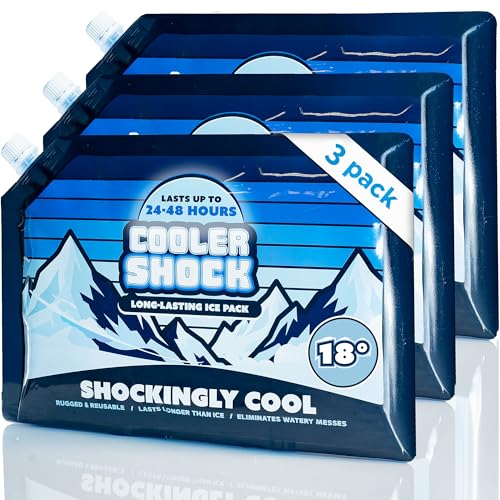
Cooler Shock takes a different route to long cooler runs. These large 10 by 14 inch packs ship dry with the maker’s gel mixture already inside; you add water once through the screw cap, shake, and seal, and from then on they freeze and refreeze like any other pack. The point of the formula is its phase-change behavior: the maker states the fill melts at 18°F rather than 32°F, so while the pack thaws it holds that lower temperature plateau, and the maker claims up to 48 hours of cooling for the large size when the packs are paired with a high-quality cooler. Read that figure the way the How to Choose section advises: it is a best-case maker claim, and your result will hinge on the cooler, the load, and how often the lid opens. The linked listing is the large three-pack, model 7CSLSET, enough to floor a mid-size cooler. Filling is a one-time job, but do it carefully and seal the cap fully, because the packs are only as leak-proof as that closure. Once filled they are heavy and freeze into rigid slabs, so give them flat freezer space.
Specs
- Size: 10 x 14 inches per pack
- Count: 3 packs in the linked listing
- Model: 7CSLSET
- Fill: dry gel mixture shipped in the pack; add water once, shake, and seal before first freeze
- Phase change: melting point of 18°F (maker statement)
- Duration: up to 48 hours claimed by the maker for the large size in a high-quality cooler
- Closure: screw cap with seal; freeze flat after filling
Frequently Asked Questions
How long should I leave an ice pack on an injury?
General guidance from makers and clinicians points to short sessions of around 15 to 20 minutes, with a thin cloth barrier between the pack and your skin, and time between sessions for the skin to return to normal temperature and color. More time does not mean more benefit, and sustained intense cold can injure skin. Treat this as general information rather than personal medical advice, and follow any specific instructions you have been given after surgery or an injury.
How long will cooler packs actually keep food cold?
It depends on the cooler, the starting temperature of the food, how full the cooler is, and how often the lid opens, which is why maker figures from controlled conditions should be read as best cases. A practical approach is to pre-chill the cooler and the contents, pack the load tight, and keep perishables at or below 40°F, checking with an inexpensive cooler thermometer if the trip is long. When in doubt about food that has sat warm, discard it rather than risk it.
What should I do if a gel pack starts leaking?
Take it out of service. A leaking pack has a failed seam or shell, and the fill belongs in the bin rather than on skin or near food. Wipe up any gel with a cloth, wash your hands, and dispose of the pack with household trash. Makers generally describe their fills as non-toxic, but gel from any pack should still be kept away from children and pets, and a leaking pack should never go back into a lunch box or cooler.
Can I fall asleep with an ice pack on, or put one directly on bare skin?
No to both. Direct contact removes the buffer that keeps intense cold from damaging skin, so always use a cloth barrier or the pack’s fabric side, and never drift off with a pack in place, because sleep removes the discomfort signal that tells you when a session has gone on too long. If an area feels numb, looks pale or blotchy, or hurts more after icing, stop and let it warm up, and seek medical advice if the reaction does not settle.
Conclusion: Which Ice Pack Fits Your Routine?
For icing knees, shoulders, and backs at home, the FlexiKold Standard Large is the flexible default, and the REVIX two-pack is the better answer when the target is a lower back you cannot keep a loose pack pressed against. For coolers, the YETI ICE 2 lb is the durable everyday block that lives in the box between trips, while the Cooler Shock large three-pack is the choice for long weekends where its phase-change fill, on the maker’s figures, holds a lower temperature longer. For school and office lunches, the Fit & Fresh XL Slim four-pack trades raw endurance for a profile that actually fits the bag. Whichever you choose, freeze it flat, respect the short-session rule on skin, and read every duration claim as the best case it is.
More from Amazon
Programs that pair well with the guide above. Offers and eligibility are set by Amazon and may change.
Free shipping on eligible items, Prime Video and more. Eligible new members can start with a free trial.
Start a Prime free trialAd-free music streaming. Eligible new subscribers can start with a free trial.
Try Music Unlimited freeA Prime membership for ages 18-24 with a trial period. Eligibility is set by Amazon.
See Prime for Young AdultsAudiobooks and podcasts to listen to on the go. Eligible new members can start with a free trial.
Try Audible freeAs an Amazon Associate we earn from qualifying purchases.