Key takeaways
- Compare the best padlocks for gates, lockers and sheds, with shackle materials, body sizes, keyed and combination designs and weather protection explained.
As an Amazon Associate we earn from qualifying purchases.
A padlock is a small purchase that carries an outsized job, and the five locks in this guide cover the places that job actually happens: a gate or job box that needs the heaviest keyed lock in the drawer, a fence latch that lives outdoors in all weather, a school or gym locker where carrying a key is a nuisance, a thick hasp or chain that a standard shackle cannot reach around, and a self-storage door where the shackle itself is the usual target. The differences that matter are concrete ones. Body width and construction decide how much abuse the lock body tolerates. Shackle diameter, shackle material, and how much of the shackle sits exposed decide how the lock answers cutting tools. Shackle clearance decides whether the lock fits your hasp at all. Every strength figure below is a maker-stated claim from the maker’s own listing copy, presented as such, because no padlock at any size is unbreakable, and honest expectations are part of choosing well.
Disclosure: This article contains affiliate links. If you make a purchase through these links, we may earn a commission at no extra cost to you.
How to Choose a Padlock
The lock is only one link in the chain. A padlock secures whatever it is attached to, and the hasp, staple, chain, and gate hardware around it are usually weaker than the lock itself. A heavy boron-carbide shackle clipped through a thin pressed-steel hasp fails at the hasp, not the shackle. Before spending up on a heavier lock, look at the mounting hardware: a stout hasp with concealed screws, a chain with hardened links sized to the shackle, and a latch that cannot simply be unscrewed will do more for real security than any single lock upgrade. Match the lock to the hardware, and the hardware to the lock.
Shackle material and diameter carry the cutting claims. Makers state cut resistance in terms of what the shackle is made from and how thick it is. Hardened steel is the baseline. Boron-carbide, used in Master Lock’s Tough-Cut shackles, is described by the maker as 50% harder than hardened steel, and that figure is a maker’s figure, quoted here as one. Diameter matters alongside material: a 3/8 inch shackle presents more metal to a cutter than a 9/32 inch one. Treat every such claim as relative resistance that buys time against tools, never as immunity, because a determined attack with power tools defeats any padlock in this guide.
Shackle clearance decides fit before anything else. The vertical clearance is the open height inside the shackle loop, and it has to clear your hasp, chain link, or locker latch with room to close. Standard locks offer roughly 3/4 inch to 1 inch. Locker latches and thin gate hasps need little; thick cast hasps, double chain links, and recessed storage latches need more, which is what long-shackle models exist for. The trade runs both ways: extra clearance leaves more shackle exposed and easier to grip with a cutter, so buy the clearance your hardware requires and no more.
Body construction sets the pry and weather story. Laminated steel bodies stack riveted plates that tolerate hammering and prying well for their size, and dual locking levers or dual ball bearings, where fitted, hold both sides of the shackle so it cannot be twisted or pried open from one side. Solid and stainless bodies shrug off corrosion better. Outdoors, the failure mode is usually not attack but weather: water and grit in the keyway and shackle holes. Covered models with a weather resistant shell and a sealed keyway are built for that environment, and makers describe them in exactly those terms.
Keyed or combination is a management decision. A keyed lock ties security to key control: copies, spares, and who holds them. A dial combination lock removes the key entirely, which suits lockers and shared access, at the trade of a preset or resettable code that anyone who learns it can use. Pin count in a keyed cylinder is the maker’s pick-resistance story, with four-pin cylinders standard across this guide. None of these locks should be described as pick-proof; the honest claim, and the one makers support, is resistance that slows casual attempts.
Disc locks solve a specific problem. On a storage unit, the latch leaves a short length of shackle exposed, and that exposed length is what cutters grip. A disc padlock wraps the shackle inside a round body so only a small arc shows. If your door hardware is a standard storage latch, that shrouded shape is worth more than a nominally thicker shackle on an open-body lock, because there is so little shackle available to attack.
Master Lock M5XD Magnum Heavy-Duty Padlock
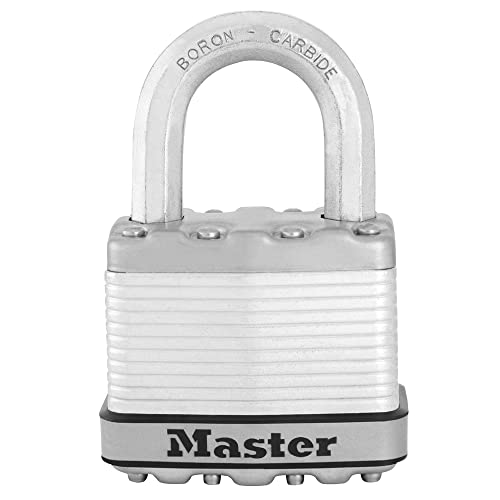
The M5XD is the heavy end of this guide and the pick when one keyed lock has to guard a gate, a job box, or equipment outdoors. Its 2 inch laminated steel body sits inside stainless steel and zinc outer components, a construction Master Lock calls Dual Armor, intended to keep the laminated core strong while the outer shell handles weather. The shackle is the headline: an octagonal Tough-Cut boron-carbide shackle, 3/8 inch in diameter, which the maker states is 50% harder than hardened steel for resistance to cutting and sawing. Dual ball bearing locking holds the shackle against prying and hammering per the maker, and the four-pin cylinder is the maker’s pick-resistance provision. Read those claims the way this guide reads all of them: as maker-stated resistance that buys time and deters casual attack, on a lock that still depends entirely on the hasp and chain you pair it with.
Specs
- 2 in (51mm) wide laminated steel body with stainless steel and zinc outer components
- Octagonal Tough-Cut boron-carbide shackle, 3/8 in (10mm) diameter, 1 in (25mm) clearance
- Maker states boron-carbide is 50% harder than hardened steel
- Dual ball bearing locking mechanism; 4-pin cylinder
- Keyed different, two keys included; model M5XD
View the Master Lock M5XD Magnum on Amazon
Master Lock M115XDLF Magnum Covered Padlock

The M115XDLF is built for the lock that never comes indoors. It is a Magnum laminated padlock, 1-7/8 inches wide, wrapped in a weather resistant cover that the maker describes as protecting the lock against snow, rain, dirt, mud, grime, and salt, with the keyway covered as well so grit and water stay out of the cylinder. Under the cover sits the same Dual Armor arrangement of a laminated steel core with stainless steel and zinc outer components. The shackle is an octagonal boron-carbide unit, 5/16 inch in diameter, with a longer 1-1/2 inch clearance that suits gate chains and latch hardware that a standard shackle cannot span. For a fence gate, a shed in an exposed yard, or a dock box, this is the shape of lock to look at: the security hardware is comparable to heavier models, and the cover addresses the corrosion and fouling that actually retire outdoor padlocks.
Specs
- 1-7/8 in (48mm) wide laminated steel body with weather resistant cover, per the maker
- Cover protects against snow, rain, dirt, mud, grime, and salt per the maker
- Octagonal boron-carbide shackle, 5/16 in (8mm) diameter, 1-1/2 in (38mm) clearance
- Dual Armor construction with stainless steel and zinc outer components
- 4-pin cylinder; keyed different, two keys included; model M115XDLF
View the Master Lock M115XDLF Magnum on Amazon
Master Lock 1500D Combination Dial Padlock

The 1500D is the classic locker lock: a 1-7/8 inch steel body, a three-digit dial, and no key to lose, lend, or duplicate. The combination is preset at the factory and cannot be reset, which is the right arrangement for a school or gym locker, since there is no reset procedure for anyone to abuse and nothing to configure out of the box; the combination is supplied with the lock, so record it somewhere safe before the packaging is thrown away. The shackle is hardened steel, 9/32 inch in diameter with 3/4 inch of clearance, sized for standard locker latches and gym bag hasps. This is a convenience-grade lock for low-risk storage, and it should be chosen with that expectation: it keeps honest people and curious hands out of a locker, which is the job it has done in hallways for decades, and it is not the lock for a gate or a storage door.
Specs
- 1-7/8 in (48mm) wide steel body
- Hardened steel shackle, 9/32 in (7mm) diameter, 3/4 in (19mm) clearance
- Preset 3-digit combination, not resettable; combination supplied with the lock
- Dial operation, no key required
- Model 1500D
View the Master Lock 1500D on Amazon
Master Lock 3DLF Long-Shackle Padlock

The 3DLF is the long-shackle version of the long-running No. 3 laminated padlock, and its reason to exist is reach. The standard No. 3 shackle clears about 3/4 inch; this version opens 1-1/2 inches of vertical clearance, enough to span thick cast hasps, double links of chain, recessed latches, and the stacked hardware on older gates and lockers where a standard lock physically cannot close. The body is the familiar 1-9/16 inch laminated steel stack, the shackle is hardened steel at 9/32 inch diameter, dual locking levers hold both shackle legs against prying, and the cylinder is a four-pin W1 unit that is not rekeyable. Keep the trade from the How to Choose section in mind: the extra inch of exposed shackle is easier for a cutter to grip, so this lock earns its place where fit demands it, not as a general upgrade over a standard-shackle lock.
Specs
- 1-9/16 in (40mm) wide laminated steel body
- Hardened steel shackle, 9/32 in (7mm) diameter
- Extended 1-1/2 in (38mm) vertical shackle clearance for thick hasps and chain
- Dual locking levers; 4-pin W1 cylinder, non-rekeyable
- Model 3DLF
View the Master Lock 3DLF on Amazon
Master Lock M40XKAD Disc Padlock

The M40XKAD, also sold under the 40DPF designation, is the disc lock of this guide, shaped for the sliding latch on a self-storage door. The round stainless steel body is 2-3/4 inches wide and wraps around the shackle so that only a small arc of it is exposed when the lock is closed, which removes the grip and leverage a cutter needs. The shackle itself is a Tough-Cut boron-carbide unit, 3/8 inch in diameter, the same shackle material the maker uses on its heaviest Magnum locks, and the cylinder is a four-pin design. Stainless construction also suits the semi-outdoor corridors and loading areas where storage units live. Two keys are included per the listing. If your storage latch accepts a disc lock, and most are designed around exactly this shape, the shrouded geometry is a more meaningful protection than stepping up a body size on an open-shackle lock.
Specs
- 2-3/4 in (70mm) wide stainless steel disc body
- Shrouded design leaves minimal shackle exposed when closed
- Tough-Cut boron-carbide shackle, 3/8 in (10mm) diameter
- 4-pin cylinder; two keys included per the listing
- Model M40XKAD, also sold as 40DPF
View the Master Lock M40XKAD Disc Padlock on Amazon
Frequently Asked Questions
Does a thicker, harder shackle make a padlock unbreakable?
No, and no maker claim in this guide says otherwise. Shackle material and diameter are stated by makers as resistance: boron-carbide is described by Master Lock as 50% harder than hardened steel, which slows sawing and cutting and defeats small hand tools. Given time and power tools, any of these locks can be cut. The practical goal is a lock whose resistance is matched to the hasp, chain, and door around it, so the lock is not dramatically stronger or weaker than everything it is attached to.
How much shackle clearance do I actually need?
Measure the hardware, not the lock you are replacing. The shackle has to pass through the hasp eye or chain link and close with the body seated, so add the thickness of the hasp or link to the space the body needs. Locker latches and light gate hasps close happily under the 3/4 inch clearance of a standard lock. Thick cast hasps, doubled chain, and recessed storage latches are the cases that need the 1-1/2 inch clearance of a long-shackle model like the 3DLF or the covered M115XDLF. Avoid buying extra clearance you do not need, since exposed shackle is the part a cutter grips.
Is a combination lock weaker than a keyed lock?
They fail differently rather than one being simply weaker. A dial lock like the 1500D removes key management entirely, which is why it suits lockers, but its preset combination cannot be changed, and anyone who learns the combination can open it. A keyed lock’s security follows key control: who holds copies and whether spares are accounted for. Body construction, shackle material, and what the lock is attached to matter more to real resistance than the key-versus-combination choice, so choose by how the lock will be used day to day.
How do I keep an outdoor padlock working in bad weather?
Start with a lock built for it: a covered model such as the M115XDLF, whose maker describes its cover as protection against rain, snow, dirt, and salt, keeps most water and grit out of the keyway and shackle holes in the first place. Mount the lock so the keyway faces down where the hardware allows it, keep the cover closed over the keyway, and work the shackle occasionally so corrosion does not seize it in place. If a keyed outdoor lock does grow stiff, that is a maintenance issue to solve while it still opens, not after a winter of neglect.
Conclusion
Match the lock to the hardware and the setting. For the heaviest general-purpose keyed lock here, the M5XD Magnum pairs a 2 inch laminated body with a boron-carbide shackle the maker positions at the top of its cut-resistance range. For a gate or shed that lives in the weather, the M115XDLF adds a protective cover and a longer shackle to the same Magnum formula. For a school or gym locker, the 1500D remains the simple answer: no key, a preset dial combination, and a body sized for standard locker latches. Where a standard shackle cannot reach, the 3DLF doubles the clearance of the classic No. 3 while keeping its laminated body and dual locking levers. And for a self-storage door, the M40XKAD disc lock protects the shackle itself by keeping nearly all of it inside a stainless body. Whichever you choose, spend a moment on the hasp and chain as well, because the strongest lock in this guide still only secures what it is fastened to.
More from Amazon
Programs that pair well with the guide above. Offers and eligibility are set by Amazon and may change.
Free shipping on eligible items, Prime Video and more. Eligible new members can start with a free trial.
Start a Prime free trialAd-free music streaming. Eligible new subscribers can start with a free trial.
Try Music Unlimited freeA Prime membership for ages 18-24 with a trial period. Eligibility is set by Amazon.
See Prime for Young AdultsAudiobooks and podcasts to listen to on the go. Eligible new members can start with a free trial.
Try Audible freeAs an Amazon Associate we earn from qualifying purchases.