Key takeaways
- Clean after every trip: Rinse salt, mud and sand from the transducer, cable connector and mount. Salt residue can corrode contacts and make a temporary mount difficult to release.
- Dry before charging: Check charging ports and seals for grit or moisture. Never force a connector that has sand in it.
- Protect the screen: Dedicated displays need a padded case; phones need a waterproof pouch that still allows touch operation.
- Expect mounts to wear first: Suction cups lose grip, straps stretch, and plastic clamps become brittle after repeated sun exposure. Carry a backup tether.
- Do not confuse noise with fish: A cluttered display can result from turbulence, electrical interference or a poorly aligned transducer rather than abundant fish.
- Save waypoints deliberately: Mark the actual structure, not merely the position where a fish symbol appeared. Fish move; depth contours and cover are more repeatable.
The best portable fish finders for kayaks and boats are the Garmin STRIKER Cast for simple wireless scouting, the Deeper PRO+ 2 for castable GPS mapping, and a compact Humminbird or Lowrance unit when you want a dedicated screen and a permanently wired transducer.
Our top picks

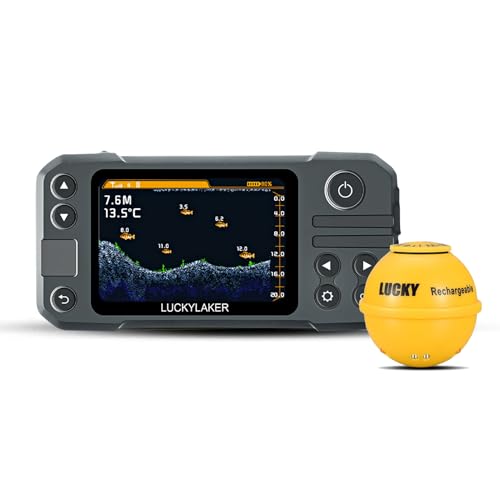


As an Amazon Associate we earn from qualifying purchases at no extra cost to you. Ratings are shown as listed on Amazon.
Quick comparison
| Model | Best for | Sonar depth | Transducer and connection | Screen or mapping | Battery and size |
|---|---|---|---|---|---|
| Garmin STRIKER Cast GPS | Small kayaks, shore casting, beginners | Up to 200 ft / 60 m | Floating wireless castable transducer; approximately 200 ft / 60 m wireless range | Phone app; GPS-enabled Quickdraw mapping | Up to 10 hours; about 2.6 oz / 74 g |
| Deeper PRO+ 2 | Castable mapping and serious kayak portability | Up to 330 ft / 100 m | Floating wireless transducer; approximately 394 ft / 120 m Wi-Fi range | Phone app; built-in GPS and bathymetric mapping | Up to 9 hours; approximately 3.5 oz / 100 g |
| Deeper CHIRP+ 2 | Sharper target separation and deeper water | Up to 330 ft / 100 m | Floating wireless CHIRP transducer; approximately 394 ft / 120 m range | Phone app; GPS mapping through the unit and app | Up to 15 hours; approximately 3.5 oz / 100 g |
| Humminbird PiranhaMAX 4 DI PT | Small boats needing a dedicated display | Up to 320 ft / 98 m, depending on conditions | Wired transom-mount transducer; portable kit with suction-cup mounting option | 4.3-inch color LCD; Down Imaging | Uses a separate 12-volt battery; approximately 5.5 lb / 2.5 kg portable kit |
| Lowrance HOOK Reveal 5 SplitShot | Small boats wanting a larger screen and charting | Depth varies by transducer and water conditions | Wired transom or portable mount; SplitShot sonar | 5-inch display; GPS plotting and C-MAP-compatible chart support | Separate 12-volt battery; roughly 2–4 hours of setup and packing time over a season, depending on mounting arrangement |
Published depth figures are maximum capability, not a guarantee of usable fish detail. Water temperature, bottom composition, boat movement, transducer position and electrical interference can all reduce the practical range.
Which portable fish finder should you buy?
Best for a lightweight kayak: Garmin STRIKER Cast GPS
The STRIKER Cast GPS is the easiest choice when every ounce matters. The transducer floats beside the kayak, sends sonar data to a phone, and does not require a display, mounting arm or permanent wiring. The GPS version can build a depth map as you move, which is more useful than a bare fish-arc display when you want to return to a drop-off later.
Its limitations are equally important. Your phone becomes the screen, so sunlight, rain, battery level and touch-screen operation affect usability. It is also less convenient while paddling than a screen mounted directly in front of you. Choose it for occasional trips, sheltered water and kayaks with little available deck space.
Best for castable mapping: Deeper PRO+ 2
The Deeper PRO+ 2 is a strong middle ground for anglers who want to scan water from shore, a kayak or a small boat. Its built-in GPS allows it to create bathymetric maps while you move, and its Wi-Fi connection avoids relying on cellular service. A castable unit can also inspect a bank, weed edge or submerged channel before you position the boat.
Compared with the Garmin, the Deeper app provides a more mapping-focused experience and a greater quoted wireless range. The trade-off is a slightly more involved workflow: charge the sonar, connect the phone to its Wi-Fi network, protect the phone from spray and keep the unit close enough for a stable signal.
Best for clearer separation: Deeper CHIRP+ 2
The CHIRP+ 2 is worth considering when identifying individual targets matters more than paying the lowest price. CHIRP sonar transmits across a range of frequencies and can produce better separation between fish, structure and bottom than a basic single-frequency castable finder. Its longer quoted battery life also suits a full day of scanning.
Do not buy it solely for the word “CHIRP.” A skilled operator with a basic finder can still learn productive water, while poor transducer placement or excessive speed can ruin the display from any model. The CHIRP+ 2 makes the most sense for frequent anglers who will use mapping and sonar interpretation regularly.
Best dedicated-screen option: Humminbird PiranhaMAX 4 DI PT
A portable Humminbird kit is preferable when you do not want to look at a phone. The 4.3-inch display is easier to read in bright conditions than many phones, and Down Imaging helps show contours and harder structure. The wired transducer can be mounted on a small boat’s transom or temporarily attached using the portable kit.
This design is heavier than a castable sonar and requires a 12-volt battery, but it avoids wireless pairing and preserves phone battery. It is a practical choice for a jon boat, inflatable boat or kayak with enough room for a battery box and display mount.
Best for a small boat with charts: Lowrance HOOK Reveal 5
The HOOK Reveal 5 is the better direction when navigation, waypoints and a larger screen are central to the purchase. A five-inch display gives you more room for sonar and chart information than a phone, and the wired transducer is less vulnerable to wireless range problems.
It is not the most compact kayak option. The screen, mount, transducer cable and 12-volt battery need a protected location, and the transducer must remain in the water without being struck by the hull or paddle. Buy this type when the boat is used often enough to justify a repeatable installation.
Decision matrix by situation
| Your situation | Most suitable type | Why | What to accept |
|---|---|---|---|
| Small kayak, limited deck space | Garmin STRIKER Cast GPS | Minimal weight and no display hardware | Phone dependence and less convenient viewing while paddling |
| Frequent kayak trips with mapping | Deeper PRO+ 2 or CHIRP+ 2 | Castable scanning plus GPS bathymetry | More app setup and careful battery management |
| Beginner on a modest budget | Basic castable sonar or PiranhaMAX portable kit | Lower entry cost and simpler features | Less detailed maps and fewer advanced sonar controls |
| Small boat used weekly | Humminbird or Lowrance wired unit | Dedicated screen and consistent transducer position | Battery, cables and installation take space |
| Shore fishing as well as boating | Deeper PRO+ 2 or CHIRP+ 2 | Can be cast without launching a boat | Do not exceed the tether, casting or water conditions recommended by the manufacturer |
How to choose sonar depth and mounting
For most kayaks, a quoted depth of 200 to 330 feet is already more than enough. The useful question is not “which goes deepest?” but whether the unit can show bottom detail at the depths you actually fish. In a shallow lake, beam coverage, GPS waypoints and readable returns matter more than maximum depth.
Castable transducers are the simplest to transport, but they drift behind the kayak and can tangle with weeds or line. A wired transducer fixed to a transom or portable arm gives a steadier reading while moving. Keep it below disturbed water, level with the hull, and clear of propellers. A suction cup is convenient but should be checked regularly; losing the transducer can cost more than the mount.
Battery-life calculation for a full day
Suppose a castable finder is rated for 10 hours and you plan an eight-hour trip. In theory, it has a 2-hour reserve. In practice, cold weather, repeated wireless reconnections, maximum screen brightness and an aging battery can consume that margin. Treat a rated 10-hour battery as roughly 7 to 8 dependable hours after normal use, and carry a waterproof power bank for the phone.
A wired unit requires a different calculation. A 12-volt, 7 amp-hour battery stores about 84 watt-hours before losses. If the finder averages 4 watts, the theoretical runtime is 84 ÷ 4 = 21 hours. Allowing for voltage drop, cold temperatures and avoiding complete discharge, planning around 14 to 17 hours is more sensible. The battery’s physical size and waterproof storage often matter more than the arithmetic.
Ownership details that affect the decision
- Clean after every trip: Rinse salt, mud and sand from the transducer, cable connector and mount. Salt residue can corrode contacts and make a temporary mount difficult to release.
- Dry before charging: Check charging ports and seals for grit or moisture. Never force a connector that has sand in it.
- Protect the screen: Dedicated displays need a padded case; phones need a waterproof pouch that still allows touch operation.
- Expect mounts to wear first: Suction cups lose grip, straps stretch, and plastic clamps become brittle after repeated sun exposure. Carry a backup tether.
- Do not confuse noise with fish: A cluttered display can result from turbulence, electrical interference or a poorly aligned transducer rather than abundant fish.
- Save waypoints deliberately: Mark the actual structure, not merely the position where a fish symbol appeared. Fish move; depth contours and cover are more repeatable.
Final recommendation
Choose the Garmin STRIKER Cast GPS for the lightest, simplest kayak setup. Choose the Deeper PRO+ 2 when mapping and shore casting are important, or the CHIRP+ 2 when you will use advanced sonar often. For a small boat with room for a battery and a permanent viewing position, a Humminbird PiranhaMAX 4 DI PT or Lowrance HOOK Reveal 5 is easier to read and more dependable underway than a phone-based system.