Key takeaways
- Compare the best toilet plungers by cup design, handle length and storage options, with guidance on flange plungers that clear clogs without splashing.
As an Amazon Associate we earn from qualifying purchases.
A clogged toilet is one of the few household problems that gets worse while you think about it, and the tool that fixes it is not the red cup plunger most people keep under the sink. That flat cup was made for flat drain openings. A toilet drain curves down through a trap and opens at an angle, so a toilet plunger needs a flange, beehive, or bellows head that seals against its curved rim. The five plungers below cover the main designs: a classic stepped flange cup, a beehive head built for modern bowl shapes, a bellows model that pushes a large volume of water per stroke, a flange plunger in a drip-catching canister, and a compact hideaway set for small bathrooms. Every design here is a toilet plunger only, with no brush bundled in, and technique matters as much as the tool itself.
Disclosure: This article contains affiliate links. If you make a purchase through these links, we may earn a commission at no extra cost to you.
How to Choose the Right Toilet Plunger
The Flange Is What Makes It a Toilet Plunger
A flange plunger starts with a cup much like a sink plunger, then adds a soft cylindrical sleeve that folds out from the center of the cup. That sleeve inserts into the toilet’s drain opening while the cup rim seals against the porcelain around it, so each push drives water through the trap instead of splashing it back up the bowl. Beehive heads take a different route to the same seal: their stacked rings narrow toward the tip, so the head wedges into outlets of different sizes, including the oblong outlets on newer high-efficiency bowls. Bellows plungers skip the cup and work like a pump, moving a larger volume of water per stroke. Whichever shape you choose, confirm the listing says it is made for toilets; a flat cup sold for sinks will skate across a toilet outlet and mostly move air.
Technique: Water First, Then a Slow First Push
A plunger moves water, not air, so the bowl needs enough water to submerge the head completely. If the bowl is low, add water from a bucket until the head is covered. If the water is rising toward the rim, stop, wait for it to drain down, and remove some with a disposable cup if it threatens to spill. Set the flange or head into the outlet, then make the first push slow and gentle: that push expels trapped air without splashing. Once the head is full of water and sealed, work the handle in firm push-and-pull strokes, keeping the seal in place, for fifteen to twenty strokes before checking with a flush. The pull matters too: the backstroke loosens the clog while the push drives it forward.
Safety Limits: Chemicals, Rising Water, and Knowing When to Stop
Never plunge a toilet after pouring in a chemical drain cleaner. Plunging can splash that liquid onto skin and eyes, and the cleaner does little for a toilet clog anyway, since it disperses through the bowl instead of sitting on the blockage. If cleaner is already in the bowl, do not plunge; follow the product label, keep people and pets away, and call a plumber if the clog remains. Repeated clogs, a clog that returns within days, gurgling from other fixtures, or more than one drain backing up at once point to a blockage deeper in the line, which is auger or plumber territory, not a bigger plunger. A dropped object such as a toy or a phone also calls for an auger or a wet vacuum rather than force, because pushing can wedge it tighter.
Handle Length, Storage, and Hygiene
Longer handles keep hands farther from the bowl and add leverage, while short or telescoping handles fit inside vanity cabinets. Holders earn their space in guest bathrooms: a canister or caddy with a drip tray catches runoff, hides the tool, and keeps a wet plunger off the floor. After each use, rinse the head in the bowl water as you flush, shake it over the bowl, and let it dry fully before storing it. A brief soak of the head in diluted household disinfectant, followed by rinsing and full drying, keeps odor down. Store the plunger dry; a head left sitting in trapped water degrades faster and smells worse.
NEIKO 60166A: The Classic Stepped-Flange Pick

The NEIKO 60166A is the traditional end of this list: a rubber flange cup on a straight aluminum handle, with no holder and no moving parts. Its patented cup is built in four steps that narrow toward the tip, and those steps are what make it work across bowl generations. The widest step seals against older round outlets the way a classic flange cup does, while the narrower steps reach down into the smaller, angled outlets of low-flow bowls and seat there instead of skating across the rim. NEIKO states the design fits standard and low-flow toilets alike.
The aluminum handle is the other half of the appeal. It does not absorb water, wipes clean, and will not splinter or swell like an old wooden handle. At roughly 24 inches overall, it gives enough reach to keep your hands well clear of the bowl during the push-and-pull rhythm described above. The tradeoff is storage: with no caddy included, this one stands in a corner or a bucket, suiting a utility closet or a bathroom where looks matter less than a head that seals on the first try.
Specs
- Cup: patented all-angle stepped flange cup in black rubber, four narrowing steps
- Fit: maker states it suits standard and low-flow toilet bowls
- Handle: aluminum, non-absorbent and wipe-clean
- Overall height: about 24 inches, per published listing data
- Weight: about 0.85 lb, per published listing data
- Model: NEIKO 60166A, black, sold as a single pack
Korky BeehiveMAX 96-8A: The Beehive for Modern Bowl Shapes

Toilet outlets changed shape as flush volumes dropped, and many newer bowls have oblong outlets that a round flange cup cannot seal. The Korky BeehiveMAX answers that change with a beehive head: a tall stack of flexible rings that narrows toward the bottom, so some ring in the stack meets the outlet wall wherever its size falls. Korky states the head seals all bowl shapes, old round drains and new high-efficiency outlets alike, and names Kohler, TOTO, American Standard, and Mansfield among the bowl brands it fits. Korky also states the design is recommended by Kohler and made in the United States.
This linked version, model 96-8A, pairs the head with a telescoping T-handle. The T shape gives a two-handed grip for the hard first pushes, and the handle collapses so the whole tool, about 17.5 inches at working length, stores in a cabinet. The head displaces a large volume of water per stroke for a cup-style plunger, which is why the beehive shape has become the default recommendation for homes with newer low-flow toilets. Note that this listing is the plunger alone; Korky sells a separate Hideaway version with a holder, so choose deliberately if covered storage matters.
Specs
- Head: beehive-shaped rubber head with stacked rings that narrow toward the tip
- Fit: maker states it seals old round and new oblong high-efficiency outlets
- Handle: telescoping T-handle, extends for use and shortens for storage
- Working length: about 17.5 inches, per published listing data
- Model: Korky 96-8A, black; holder not included with this version
- Origin: designed and made in the United States, per the maker
JS Jackson Supplies Professional Bellows: The High-Volume Pump
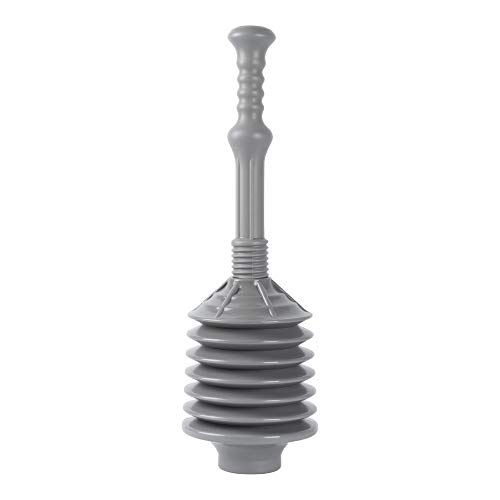
A bellows plunger replaces the cup with a ribbed chamber that collapses like an accordion, and the JS Jackson Supplies Professional Bellows is the category’s standard shape. Each stroke squeezes the chamber and drives its full volume of water through the outlet in one thrust, suiting dense clogs that shrug off a cup plunger’s smaller pushes. The outlet opening is 2-3/8 inches across, sized to seat into a toilet drain, and the maker shapes the lip so it does not fold back under pressure, a fold being the usual cause of splash-back with stiff plungers.
The construction is all polymer, with a 7-inch bellows body and an 11-inch non-absorbent handle, so the whole tool rinses clean and nothing soaks up bowl water. The handle unscrews from the head, which makes the head easy to soak on its own and lets the two pieces store in a shorter space. Two honest tradeoffs come with the design: the stiff chamber takes more arm effort per stroke than a soft rubber cup, and the bellows grooves need a deliberate rinse after use because they give residue places to sit.
Specs
- Body: accordion bellows chamber, about 7 inches, in durable polymer
- Outlet opening: 2-3/8 inch diameter, shaped to seat in toilet drains
- Lip: no-fold lip design, per the maker, to limit splash-back
- Handle: 11-inch non-absorbent handle; removes from the head for storage and soaking
- Construction: all-plastic build that rinses clean
- Model: 512 JSP3514GRY, grey, from JS Jackson Supplies
OXO Good Grips Toilet Plunger and Canister: The Tidy Holder Pick
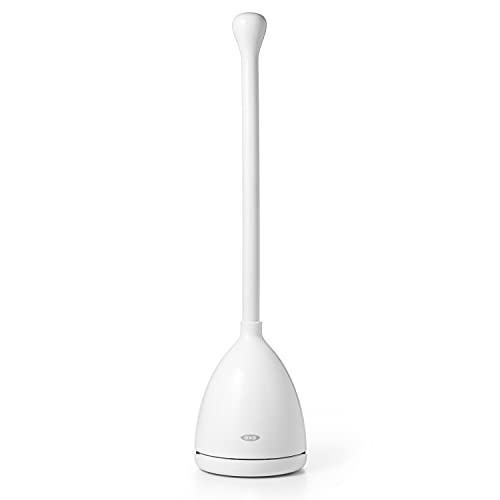
The OXO Good Grips set solves the storage half of the problem. The plunger itself is a flange design made for toilet outlets, with a plastic handle topped by a flat grip for palm pressure. What sets the set apart is the canister: OXO states that it opens automatically when you lift the plunger out and closes again when you set the plunger back, so the head stays hidden and never drips across the floor.
Inside the canister sits a drip tray that catches the water running off the head, and the canister’s design lets that water evaporate instead of pooling around the rubber. That matters for hygiene and for the head itself, since rubber stored wet ages faster. The canister’s long neck lets the whole unit be carried one-handed without touching the head end. The listing for this model, 12241700, confirms the set includes plunger and canister, in white, at about two pounds total. For a guest bathroom or a small powder room where the plunger lives in plain sight, this is the pick that keeps it presentable while staying within reach.
Specs
- Set: flange toilet plunger with matching storage canister
- Canister: opens when the plunger is lifted and closes when it is replaced, per the maker
- Drip tray: built into the canister to catch runoff and let it evaporate
- Handle: plastic with a flat top grip for palm pressure
- Model: OXO 12241700, white; item weight about 2 lb per the listing
- Use: listing specifies the plunger for toilets and porcelain surfaces
Clorox Toilet Plunger with Hideaway Caddy: The Compact Pick

Small bathrooms have no spare corner for a tall plunger, and the Clorox Hideaway set is built around that constraint. Each caddy in this set of two measures 6.5 by 6.5 inches at the base and 16.5 inches tall, a footprint that tucks into the narrow gap beside most toilet tanks, and the plunger inside carries a heavy-duty flange cup on a handle of about 15.5 inches. The shorter handle gives up some leverage compared with the full-length picks above, but it is why the set also fits under a sink or inside a shallow cabinet.
The caddy itself is a clamshell that, per the listing, opens automatically when the plunger is lifted out and closes when it is put back, with an internal drip tray to catch runoff and a non-skid rubber base that keeps the unit from sliding or tipping on tile. Because the linked listing is a set of two, it covers a two-bathroom home in one purchase, or keeps a spare in a utility closet. Buyers with one bathroom should know the single version exists under a separate listing. For apartments, rentals, and half baths where every inch is spoken for, this is the most storage-friendly way to keep a real flange plunger in the room.
Specs
- Pack: set of two plungers, each with its own hideaway caddy
- Caddy size: 6.5 x 6.5 x 16.5 inches each, per the listing
- Caddy: clamshell design that opens on lifting and closes on return, with an internal drip tray
- Base: non-skid rubber base to prevent sliding and tipping
- Cup: heavy-duty flange cup for toilet outlets
- Handle: about 15.5 inches with an ergonomic grip, per published data for this model line
- Model: Clorox 620050, white
Frequently Asked Questions
Why does my sink plunger barely work on the toilet?
A sink plunger is a flat cup made to seal against flat surfaces. A toilet outlet sits at the bottom of a curved trap and opens at an angle, so the flat cup seals poorly and most of each stroke moves air or splashes water. A flange, beehive, or bellows head reaches into the outlet and seals against it, which turns each stroke into water pressure through the trap.
How much water should be in the bowl before I start?
Enough to cover the plunger head completely, because the tool works by moving water, and a head working in air compresses the air instead of pushing the clog. If the bowl level is low, add water from a bucket. If the level is high and climbing toward the rim, wait for it to drain down before starting, and stop again if it climbs while you work.
Can I plunge after using a chemical drain cleaner?
No. Plunging agitates the bowl water and can splash the cleaner onto your skin, eyes, and the surrounding room. Chemical cleaners are also a poor match for toilet clogs, since they dilute through the bowl rather than concentrating on the blockage. If cleaner is already in the bowl, leave the plunger in the closet, follow the label directions, and call a plumber if the clog does not clear.
When should I stop plunging and get an auger or a plumber?
Give a well-sealed plunger fifteen to twenty firm strokes and a test flush. If nothing moves, a closet auger is the next step, since it reaches through the trap where a plunger only pushes water. Call a plumber when clogs repeat often, when other fixtures gurgle or back up at the same time, when you suspect a dropped object, or when water rises toward the rim despite waiting.
Conclusion
For most homes, the right answer is the plunger whose head matches the bowl. Older toilets with round outlets are well served by the classic stepped flange of the NEIKO 60166A, while newer high-efficiency bowls with oblong outlets point to the Korky BeehiveMAX and its telescoping handle. Households fighting frequent, dense clogs should look at the JS Jackson bellows, which moves the most water per stroke. If the plunger will live in sight, the OXO canister set keeps it covered and drip-free, and tight bathrooms are best matched by the compact Clorox Hideaway set. Whichever you choose, pair it with the technique above: water over the head, a slow first push, firm push-and-pull strokes, and the discipline to stop when the job belongs to an auger or a plumber.
More from Amazon
Programs that pair well with the guide above. Offers and eligibility are set by Amazon and may change.
Free shipping on eligible items, Prime Video and more. Eligible new members can start with a free trial.
Start a Prime free trialAd-free music streaming. Eligible new subscribers can start with a free trial.
Try Music Unlimited freeA Prime membership for ages 18-24 with a trial period. Eligibility is set by Amazon.
See Prime for Young AdultsAudiobooks and podcasts to listen to on the go. Eligible new members can start with a free trial.
Try Audible freeAs an Amazon Associate we earn from qualifying purchases.