Key takeaways
- Small garage or multipurpose room: a wall-mounted folding rack such as the Rogue RML-3W, provided you can anchor it securely to structural framing.
- Best all-around freestanding choice: the REP Fitness PR-5000, with a substantial footprint, 3-by-3-inch uprights and broad accessory compatibility.
- Budget-conscious home gym: the Titan T-3 Series Power Rack, which offers useful rack height and capacity without the price of premium modular systems.
- Maximum stability and versatility: a full-size 3-by-3-inch power rack with a 1-inch or 1.25-inch hole system, weight storage and a pull-up crossmember.
- Low-ceiling basement: a short rack around 72 inches tall, but check that its pull-up bar and your head clearance work before ordering.
The best home gym squat rack for most people is a 3-by-3-inch, 11-gauge steel power rack with adjustable safeties, but a folding rack suits small garages better while a full-height four-post rack wins for heavy, frequent training.
Our top picks

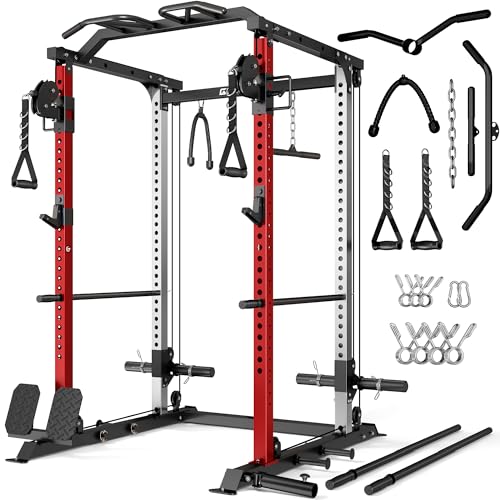

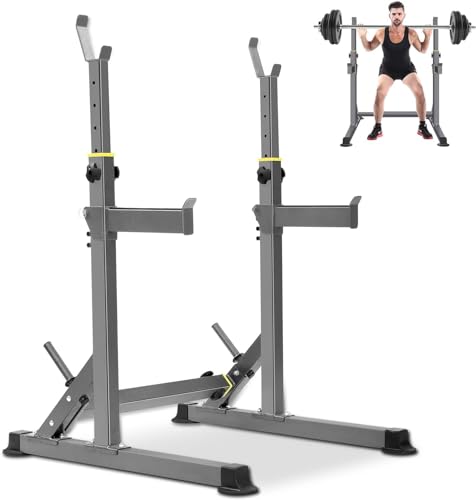
As an Amazon Associate we earn from qualifying purchases at no extra cost to you. Ratings are shown as listed on Amazon.
Quick picks by training space
- Small garage or multipurpose room: a wall-mounted folding rack such as the Rogue RML-3W, provided you can anchor it securely to structural framing.
- Best all-around freestanding choice: the REP Fitness PR-5000, with a substantial footprint, 3-by-3-inch uprights and broad accessory compatibility.
- Budget-conscious home gym: the Titan T-3 Series Power Rack, which offers useful rack height and capacity without the price of premium modular systems.
- Maximum stability and versatility: a full-size 3-by-3-inch power rack with a 1-inch or 1.25-inch hole system, weight storage and a pull-up crossmember.
- Low-ceiling basement: a short rack around 72 inches tall, but check that its pull-up bar and your head clearance work before ordering.
What separates the best home gym squat racks?
Four measurements determine whether a rack is convenient or frustrating: footprint, height, steel size, and rated capacity. A rack that technically fits may still be unusable if you cannot load a barbell without hitting a wall, perform pull-ups without touching the ceiling, or open its folding arms around parked equipment.
For most lifters, 3-by-3-inch, 11-gauge steel is the useful middle ground. Smaller 2-by-2-inch uprights can be entirely adequate for moderate loads and usually cost less, while 3-by-3-inch racks provide more rigidity and a larger ecosystem of attachments. Published capacity is only meaningful when the rack is assembled on a level surface and, for folding or half racks, properly bolted down.
Head-to-head comparison
| Rack type or example | Approx. footprint | Typical height options | Steel and capacity | Assembly difficulty | Best fit |
|---|---|---|---|---|---|
| Wall-mounted folding rack, such as Rogue RML-3W | About 21–24 in deep when folded; roughly 43–45 in open | 90 or 108 in versions are common | 3 x 3 in, 11-gauge steel; roughly 1,000 lb class when correctly anchored | Moderate to difficult; wall layout is critical | Small garages and rooms that need clear floor space |
| Half rack | About 48–55 in wide x 45–50 in deep | 72–93 in | Usually 2 x 2 or 3 x 3 in steel; about 500–1,000 lb class | Moderate; often requires stabilizer or floor anchoring | Efficient barbell training with easier walk-in access |
| Full power rack, such as REP PR-5000 | About 40–50 in wide x 40–50 in deep, excluding lifting space | 80–93 in common | 3 x 3 in, 11-gauge steel; approximately 1,000 lb class | Moderate to difficult; two-person assembly recommended | Large home gyms and frequent heavy training |
| Budget power rack, such as Titan T-3 | About 45–50 in wide x 45–50 in deep | 72, 82 or 91 in versions are typical | 2 x 3 in, 11-gauge steel; commonly rated around 1,100 lb | Moderate; fit and finish may require more adjustment | Value-focused lifters with a dedicated corner |
Dimensions vary by configuration, pull-up bar, plate storage and spotter-arm selection, so treat these as planning figures rather than a substitute for the manufacturer’s current drawing. Leave at least 24 inches of clearance on each side of a barbell and roughly 36 inches in front of the rack for loading plates and stepping back to squat.
Best choice for a small garage: folding wall rack
A folding rack uses the least permanent floor area. When the uprights fold toward the wall, you can reclaim the bay for a vehicle, workbench or storage. The trade-off is installation: the rack must be attached to studs, masonry or another structure rated for the forces involved. Drywall anchors alone are not suitable.
Measure more than the rack’s folded depth. A loaded bar needs room to rotate into the J-cups, and folding arms need a clear path. A 90-inch rack may fit a garage comfortably but leave insufficient overhead clearance for pull-ups. If the ceiling is below about 96 inches, choose a shorter model and accept reduced pull-up height, or use a separate low-profile pull-up solution.
Best choice for a large home gym: full power rack
A full rack is the easiest recommendation when space is available. Its four uprights enclose the bar, so the safety pins or straps can catch a failed squat or bench press from several positions. It also provides more attachment points for a lat pulldown, dip handles, cable columns and weight storage.
The REP PR-5000 and comparable modular racks are aimed at lifters who expect to add equipment over time. Their 3-by-3-inch uprights and dense hole patterns support many accessories, but they are expensive and heavy. A four-post rack can weigh several hundred pounds before plates are added, so assemble it near its final location and protect concrete or finished flooring with appropriate mats.
Where the Titan T-3 makes sense
The Titan T-3 is attractive when your budget favors capacity over refinement. Its 2-by-3-inch uprights offer a strong platform for squats, presses and rack pulls, and its shorter height options help in basements. It generally costs less than premium 3-by-3-inch modular racks, with typical market pricing in the mid-hundreds before accessories and shipping.
The compromises are less uniform fit and finish, fewer cross-compatible accessories than the most established 3-by-3-inch ecosystems, and a greater need to check bolt alignment during assembly. For occasional training, that may be an excellent trade. For a commercial-style setup or frequent accessory expansion, the larger modular system is easier to live with.
Decision matrix: match the rack to your situation
| Your situation | Recommended format | Minimum practical specification | Why |
|---|---|---|---|
| Training once or twice weekly, moderate loads | 2 x 2 or 2 x 3-inch power rack | 500 lb or higher rated capacity, adjustable safeties | Avoids paying for unused modular features |
| Heavy squats and bench pressing three or more times weekly | Bolted full rack or anchored folding rack | 3 x 3-inch, 11-gauge steel; 1,000 lb class | Improves rigidity and safety-margin headroom |
| Garage must remain usable for a car | Wall-mounted folding rack | Folded depth near 24 inches; compatible wall structure | Restores floor space between sessions |
| Ceiling below 8 feet | Short power rack or half rack | Rack height at least 4 inches below the ceiling | Allows assembly and prevents pull-up interference |
| Planning cables and many attachments | 3 x 3-inch modular power rack | Compatible hole spacing and accessory ecosystem | Reduces replacement costs as the gym expands |
Assembly, sizing and ownership realities
Plan on two to four hours for a basic freestanding rack and longer for a folding or cable-equipped system. The difficult parts are not usually tightening bolts; they are positioning heavy uprights, keeping the frame square and finding structural anchors. Assemble loosely, level the frame, measure the diagonals, and tighten progressively. A rack that is out of square can make safeties bind and attachments sit unevenly.
Use a simple space calculation before buying. If the rack is 48 inches deep, the barbell is 7 feet long, and you want 36 inches of loading clearance in front, reserve at least 84 inches of depth from the wall. Add room behind the rack if it is not against a wall. For a 90-inch-tall rack in an 8-foot room, the nominal gap is only 6 inches; that may be enough for assembly but not for a tall pull-up bar or comfortable overhead movement.
The parts that wear first are usually J-cup UHMW-PE liners, safety-strap edges, pin coatings, cable components and the rubber feet—not the steel uprights. Replace damaged liners before metal contacts the bar. Inspect bolts every few months, especially on folding racks, and look for wall-anchor movement, cracked welds, stretched straps and rust. Wipe chalk and sweat from painted surfaces, keep bare metal dry, and do not store a barbell permanently on a rack if the contact point is damaging the knurling.
Bottom line
Choose a folding wall rack when floor space is the deciding constraint, a budget 2-by-3-inch rack when cost matters most, and a 3-by-3-inch full power rack when stability, accessories and long-term expansion matter more than footprint. Before comparing brands, confirm the rack height, open and folded depth, anchor requirements, hole spacing, safety type, and the manufacturer’s capacity conditions. Those details determine whether the rack fits your home and your training—not the headline weight rating alone.