Key takeaways
- Capacity and turntable: Capacity helps compare broad size classes, but the turntable sets a practical limit on round plates and bowls. Measure your largest routinely used dish across its widest point, including handles.
- Wattage: Moving from 1,000 W to 1,200 W is a 20% increase in rated output, not a promise that every meal finishes 20% sooner. Food shape, starting temperature, and pauses for stirring also affect total time.
- Heating consistency: Inverter designs can maintain lower power more continuously, while conventional microwaves often alternate between full-power bursts and pauses. Neither eliminates the need to stir or rotate food, especially in dense or uneven portions.
- Controls and sensors: One-touch presets are convenient, but manual time and power settings are more predictable for familiar recipes. Sensor programs work best with vented, microwave-safe containers and portions within the manufacturer’s guidance.
- Noise: Fan and turntable noise varies by model and task. A cooling fan may continue briefly after cooking; a steady hum is different from new rattling or grinding, which can indicate a misseated turntable or roller ring.
- Counter space: Include clearance behind and above the appliance, space to open its door, and room to lift hot dishes out safely. A microwave that fits the counter but blocks a cabinet or cooking zone is not a good fit.
Best countertop microwaves: quick picks
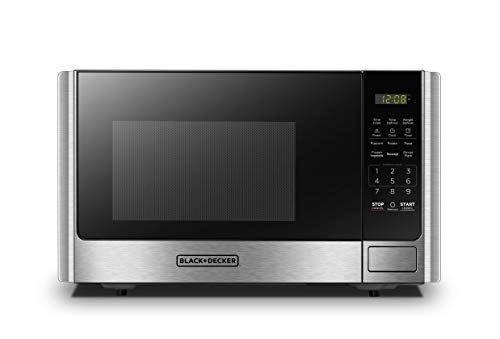
The best countertop microwave for fast, even cooking is a 1,000–1,200-watt model with an interior large enough for your usual dishes, a turntable that fits them, and sensor reheat if you often warm leftovers. For compact kitchens, prioritize external width and depth over a big advertised capacity; for family-size plates or multiple servings, look at 1.2–2.2 cubic feet and a turntable around 13–16 inches.
Among established options, the Panasonic NN-SN67KS is a strong all-around choice, the Toshiba EM131A5C suits smaller budgets and counters, and the Breville Smooth Wave is a more premium pick for quieter operation and more controlled heating. Exact dimensions and features can vary by model suffix and market, so confirm the manufacturer’s specification sheet before buying.
Our top picks



As an Amazon Associate we earn from qualifying purchases at no extra cost to you. Ratings are shown as listed on Amazon.
At a glance
| Model | Capacity | Output power | Approx. exterior size (W × D × H) | Best fit |
|---|---|---|---|---|
| Panasonic NN-SN67KS | 1.2 cu. ft. | 1,200 W | 20.7 × 15.8 × 12.2 in. | Fast everyday cooking in a mid-size footprint |
| Toshiba EM131A5C | 1.2 cu. ft. | 1,100 W | 20.5 × 17.1 × 12.8 in. | Value-oriented reheating and defrosting |
| Breville Smooth Wave (BMO850) | 1.2 cu. ft. | 1,250 W | About 20.5 × 17.5 × 12.8 in. | Premium controls and a quieter-use focus |
| Panasonic NN-SN97JS | 2.2 cu. ft. | 1,250 W | About 23.9 × 19.4 × 14.0 in. | Large dishes and bigger households |
Dimensions are approximate and can differ by regional version. Capacity describes the full cavity, not the usable flat area: the turntable diameter, interior shape, and door opening determine what fits in practice. Allow the manufacturer’s specified ventilation clearance around the unit.
Which one should you choose?
Best all-around: Panasonic NN-SN67KS
With 1,200 watts in a 1.2-cubic-foot cavity, the NN-SN67KS balances cooking speed with a footprint that is more manageable than a large family-size microwave. Panasonic’s inverter technology is designed to deliver more continuous lower-power cooking than conventional models that cycle full power on and off. That can help with delicate defrosting and simmering, where aggressive bursts may heat edges before the center.
Choose it if you use your microwave most days, want more power than a basic compact model, and have room for a unit roughly 21 inches wide and 16 inches deep. Measure the counter depth carefully: the listed appliance depth does not include extra clearance or necessarily account for how far the door or handle projects.
Best value for a smaller household: Toshiba EM131A5C
The Toshiba offers 1.2 cubic feet and 1,100 watts, plus sensor cooking and a dedicated sensor-reheat function. Its automatic programs are useful when you want the oven to estimate cooking time from the moisture released by food, rather than entering a time yourself. Sensor results still depend on portion size, container shape, food temperature, and whether the vent is covered, so check the first few cycles and adjust your routine.
This model makes sense for daily reheating, beverages, and ordinary frozen meals without paying for premium features. Its depth is relatively substantial for its capacity, so it may be a better counter fit by width than by front-to-back space.
Best premium option: Breville Smooth Wave
The Smooth Wave combines 1,250 watts with sensor programs and controls intended to make common tasks—such as reheating, softening, and defrosting—less dependent on guesswork. It is worth considering if you regularly use a microwave for a variety of foods and value more refined controls and a quieter-use design. It remains a full-size countertop appliance, not a space-saving pick, and its higher price is harder to justify if you mainly warm coffee or an occasional plate.
Best for large dishes: Panasonic NN-SN97JS
The NN-SN97JS provides 2.2 cubic feet and 1,250 watts for larger plates, family portions, and cookware that smaller cavities cannot accommodate. The trade-off is substantial: at roughly 24 inches wide and 19 inches deep, it needs a generous, sturdy counter and enough clearance for ventilation. Check the turntable diameter and door opening against your largest dish; a big capacity number alone does not guarantee a particular casserole will fit.
What matters more than the headline wattage
- Capacity and turntable: Capacity helps compare broad size classes, but the turntable sets a practical limit on round plates and bowls. Measure your largest routinely used dish across its widest point, including handles.
- Wattage: Moving from 1,000 W to 1,200 W is a 20% increase in rated output, not a promise that every meal finishes 20% sooner. Food shape, starting temperature, and pauses for stirring also affect total time.
- Heating consistency: Inverter designs can maintain lower power more continuously, while conventional microwaves often alternate between full-power bursts and pauses. Neither eliminates the need to stir or rotate food, especially in dense or uneven portions.
- Controls and sensors: One-touch presets are convenient, but manual time and power settings are more predictable for familiar recipes. Sensor programs work best with vented, microwave-safe containers and portions within the manufacturer’s guidance.
- Noise: Fan and turntable noise varies by model and task. A cooling fan may continue briefly after cooking; a steady hum is different from new rattling or grinding, which can indicate a misseated turntable or roller ring.
- Counter space: Include clearance behind and above the appliance, space to open its door, and room to lift hot dishes out safely. A microwave that fits the counter but blocks a cabinet or cooking zone is not a good fit.
Pick by kitchen and routine
| Your situation | Look for | Why |
|---|---|---|
| Very limited counter space | A compact 0.7–1.0 cu. ft. model, usually around 700–1,000 W | Smaller exterior dimensions matter more than extra capacity, but confirm your plate fits the turntable. |
| Daily meals for one or two | About 1.1–1.3 cu. ft. and 1,000–1,200 W | A useful balance of usable space, speed, and counter footprint. |
| Frequent leftovers and mixed portions | Sensor reheat, clear power controls, and at least 1,000 W | Sensors reduce time-entry guesswork; stirring remains important for even temperature. |
| Large platters or family portions | At least 1.6 cu. ft.; check turntable and exterior depth | Dish clearance and counter support can be limiting before wattage is. |
| Mostly occasional snacks | A simple 700–1,000 W model with mechanical or basic digital controls | Paying extra for many presets or premium sensor features may bring little practical benefit. |
Fit and upkeep: two details that prevent regret
Do a three-measurement check. Measure the available counter width, usable depth, and vertical clearance. Then compare those with the microwave’s exterior dimensions and required ventilation gaps. Separately measure your largest plate and compare it with the turntable diameter. For example, a 12-inch plate needs a turntable larger than 12 inches to rotate without touching the walls; leave a little extra room for irregular rims and handles.
Keep the turntable assembly clean and seated. Spills under the glass tray can cause odors, uneven rotation, and rattling. Remove the tray and roller ring according to the manual, wash them with mild soap, dry them, and reinstall them in the correct position. Avoid running the oven empty, blocking vents, or using metal cookware unless the manufacturer explicitly permits it. These habits help protect the cavity and make the appliance quieter in normal use.
For most kitchens, a 1.1–1.3-cubic-foot microwave around 1,100–1,200 watts is the most versatile starting point. Choose the Panasonic NN-SN67KS for a strong all-around balance, the Toshiba EM131A5C for useful sensor features at a value-oriented level, or step up to the larger Panasonic NN-SN97JS only when your dishes and counter genuinely need the extra space.