
Key takeaways
- Choosing 6 volt batteries for a travel trailer or motorhome is not like grabbing a single 12 volt unit off a shelf.
Choosing 6 volt batteries for a travel trailer or motorhome is not like grabbing a single 12 volt unit off a shelf. Six volt golf-cart-style cells (the GC2 case size) are wired in pairs to make a 12 volt house bank, and the whole setup is only as good as the weakest battery in the series string. That means the decision is really about amp-hour capacity, plate chemistry (flooded versus AGM), how many batteries you need to buy at once, and whether the case fits the tray you already have.
This roundup is for RVers who boondock, run an inverter for a coffee maker or laptop, or want solar to refill a bank that carries them through a few cloudy days. It is also for owners replacing a worn-out pair and trying to decide whether to stay with flooded cells or step up to sealed AGM. Everything below is judged from the listing titles for 2026 shopping, so use it to narrow the field and then confirm dimensions and terminal type against your battery box.
Quick Picks
Our top picks




As an Amazon Associate we earn from qualifying purchases at no extra cost to you.
| Product | Best for | Key spec from the title |
|---|---|---|
| VMAX XTR6-235 | Sealed, maintenance-free bank | 235Ah, 1.62kWh each, 500 min reserve capacity, AGM, GC2 |
| Trojan T-125 | Large flooded-cell bank | 6V, 240Ah, sold as a 4 pack |
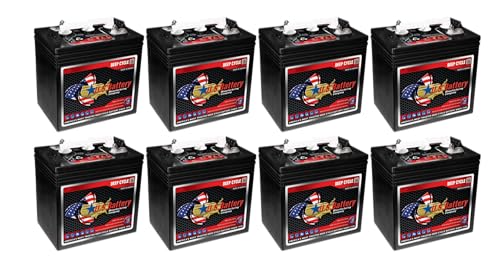
| US Battery US1800XC2 | Replacing T-605 batteries | 6V, 208Ah, BCI Group GC2, sold as sets |
| Casil 6V 220Ah | AGM replacement, solar and RV mix | 220Ah AGM deep cycle |
| Trojan T605 | Mid-capacity flooded bank | 6V, 210Ah, 4 pack |
| Trojan T-105 GC2 | Traditional two-battery swap | 6V, 225Ah, flooded lead acid, pair |
| Interstate 6V 210Ah | AGM for golf cart size trays | 210Ah AGM, GC2, deep cycle |
How to Choose
Flooded versus AGM
Flooded lead acid cells such as the Trojan T-105 are the traditional choice because they tolerate repeated deep discharges and cost less per amp-hour, but they need distilled water top-ups and a vented battery box. AGM batteries are sealed, do not need watering, and can sit in a compartment that is awkward to reach. If you will not open the box every month or two, lean toward AGM and accept the higher entry cost.
Capacity and series wiring
Two 6 volt batteries in series give 12 volts at the capacity of one battery, so a pair of 225Ah units is a 225Ah house bank. Four batteries wired as two series strings in parallel double that figure. Look for 200Ah or more per battery if you run an inverter, and remember the listing title tells you the rating of one battery, not the bundle.
Pack quantity and what is in the box
Several listings here are sold as a 4 pack, an 8-set, or a quantity of two. Check that the count matches your plan: a standard single-string bank needs two, a larger bank needs four. Buying the wrong multiple is the most common way to end up with leftover batteries or a bank that is one cell short.
Fit, terminals, and what to ignore
The GC2 group designation means a common golf-cart case size, but tray depth, hold-down hardware, and terminal style still vary between brands. Measure your compartment before ordering. Ignore marketing phrases about use in golf carts, floor scrubbers, or marine service; they describe the cell family, not how well it suits an RV. Budget models can cut corners with thinner plates or loose capacity labeling, so favor listings that publish a clear Ah figure and a reserve capacity number.
The 7 Best Options
VMAX XTR6-235
The VMAX XTR6-235 is a 6 volt, 235Ah Group GC2 AGM deep cycle battery, and the title lists 1.62kWh of energy per battery along with a 500 minute reserve capacity. It suits RVers who want a sealed, no-watering bank and are building a pair for a typical travel trailer. The listing is sold in a quantity of two, which maps neatly to a single series string.
- Strength: the 235Ah rating is among the highest capacities in this group.
- Strength: AGM construction means no watering and fewer venting concerns.
- Trade-off: sealed AGM generally costs more up front than flooded cells of similar size.
Skip it if you already own a flooded charger profile you cannot change or if your battery tray is tight on height.
Trojan T-125
The Trojan T-125 is listed as a 6 volt, 240Ah deep cycle battery sold in a 4 pack. That count suits owners planning a two-string bank for a larger fifth wheel or a solar-heavy rig with plenty of space. At 240Ah it posts the largest capacity figure of any single battery in this roundup.
- Strength: 240Ah per battery is the top listed capacity here.
- Strength: the four-battery quantity covers a full bank in one order.
- Trade-off: the title does not state AGM, so plan for the maintenance routine of a flooded design.
Skip it if you only need a single pair or have no room for four batteries.
US Battery US1800XC2
The US1800XC2 is a 6 volt, 208Ah BCI Group GC2 deep cycle battery, marketed for golf cart, solar, marine, RV, and industrial use, and the title says it replaces the T-605. It fits owners with an older T-605 bank who want a like-for-like swap. The listing is offered in sets of 4 and sets of 8, so it also suits larger off-grid arrays.
- Strength: a clear replacement path for T-605 installations.
- Strength: set quantities scale from a modest RV bank to a bigger storage array.
- Trade-off: at 208Ah it sits below several rivals on capacity.
Skip it if you want the maximum amp-hours per battery or only need a pair.
Casil 6V 220Ah
The Casil is a 6V, 220Ah deep cycle AGM replacement battery aimed at RV, solar energy storage, marine, golf carts, floor scrubbers, and off-grid power. It makes sense for buyers who want a sealed battery in the 220Ah class without stepping all the way up to the largest cells.
- Strength: sealed AGM design avoids watering chores.
- Strength: 220Ah lands comfortably above the 200Ah comfort line for inverter use.
- Trade-off: the title gives no reserve capacity figure, so comparing runtime to the VMAX is harder.
Skip it if you prefer a brand with a long track record in deep cycle flooded cells or need a published reserve rating.
Trojan T605
The Trojan T605 is a 6 volt, 210Ah deep cycle battery listed as a 4 pack. It is a straightforward pick for owners whose existing bank already uses this model and who want to replace every battery together, which keeps the string balanced.
- Strength: 210Ah is a solid middle-of-the-range capacity.
- Strength: the 4 pack lets you refresh a two-string bank in one go.
- Trade-off: the title does not specify AGM or flooded construction, so confirm that before ordering.
Skip it if you want a pair only, or if you need more than 210Ah per battery.
Trojan T-105 GC2
The Trojan T-105 GC2 is a 6V, 225Ah deep cycle flooded lead acid battery, sold as two. It is the classic pick for a single series pair in a motorhome or trailer where the owner is comfortable adding distilled water on a schedule.
- Strength: 225Ah in a two-battery quantity matches the common house bank layout.
- Strength: flooded lead acid chemistry is familiar to most RV service shops.
- Trade-off: flooded cells need regular watering and proper venting.
Skip it if your battery box is sealed or sits in a living space where venting is a worry.
Interstate 6V 210Ah AGM
The Interstate is a 6V, 210Ah AGM golf cart battery in the GC2 size with deep cycle construction. It is aimed at buyers who want a sealed battery from a name found at many local retailers, which can simplify warranty questions and replacements down the road.
- Strength: sealed AGM means no watering.
- Strength: GC2 sizing fits standard 6 volt trays.
- Trade-off: 210Ah is mid-pack on capacity.
Skip it if you want the highest amp-hours per dollar or a larger bank in one order.
Taken together, the seven listings split into two camps. The VMAX, Casil, and Interstate entries are sealed AGM designs for owners who want to install and forget, while the Trojan and US Battery entries follow the classic deep cycle format that rewards a bit of routine care. Capacity runs from 208Ah to 240Ah per battery in this group, so the gap between the smallest and largest is narrower than the gap between chemistries. That is why the maintenance question usually matters more than a few extra amp-hours when you are choosing a bank for the road.
One more practical point: the listing title describes the battery, not the cables, hold-downs, or charger. Budget for matching cable gauge, a charger with the right profile for your chemistry, and a battery disconnect, since those parts decide whether the bank performs the way the label suggests.
Which One Fits Your Situation
Weekend camper with a modest inverter
A pair of Interstate 6V 210Ah AGM batteries covers lights, a water pump, and a laptop without any maintenance. Sealed construction suits someone who only opens the battery box a few times a season.
Full-time boondocker with solar
The VMAX XTR6-235 gives the sealed route with a high capacity rating and a published reserve time. If you have space for a larger string, the Trojan T-125 4 pack offers the highest per-battery capacity here, provided you will handle flooded cell upkeep.
Replacing an older bank
If the current bank uses T-605 batteries, the US Battery US1800XC2 is named in its title as a replacement, and the Trojan T605 is the same model family. Replace the whole string at once rather than mixing old and new batteries.
Traditional two-battery setup on a tight budget
The Trojan T-105 GC2 pair keeps the classic flooded design at a mid-range outlay. Confirm you have a vented box and a charger that supports flooded profiles.
Common Mistakes
- Mixing old and new batteries in one string, which drags the new ones down to the age of the worst.
- Ordering a 4 pack or 8-set when the plan calls for a single pair, or the reverse.
- Forgetting that a flooded battery needs venting and watering, then placing it in a sealed compartment.
- Treating the voltage as the capacity: 6 volts is the cell rating, and the Ah figure tells you how long it runs.
- Skipping a tray measurement, then discovering the GC2 case or hold-down hardware does not fit.
Related guides
- Helping Hands Soldering Station With Magnifier
- Bench Power Supply For Electronics Hobbyists
- Is 8000Hz Polling Rate Worth It For 144Hz Monitor
Frequently Asked Questions
Why use two 6 volt batteries instead of one 12 volt?
Golf-cart-style 6 volt batteries generally pack more capacity into heavy plates. Wiring two in series gives 12 volts at the capacity of a single battery, which is why many RVers favor them for deep daily cycling.
Is AGM always better than flooded?
Not always. AGM is sealed and needs no watering, but flooded cells such as the Trojan T-105 can offer high capacity for less. The right choice depends on whether you will keep up with maintenance.
How many amp-hours should an RV bank have?
For simple weekend trips a pair around 200Ah is a workable starting point. If you run an inverter or live off-grid, look at 220Ah or more per battery and consider a four-battery bank.
Can I add a new 6 volt battery to an older bank?
It is better to replace the whole string. Differences in age and capacity cause uneven charging, and the weakest battery limits the whole bank.


