Key takeaways
- Five network integrated amplifiers with built-in streaming compared: Yamaha, Denon, Marantz, Bluesound and WiiM picks for stereo music systems at home.
The real decision with a network integrated amplifier is not how it sounds on day one, but which streaming platform you are willing to live inside for the next decade. The amplifier, the app and the multiroom ecosystem arrive as a single package: pick HEOS, MusicCast, BluOS or the WiiM platform and every future speaker or second-room player has to speak the same language. Power output, phono stages and TV inputs all matter, but they are secondary to that one commitment.
This roundup is for stereo listeners who want one box between their speakers and everything they play: streaming services, a turntable, the TV and a local file library. Every model below is a two-channel integrated amplifier with Wi-Fi or Ethernet streaming built in, chosen from its Amazon listing, where the model name, power rating and input set on the product page decided the shortlist.
Quick Picks
As an Amazon Associate we earn from qualifying purchases
| Product | Best for | Key spec from title |
|---|---|---|
| Yamaha R-N800A | Vinyl and streaming in one full-size system | 100 W per channel with YPAO room calibration |
| Denon PMA-900HNE | Turntables with moving-coil cartridges | HEOS streaming with MM and MC phono stage |
| Marantz MODEL 40n | TV and music sharing one pair of speakers | 70 W Class AB power with HDMI ARC |
| Bluesound POWERNODE | Compact multiroom stereo setups | 80 W per channel on the BluOS platform |
| WiiM Amp Ultra | Small rooms built around a TV and streaming | 100 W per channel with touchscreen control |
How to Choose
Choose the streaming platform first
Every amplifier here streams, but each one locks you into a different control app and multiroom family. HEOS covers the Denon and the Marantz, MusicCast is Yamaha-only, BluOS runs across Bluesound and NAD, and WiiM uses its own WiiM Home app. Players from rival platforms will not group together for synchronized playback, so a second-room speaker bought later must match the amplifier you buy now. Check that your main service is supported natively, and think about whether you prefer controlling music from the service’s own app through a Connect feature or from the amplifier maker’s app.
Match amplifier power to your speakers
Wattage headlines only mean something next to the impedance used for the rating and the sensitivity of your speakers. A sensitive bookshelf speaker in a small room will play loudly on the Denon’s 50 watts per channel, while a low-sensitivity floorstander in an open-plan space will use everything the Yamaha or WiiM can give. Look for a rating into 4 ohms as well as 8, because many speakers dip well below their nominal impedance. If your speakers are known to be demanding, current delivery and a 4-ohm figure matter more than a big 8-ohm number.
Count your wired sources before you buy
Streaming hides a hard truth: these five amplifiers differ sharply on old-fashioned inputs. Only the Yamaha, Denon and Marantz have a phono stage for a turntable, and only the Denon accepts a moving-coil cartridge. The Bluesound and the WiiM have no phono input at all, so a turntable needs its own built-in phono stage. Television is the other dividing line: the Marantz, Bluesound and WiiM take TV audio over HDMI ARC or eARC, while the Yamaha and Denon rely on an optical cable. List every source you own today, then match the input set to that list.
Room correction and subwoofer control
Two amplifiers here measure your room: the Yamaha runs its YPAO calibration with a microphone, and the WiiM applies RoomFit EQ from its app. The others leave placement and tone controls to you, which is fine in a treated room and limiting in a bare one. Subwoofer support also varies. The Marantz offers a subwoofer pre-out with an adjustable low-pass filter, the Bluesound sets its crossover inside the BluOS app, and the Yamaha and Denon provide a plain subwoofer output. If a sub is part of the plan, adjustable bass management is worth more than extra watts.
The 5 Best Options
Yamaha R-N800A

The R-N800A is the traditionalist’s network amplifier: a full-width chassis with tone controls, a phono input and a proper remote, wrapped around Yamaha’s MusicCast streaming platform. Its YPAO room calibration is the feature rivals skip, using a microphone to tame the boom that comes from speakers pushed against a wall. With 100 watts per channel and an ESS SABRE DAC, it suits a main living-room system where vinyl, streaming and a CD collection all get regular play, and where the speakers deserve a calibration routine rather than guesswork.
Specs
- 100 W per channel into 8 ohms
- ESS SABRE ES9080Q DAC, 32-bit/384 kHz
- MusicCast streaming over Wi-Fi and Ethernet, plus AirPlay 2 and Bluetooth
- YPAO R.S.C. automatic room calibration with microphone
- Phono input for turntables and USB DAC input for computers
- Speaker A/B switching and subwoofer output
Best for: A main-room stereo system mixing vinyl, streaming and room calibration
Watch out for: No HDMI input, so the TV connects by optical cable; the full-width chassis needs real shelf depth
ASIN: B0CH23MZZN
Denon PMA-900HNE

Vinyl listeners get the most from the PMA-900HNE, because it is the only amplifier in this group whose phono stage handles both moving-magnet and moving-coil cartridges. Around that turntable-friendly core, Denon builds HEOS streaming, a generous set of digital inputs and playback of hi-res files from a USB drive or the network. The 50-watt rating looks modest on paper, yet the Advanced High Current design is aimed at control rather than headline numbers. Choose it when records come first and streaming is the second source, not the other way round.
Specs
- 50 W per channel into 8 ohms, 85 W per channel into 4 ohms
- HEOS Built-in streaming over Wi-Fi and Ethernet
- AirPlay 2, Bluetooth and Alexa voice control
- Phono input with MM and MC equalizer
- Three optical and one coaxial digital input, PCM up to 192 kHz/24-bit
- USB-A playback of FLAC, WAV, ALAC and DSD files
- Subwoofer pre-out and speaker A/B terminals
Best for: Turntable-first systems, including moving-coil cartridges
Watch out for: No HDMI ARC, so TV sound arrives over optical; 50 watts can run short in large rooms with insensitive speakers
ASIN: B0B3M1W4FG
Marantz MODEL 40n

The MODEL 40n is built for the room where the television and the hi-fi share one pair of speakers. Its HDMI ARC input lets the TV remote control volume through the stereo system, while the Class AB amplifier section with Marantz HDAM circuitry keeps music as the priority rather than an afterthought. HEOS streaming, an MM phono stage with Marantz Musical Phono EQ and a subwoofer output with an adjustable crossover round out a specification aimed squarely at a single, do-everything living-room system. This listing is the silver finish.
Specs
- 70 W per channel into 8 ohms, Class AB with HDAM-SA3 circuitry
- HEOS Built-in streaming over Wi-Fi and Ethernet
- AirPlay 2 and Bluetooth
- HDMI ARC input for TV sound
- Marantz Musical Phono EQ, MM phono input
- ESS ES9016 DAC, hi-res audio up to 24-bit/192 kHz over network and USB
- Subwoofer pre-out with adjustable low-pass filter
Best for: One stereo system that handles both TV sound and serious music listening
Watch out for: The phono stage is MM only, with no moving-coil support; confirm the silver finish on this listing is the one you want
ASIN: B09VQQ7KK1
Bluesound POWERNODE

The POWERNODE shrinks the network amplifier to a compact box that hides on a shelf or beside the TV, yet still drives speakers with 80 watts per channel of HybridDigital amplification. Everything runs through the BluOS app, which is the draw for anyone planning multiroom audio: add Bluesound speakers or another BluOS component later and they group together. HDMI eARC covers TV duties, and two-way Bluetooth can send sound to wireless headphones at night. What it deliberately leaves out is a phono stage, so vinyl needs help elsewhere.
Specs
- 80 W per channel HybridDigital amplification
- BluOS streaming platform with multiroom grouping
- HDMI eARC input for TV audio
- Dual-band Wi-Fi and Gigabit Ethernet, plus AirPlay 2
- Bluetooth 5.0 aptX HD, two-way
- 32-bit/384 kHz DAC and USB-A input for local files
- Subwoofer output with crossover set in the BluOS app
Best for: Compact stereo systems that will grow into a BluOS multiroom setup
Watch out for: No phono input, so a turntable needs a built-in or external phono stage; no display, so control lives in the app
ASIN: B0937MJJ2R
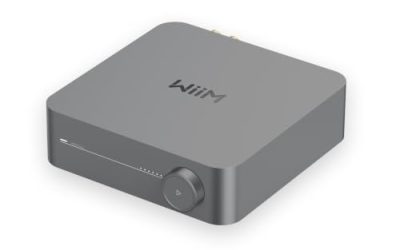
WiiM Amp Ultra
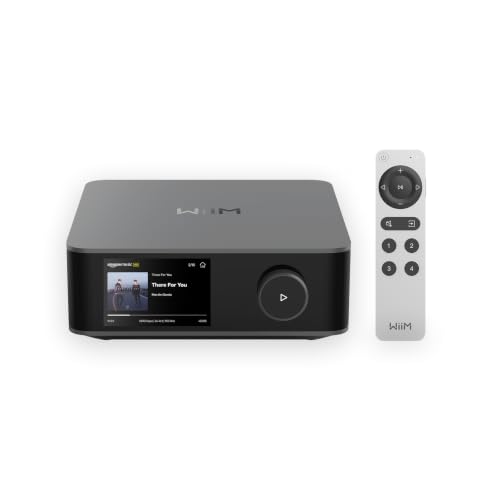
The Amp Ultra is the small-room answer: a compact streaming amplifier with a color touchscreen on the front, a voice remote in the box and 100 watts per channel behind it. WiiM’s RoomFit feature measures the room through the app and adjusts the EQ, which helps in the apartments and spare rooms where this amplifier will usually live. Streaming runs over Wi-Fi 6E or Ethernet with Spotify Connect, TIDAL Connect and Chromecast built in, and HDMI ARC folds TV sound into the same system without a soundbar.
Specs
- 100 W per channel into 8 ohms
- ESS ES9039Q2M DAC with dual TI TPA3255 amplifier chips
- 3.5-inch touchscreen display, Voice Remote 2 included
- RoomFit room correction EQ
- HDMI ARC, optical and RCA line inputs
- Wi-Fi 6E and Ethernet streaming with Spotify Connect, TIDAL Connect and Chromecast
Best for: Apartments and small rooms wanting TV sound and streaming in one compact box
Watch out for: No AirPlay 2 support and no phono input, so a turntable needs its own phono stage to use the line input
ASIN: B0F995W2NG
Which One Fits Your Situation
You play records most evenings
Start with the Denon PMA-900HNE if your cartridge is a moving-coil design, because it is the only phono stage here that accepts one. Moving-magnet owners can also take the Yamaha R-N800A for its extra power and room calibration, or the Marantz MODEL 40n if the same system must handle the television. The Bluesound and WiiM only join a vinyl setup when the turntable carries its own phono stage.
The TV shares your speakers
Pick the Marantz MODEL 40n for a classic full-size system, the Bluesound POWERNODE for BluOS multiroom plans, or the WiiM Amp Ultra for a compact room; all three take TV audio over HDMI and let the TV remote run the volume. The Yamaha and Denon still work with a television through an optical cable, but volume then lives on the amplifier’s own remote.
You plan to add more rooms later
Your amplifier choice fixes your multiroom platform, so decide it now. The POWERNODE opens the BluOS family of speakers and components, the Denon and Marantz join a HEOS household, the Yamaha speaks MusicCast, and the WiiM groups with other WiiM devices. None of these ecosystems group natively with each other, so a house that starts with one brand should keep buying that brand.
Space is tight and the budget is one box
The WiiM Amp Ultra and the Bluesound POWERNODE are the two compact options, both small enough for a media unit shelf. The WiiM adds a touchscreen, a voice remote and room correction; the Bluesound counters with the deeper BluOS multiroom ecosystem and headphone-friendly two-way Bluetooth. Measure your shelf either way, because the three full-width amplifiers in this list need considerably more room.
Common Mistakes
- Comparing wattage figures without checking whether they were measured into 8 ohms or 4 ohms, and at what distortion
- Assuming every streaming amplifier has a phono stage, then discovering a turntable has nothing to plug into
- Buying a HEOS amplifier and BluOS speakers in the same year and expecting them to play in sync
- Forgetting that optical TV connections cannot be controlled with the TV remote, unlike HDMI ARC
- Running a hi-res streaming setup over a weak Wi-Fi signal in a far room instead of using the Ethernet port
Frequently Asked Questions
Can a network integrated amplifier replace an AV receiver for TV sound?
For stereo listening, yes. An amplifier with HDMI ARC or eARC plays TV audio through your two speakers and usually sounds far better than a soundbar. What it cannot do is decode center and surround channels or drive a 5.1 speaker layout. If your viewing is mostly dialogue-driven shows and music, two good channels cover it; dedicated home cinema still needs a receiver.
Do I still need a separate streamer with one of these amplifiers?
No. Streaming is built into every model here, covering the major music services, internet radio and files stored on your home network. A separate streamer only makes sense if you strongly prefer a different platform’s app or features. Remember that the amplifier and any future multiroom speakers must share one platform, which is the real decision behind the purchase.
Can I connect a turntable to any of these amplifiers?
Only the Yamaha, Denon and Marantz have a phono input, and only the Denon accepts moving-coil cartridges. The Bluesound POWERNODE and WiiM Amp Ultra have line-level inputs only, so they work with a turntable that has a built-in phono stage, or with a small external phono preamp between the turntable and the amplifier. Check your cartridge type before ordering.
Should I connect the amplifier by Ethernet or Wi-Fi?
Use Ethernet whenever the cable run is practical. A wired connection removes dropouts during hi-res streaming and keeps multiroom playback in sync more reliably. Wi-Fi is fine for a single room at ordinary streaming quality, especially on the models with modern wireless radios, but walls, distance and neighboring networks all eat into that headroom over time.
More from Amazon
Programs that pair well with the guide above. Offers and eligibility are set by Amazon and may change.
Free shipping on eligible items, Prime Video and more. Eligible new members can start with a free trial.
Start a Prime free trialAd-free music streaming. Eligible new subscribers can start with a free trial.
Try Music Unlimited freeA Prime membership for ages 18-24 with a trial period. Eligibility is set by Amazon.
See Prime for Young AdultsAudiobooks and podcasts to listen to on the go. Eligible new members can start with a free trial.
Try Audible freeAs an Amazon Associate we earn from qualifying purchases.