Key takeaways
- Compare the best network integrated amplifiers for home theater, with HDMI ARC or eARC, built-in streaming and subwoofer outputs, to pick the right one.
A network integrated amplifier folds three boxes into one: a stereo amplifier for your passive speakers, a network streamer for music services, and an HDMI input that takes sound from your TV. For a home theater setup built around two speakers, or two speakers plus a subwoofer, that single box replaces a bulky AV receiver and a separate streamer while keeping the wiring simple enough to hide in a media console.
The five amplifiers below all stream over Wi-Fi or Ethernet, all drive passive speakers directly, and all accept TV audio over HDMI ARC or eARC. They differ in power, in which streaming platform they run, in how they handle Dolby soundtracks, and in how much control you get without reaching for a phone app. Work through those differences and the right pick for your room becomes clear.
As an Amazon Associate, we earn from qualifying purchases.
Quick Picks
| Product | Best for | Key point |
|---|---|---|
| WiiM Amp (Space Gray) | Compact rooms and smaller budgets that still want real TV sound | 60 watts per channel, HDMI ARC and a full streaming stack in a small aluminum box |
| WiiM Amp Ultra (Space Gray) | Bigger speakers and viewers who want the strongest WiiM option | 100 watts per channel, a touchscreen, RoomFit EQ and Dolby Digital over HDMI ARC |
| Denon Home Amp | Homes already using HEOS speakers in other rooms | 100 watts per channel, HDMI eARC and Dolby Digital Plus decoding |
| Marantz MODEL M1 | Listeners who want hi-fi build quality with TV duties covered | 100 watts per channel, HEOS streaming and onboard Dolby decoding via eARC |
| Bluesound POWERNODE | BluOS households and hi-res music collectors | 80 watts per channel, HDMI eARC and MQA support in the BluOS ecosystem |
How to Choose
Confirm it is an amplifier, not just a streamer. A network integrated amplifier has speaker terminals and a rated power output, so it drives passive speakers on its own. Plenty of network streamers look similar in photos but only output a line-level signal for a separate amp. If the listing shows no speaker binding posts and no watts-per-channel figure, it is a streamer, not the product type covered here.
Match the HDMI input to your TV habits. Every model here takes TV sound over HDMI, but there are two grades. ARC carries stereo PCM and Dolby Digital, which covers broadcast TV and most streaming apps once the TV is set to output those formats. eARC adds bandwidth and, on the Denon and Marantz models here, the amplifier itself decodes Dolby Digital Plus, the format most streaming services use. None of these stereo amplifiers decodes Dolby Atmos or DTS, so set the TV to PCM or Dolby Digital output and let the amp do the rest.
Pick a streaming platform you can live with. The amplifier’s app becomes your remote for music, so the platform matters as much as the hardware. WiiM models run the WiiM Home app with Google Cast, Spotify Connect, TIDAL Connect and DLNA. The Denon and Marantz run HEOS, which groups with Denon Home and other HEOS speakers around the house. The Bluesound runs BluOS, the deepest platform here for local hi-res libraries. If you already own speakers from one ecosystem, staying inside it makes multiroom grouping painless.
Size the power to your speakers and room. The amplifiers here range from 60 to 100 watts per channel into 8 ohms. Efficient bookshelf speakers in a small room are happy at the lower end. Large floor-standing speakers, low-sensitivity designs, or a big open-plan room argue for the 100-watt models, which also hold up better when movie soundtracks swing from dialogue to explosions.
Plan for a subwoofer. Film sound benefits from a sub far more than from extra amplifier features. All five models have a subwoofer output, but the better ones add bass management or crossovers so the sub and the main speakers hand off cleanly. If you intend to run a 2.1 setup, that crossover control is worth more than a small power difference.
Wire the network connection when you can. Every model here offers Ethernet as well as Wi-Fi. A wired connection removes dropouts during hi-res streaming and firmware updates, and it keeps the amp responsive to app commands. Use Wi-Fi for placement freedom, Ethernet for reliability, and decide before you arrange the furniture.
Best Options
WiiM Amp (Space Gray)

The WiiM Amp is the smallest and simplest route into this category. Inside an anodized aluminum shell barely wider than a paperback, it pairs a 60-watt-per-channel amplifier with the full WiiM streaming platform, so Spotify, Amazon Music, TIDAL and your own library all play from the WiiM Home app, Google Cast or AirPlay 2. For TV duty, the HDMI ARC input wakes the amp with the television and hands volume control to the TV remote, which is exactly how a living-room system should behave.
A subwoofer output with bass management makes a 2.1 movie setup easy to build, and room correction plus EQ in the app help tame a reflective room. The honest limits are the plain ARC connection and stereo-only decoding: set the TV to PCM or Dolby Digital and the WiiM Amp handles everything cleanly.
Specs
- 60 watts per channel at 8 ohms, 120 watts per channel at 4 ohms; ESS Sabre DAC with TI TPA3255 amplifier stage; SNR 98 dB; HDMI ARC, optical and line inputs; subwoofer output with bass management; dual-band Wi-Fi and 10/100 Ethernet; Bluetooth 5.1; AirPlay 2, Google Cast, Spotify Connect and TIDAL Connect; streaming up to 24-bit/192 kHz; dimensions 8.54 x 7.48 x 2.52 inches
Best for: Compact rooms and smaller budgets that still want real TV sound
Watch out for: HDMI is ARC rather than eARC, TV audio is stereo PCM or Dolby Digital only, and AirPlay works as a receiver only, not as a sender to other speakers
WiiM Amp Ultra (Space Gray)
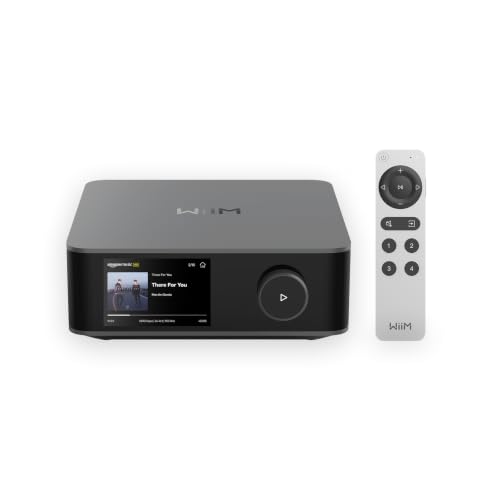
The WiiM Amp Ultra is the step up for larger speakers and larger rooms. Output doubles to 100 watts per channel, the DAC moves to a premium ESS Sabre ES9039Q2M, and dual amplifier stages with post-filter feedback keep distortion very low even as speaker loads change. A front touchscreen shows what is playing and handles basic control without a phone, and the included voice remote covers the couch-distance basics.
For home theater use, the HDMI ARC input accepts stereo PCM and Dolby Digital, and RoomFit EQ tunes the system to the room, which helps dialogue sit clearly in a 2.1 setup. Wi-Fi 6 and a subwoofer output with bass management round out a package aimed at people who want one box to run the whole room.
Specs
- 100 watts per channel at 8 ohms, 200 watts per channel at 4 ohms; ESS ES9039Q2M Sabre DAC with dual TI TPA3255 amplifier stages and post-filter feedback; HDMI ARC input for stereo PCM and Dolby Digital; touchscreen display and voice remote included; RoomFit EQ room correction; subwoofer output; Wi-Fi 6 and Ethernet; Bluetooth 5.3; Google Cast, Spotify Connect, TIDAL Connect, Qobuz Connect, DLNA and Roon Ready; dimensions 7.87 x 8.3 x 3 inches; weight 5.4 lb
Best for: Bigger speakers and viewers who want the strongest WiiM option
Watch out for: There is no AirPlay support on this model, the HDMI input is ARC rather than eARC, and DTS soundtracks must be converted to PCM by the TV first
Denon Home Amp
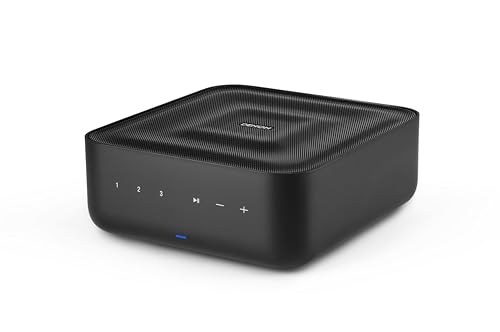
The Denon Home Amp brings the HEOS multiroom platform to a compact 100-watt amplifier, which makes it the natural pick if Denon Home speakers already live in your kitchen or bedroom. HEOS groups rooms together from one app, and the amp also accepts AirPlay 2 and Bluetooth for quick playback from a phone.
Its home theater credentials are the strongest of the group alongside the Marantz: the HDMI eARC input feeds onboard Dolby Digital Plus decoding, so streaming services that send Dolby Digital Plus play without forcing the TV into a compatibility mode. A subwoofer output with adjustable low-pass and high-pass crossovers makes 2.1 integration tidier than a simple summed output, and hi-res file support covers local libraries up to 192 kHz.
Specs
- 100 watts per channel at 8 ohms, Class D amplification; HEOS Built-in streaming; HDMI eARC input with Dolby Digital Plus decoding; dual-band Wi-Fi (802.11ac) and Ethernet; AirPlay 2 and Bluetooth; FLAC, ALAC and WAV up to 192 kHz/24-bit plus DSD 2.8 MHz and 5.6 MHz; subwoofer output with low-pass and high-pass crossovers; optical, line and USB inputs; model DENONHOMEAMP
Best for: Homes already using HEOS speakers in other rooms
Watch out for: Control leans heavily on the HEOS app since the unit itself has no display, and like every model here it is a stereo amplifier, so surround formats are folded down to two channels
Marantz MODEL M1

The Marantz MODEL M1 is the hi-fi option in this group: a compact streaming amplifier built with the finish and circuit care of the company’s separate components, rated at 100 watts per channel with low distortion. HEOS streaming is built in, covering the major music services, network files up to 24-bit/192 kHz, and DSD playback.
For television, the HDMI eARC input and onboard decoding for Dolby Digital Plus, Dolby Digital and LPCM mean the M1 takes whatever a modern TV sends over eARC and renders it in stereo without fuss. A subwoofer output supports a 2.1 layout, and the rear panel adds optical, line-in and USB connections for a game console or computer. It is the choice for a main listening room where the TV shares duty with serious music sessions.
Specs
- 100 watts per channel at 8 ohms; HEOS Built-in streaming; HDMI eARC input with Dolby Digital Plus, Dolby Digital and LPCM decoding; network playback up to 24-bit/192 kHz PCM plus DSD64 and DSD128; Wi-Fi and Ethernet; subwoofer output; optical, line-in and USB inputs; model MODELM1
Best for: Listeners who want hi-fi build quality with TV duties covered
Watch out for: There is no phono input for a turntable without its own phono stage, and the compact case leaves little room for chunky speaker cables with wide plugs
Bluesound POWERNODE

The Bluesound POWERNODE is the pick for listeners whose music lives in the BluOS ecosystem or in a local hi-res library. BluOS indexes network shares and USB storage, handles files up to 24-bit/192 kHz, and supports MQA, while grouping with other Bluesound players around the home. The amplifier section delivers 80 watts per channel, enough for most bookshelf and many floor-standing speakers in typical rooms.
Home theater integration runs through HDMI eARC, so TV sound joins the same system that plays your records and files, and a subwoofer output supports a 2.1 arrangement. Control is app-first through BluOS, with a touch panel on the unit for volume and presets.
Specs
- 80 watts per channel; BluOS streaming platform with multiroom grouping; HDMI eARC input; hi-res playback up to 24-bit/192 kHz with MQA support; dual-band Wi-Fi and Gigabit Ethernet; subwoofer output; optical, analog and USB inputs; two-way Bluetooth
Best for: BluOS households and hi-res music collectors
Watch out for: There is no display and everyday control depends on the BluOS app, and Amazon carries more than one POWERNODE generation, so confirm the exact version on the listing before ordering
Which One Fits
- Choose the WiiM Amp if you want the compact, lower-cost route to TV sound plus streaming in a smaller room.
- Choose the WiiM Amp Ultra if your speakers are larger or less efficient and you want a touchscreen, a voice remote and room correction.
- Choose the Denon Home Amp if HEOS speakers already fill other rooms and you want Dolby Digital Plus decoding for streaming apps.
- Choose the Marantz MODEL M1 if the same system serves serious music listening and you value build quality and eARC decoding.
- Choose the Bluesound POWERNODE if your library is hi-res or MQA-based, or if other BluOS players already run your multiroom system.
Common Mistakes
Expecting surround sound from a stereo amplifier. These amplifiers run two speakers, optionally with a subwoofer. That is a deliberate trade: dialogue clarity and music quality in exchange for no rear channels. If true surround is the goal, an AV receiver is the correct product type instead.
Leaving the TV set to an unsupported format. A TV passing DTS or Dolby Atmos bitstreams to a stereo amplifier produces silence or an error, not downmixed sound. Set the TV’s digital output to PCM or Dolby Digital, or let an eARC model with onboard decoding handle Dolby Digital Plus.
Buying a streamer with no amplifier inside. Several popular network streamers share shelf space with these amplifiers but cannot power speakers at all. Check for speaker terminals and a watts-per-channel rating before assuming a box will drive your speakers.
Skipping the subwoofer crossover setup. Plugging in a sub without setting the crossover leaves a hump or a hole where the sub and main speakers overlap. Use the amp’s bass management or crossover controls and match the sub’s own settings to them.
Hiding the amp where Wi-Fi cannot reach. A closed cabinet in a corner is the weakest spot in the house for wireless signal. If streaming drops out, move to the Ethernet port every model here provides rather than blaming the service.
FAQ
Can a network integrated amplifier replace an AV receiver in a home theater?
For a setup built on two speakers, or two speakers plus a subwoofer, yes. You give up surround channels and room-correction suites aimed at many speakers, and in return you get a smaller box, a simpler remote life, and usually better stereo music performance for the money. If you plan to add rear and height speakers later, an AV receiver remains the right foundation.
Will these amplifiers play Dolby Atmos or DTS soundtracks?
They play the programme, but in stereo. None of the five decodes Atmos or DTS. The Denon Home Amp and Marantz MODEL M1 decode Dolby Digital Plus and fold it down to two channels; the WiiM models accept stereo PCM and Dolby Digital. Set the TV to output PCM or Dolby Digital and every show and film will play correctly through two speakers.
What is the practical difference between ARC and eARC here?
ARC carries stereo PCM and Dolby Digital, which covers most viewing once the TV output is set correctly. eARC adds capacity and, on the Denon and Marantz models, lets the amplifier decode Dolby Digital Plus directly, which is the format most streaming services prefer. In daily use the difference is fewer TV settings to adjust rather than a dramatic change in sound.
Can I use my existing passive speakers and add a subwoofer later?
Yes. Any passive speakers with standard binding-post connections work, and every amplifier here has a subwoofer output, so a powered sub can join now or later. Check the speaker sensitivity if your room is large: efficient speakers suit the 60- and 80-watt models, while quieter designs pair better with the 100-watt amplifiers.
Final Verdict
For most home theater setups built around two speakers, the WiiM Amp covers the brief with the least money and the least fuss, while the WiiM Amp Ultra earns its step up with double the power, a touchscreen and room correction. Homes invested in HEOS should look at the Denon Home Amp for its Dolby Digital Plus decoding, or the Marantz MODEL M1 when build quality and music come first. BluOS loyalists and hi-res collectors are best served by the POWERNODE. Pick by the ecosystem you already own and the speakers you need to drive, and any of the five will run a tidy, good-sounding TV room.
More from Amazon
Programs that pair well with the guide above. Offers and eligibility are set by Amazon and may change.
Free shipping on eligible items, Prime Video and more. Eligible new members can start with a free trial.
Start a Prime free trialAd-free music streaming. Eligible new subscribers can start with a free trial.
Try Music Unlimited freeA Prime membership for ages 18-24 with a trial period. Eligibility is set by Amazon.
See Prime for Young AdultsAudiobooks and podcasts to listen to on the go. Eligible new members can start with a free trial.
Try Audible freeAs an Amazon Associate we earn from qualifying purchases.