Key takeaways
- Four hundred dollars is the first budget in this series where the honest answer changes shape.
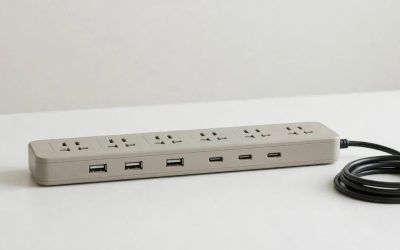
Four hundred dollars is the first budget in this series where the honest answer changes shape. At $100 through $300, the same truth kept repeating: the best strip costs about $55, and the extra money bought a UPS, a whole-home device, or nothing. At $400, that pattern finally breaks in one place — a professionally installed whole-home surge protector can now fit, if the labor lands low — and it holds everywhere else. No strip at $400 combines 140W USB-C charging with 4,000-plus joules in one box, and no name-brand strip with USB runs a 12-foot cord.
Surge protection is a solved problem at about $50. The rest is best spent on the two things a strip cannot do: keep your PC running through a blackout, and protect every circuit in your house at the panel.
Prices are as checked in November 2026. Check the current price on Amazon before buying — Black Friday pricing moves fast, and several prices below are deal reads, not street prices.
As an Amazon Associate, we earn from qualifying purchases.
Our top picks
Best for: Desks where the gear is worth far more than the strip, and where fail-safe shutoff matters more than USB-C
Check price on AmazonBest for: Homeowners with an accessible panel and a spare breaker slot who want every circuit guarded and are willing to get a quote before committing
Check price on AmazonBest for: A gaming or workstation desk where losing power mid-game, mid-render, or mid-save costs real work
Check price on Amazon
Best for: A shared table, a small desk, or a conference setup where a tower’s footprint matters more than maximum joules
Check price on AmazonQuick Picks
| Pick | Best For | Price |
|---|---|---|
| Rocketfish RF-HTS2223 | Highest joules and USB-C in one strip | $54.99 ($44.99 Black Friday deal) |
| Tripp Lite TLP128TTUSBB | Best protection pedigree and data-line protection | $41–$77 |
| Eaton CHSPT2ULTRA, installed | Whole-home protection that finally fits at $400 | $195.22 device; $335–$422 installed in the low-to-mid labor case |
| CyberPower CP1500PFCLCD + TLP128TTUSBB | Best UPS pair — protects a real gaming PC | $280.94 combined |
| Tripp Lite TLP606UCTOWER | Best tower with USB-C | $84.67 (one read; out of stock at that seller) |
How to Choose
Joules are the headline number, and the most misunderstood. A joule rating says how much surge energy a strip can absorb before its components wear out. More is better, but only alongside clamping voltage (lower is better — 330V is the tightest common figure), fail-safe shutoff (the strip cuts power when its protection is spent, instead of silently becoming a dumb power strip), and UL 1449 listing.
USB wattage is where the traps live. Most strips share a small wattage budget across all USB ports. Two USB-A ports “sharing 2.1A” means about 5W per port when both are in use — phone trickle charging, not fast charging. A single USB-C port at 20W fast-charges a modern phone; it will not meaningfully charge a 16-inch laptop. The 140W USB-C charging laptop owners want exists only in charging stations that barely protect anything.
A surge protector is not a UPS. A strip absorbs a spike and, in the best case, sacrifices itself. It does nothing when the power goes out, sags, or browns out. Only a battery backup keeps a PC running long enough to save work and shut down cleanly. If your fear is losing unsaved work, buy the UPS pair in pick four.
Whole-home protection is a different purchase from a strip. A Type 2 device like the Eaton CHSPT2ULTRA mounts at your main electrical panel and guards every circuit in the house. It needs a licensed electrician, a spare breaker slot, and sometimes a permit — so its price is two numbers, device and installed, and only the installed number matters. At $300 it did not fit installed. At $400 it fits, but only if the job is straightforward.
Cord length still has a ceiling with USB. The longest cord on any name-brand strip with USB in this series is 10 feet; 12-foot strips exist, but none has USB.
1. Rocketfish RF-HTS2223 — Our Top Pick
Specs: 4,680 joules; 12 AC outlets; 1x USB-C (20W PD) + 1x USB-A (12W); coax and modem jacks; 6 ft cord; $54.99 at Best Buy ($44.99 Black Friday deal read); Check price on Amazon
Pros: The highest joule rating of any strip in this series — 4,680 joules, the first to beat the Tripp Lite TLP128TTUSBB’s 4,320. Twelve outlets cover a full desk plus peripherals, a real USB-C port at 20W fast-charges a phone alongside a 12W USB-A port, and coax and modem jacks guard the cable and phone lines, the two surge paths most strips ignore. At $54.99, it is the best protection-per-dollar in this guide.
Cons: Rocketfish is Best Buy’s house brand, with a thinner track record than Tripp Lite or APC. No fail-safe auto shut-off is advertised: when the protection is spent, nothing promises it will cut power and tell you. The 6-foot cord is short for a desk away from the wall. The $44.99 price is a Black Friday deal read, not a street price.
Best for: Anyone who wants the most joules and a USB-C port in a single strip and will trade a little brand pedigree for a lot of protection-per-dollar.
2. Tripp Lite TLP128TTUSBB — Best Protection Pedigree
Specs: 4,320 joules; 12 AC outlets (6 transformer-spaced); 2x USB-A sharing 2.1A; 8 ft cord; RJ11 + coax line protection; fail-safe auto shut-off; 330V let-through (L-G); $150,000 Ultimate Lifetime Insurance; $41–$77; Check price on Amazon
Pros: The fail-safe auto shut-off is the most important protection feature in this guide — when the protection is spent, the strip cuts power instead of silently becoming an unprotected power strip. The 330V let-through voltage is the tightest in the series, and RJ11 and coax protection guard the phone and cable lines.
Cons: No USB-C port — the two USB-A ports share 2.1A, about 5W each when both are in use, which is phone trickle charging. The price range is wide, $41–$77 depending on the seller. At 4,320 joules it is now second to the Rocketfish on the headline number, even if it still leads on the specs that matter after the surge.
Best for: Desks where the gear is worth far more than the strip, and where fail-safe shutoff matters more than USB-C.
Correction carried forward: the $300 guide corrected this strip’s price range to $41–$77 — the $41–$66 range in earlier guides was too narrow after new catalog reads of $54.08 and $77.49 surfaced. The low read of $40.99 at Dell still holds.
3. Eaton CHSPT2ULTRA, Professionally Installed — Best Whole-Home Protection
Specs: Type 2 SPD; 108 kA maximum surge current; 20 kA nominal discharge current; 700V VPR; NEMA 4 enclosure; UL 1449 listed; LED + audible alarm; $75,000 connected-equipment coverage; device $195.22; installed $335–$422 in the low-to-mid labor case; Check price on Amazon
Pros: Protects every circuit in the house at the panel, not just the outlets on one strip. A 108 kA surge-current rating dwarfs any plug-in strip’s capacity, and the 700V voltage protection rating is the lowest in its class among the premium Type 2 devices surveyed for 2026. At $400, the installed price finally fits — in the right circumstances.
Cons: The installed price is a range, not a number. Device $195.22 plus professional labor of $140–$300 puts the honest total at $335.22–$495.22. It fits under $400 only if labor lands at the low-to-mid end — a straightforward job, an accessible panel, a spare breaker slot, no permit and no extra work. One 2026 cost survey’s illustrative total was $421.65 with a cheaper $136.65 device read and $200 of labor; with the $195.22 device read, that same job is $395.22 — inside by less than five dollars. And this is not a substitute for point-of-use strips.
Best for: Homeowners with an accessible panel and a spare breaker slot who want every circuit guarded and are willing to get a quote before committing.
This is the $400 question that finally gets a yes — with conditions attached. At $300, the installed whole-home device did not fit: the cheapest honest path was the smaller CHSPT2SURGE at $77.50 plus labor, or $217.50 in the best case. At $400, the premium CHSPT2ULTRA itself fits installed when the job is straightforward — but get the electrician’s quote first, confirm the spare breaker slot, and ask about a permit. Do not install a panel device yourself: this is mains-voltage work, and the warranty generally requires professional installation.
4. CyberPower CP1500PFCLCD + Tripp Lite TLP128TTUSBB — Best UPS Pair
Specs: CP1500PFCLCD: 1500VA / 1,000W pure sine wave UPS; 12 outlets; LCD display; AVR; $239.95. TLP128TTUSBB: 4,320 joules; 12 outlets; 2x USB-A; 8 ft cord; $40.99 low read. Combined $280.94 — fits $400 by $119.06; Check price on Amazon
Pros: The first pair in this series that protects a real gaming PC, not just a router and a monitor. A typical RTX 5060 gaming build draws about 290W while gaming, and about 345W with a monitor and router added — well under the 800W ceiling the 80-percent rule sets on a 1,000W UPS. Pure sine wave output is safe for modern active-PFC power supplies, which simulated-sine UPS units can trip.
Cons: The UPS is a tower the size of a small PC — it needs floor space and it has a fan. Its battery is a consumable; expect to replace it in three to five years at roughly $50–$80. Never plug the surge strip into the UPS, and never plug the UPS into the strip — the pair works side by side, not chained together. The $239.95 read is the standard price; a TAA-compliant variant lists at $309.95 and is a different model — do not pay the TAA price by mistake.
Best for: A gaming or workstation desk where losing power mid-game, mid-render, or mid-save costs real work.
5. Tripp Lite TLP606UCTOWER — Best Tower With USB-C
Specs: 6 AC outlets; 3x USB-A + 1x USB-C; 8 ft braided cord; 1,800 joules; $10,000 Ultimate Lifetime Insurance; $84.67 (one catalog read; out of stock at that seller); Check price on Amazon
Pros: The first name-brand tower in this series with a USB-C port — three USB-A ports plus one USB-C, on a slim tower that fits on a conference table or a crowded desk where a flat strip does not. At 1,800 joules it is the strongest tower with USB in the series, well ahead of the older TLP66USB tower’s 1,200 joules.
Cons: One thousand eight hundred joules is still the weakest protection in this guide — less than half the Rocketfish and less than half the TLP128TTUSBB. The only price read found is $84.67, and that seller showed it out of stock, so treat the price as unverified until you find a live listing. The USB-C wattage is not published, so budget it as a phone-charging port, not a laptop charger.
Best for: A shared table, a small desk, or a conference setup where a tower’s footprint matters more than maximum joules.
What to Avoid
The Anker Prime 140W Power Strip. It delivers 140W of USB-C charging and has no surge protection at all — a charging station wearing a surge protector’s shape. The honest 140W answer is still a pair: the Anker Prime Charging Station (8-in-1, 240W, 140W per port, $99.99–$129.99) plus the Rocketfish strip at $54.99, for $154.98–$184.98 combined — 140W charging and 4,680 joules, in two boxes, for less than half the budget.
The BSV804 trap. Listings have advertised this strip at 4,000 joules; its real rating is 900 joules. Read the spec sheet, not the title.
The 12-foot-with-USB mirage. Twelve-foot strips exist — the Tripp Lite TLM812SA at $101.19–$113.03 and the Isobar ISOBAR8ULTRA at $107.99–$132.98 both run 12 feet — but neither has USB. Ten feet remains the ceiling with USB: the Tripp Lite TLP610U30CLAMPB ($113.24–$137.99, 900 joules, 2x USB-C 30W) and the Isobar IBAR6ULTRAUSBB (catalog $149.99, reads $135.37–$209.15) both top out at 10 feet. Any listing claiming 12 feet and USB from a name brand deserves a second look at the spec sheet.
The Isobar IBAR6ULTRAUSBB availability confusion. One reseller lists this 10-foot, USB-equipped Isobar as “not for sale in the USA until further notice,” while others list it at $135.37–$209.15. Treat it as a maybe, not a pick.
Daisy-chaining and strip-into-UPS chains. Never plug a surge strip into another strip, and never plug a strip into a UPS or a UPS into a strip — the pair in this guide works because the two boxes sit side by side on separate wall outlets.
FAQ
Does $400 finally buy a strip with 140W USB-C and 4,000-plus joules in one box?
No. The honest answer is still two boxes: the Anker Prime Charging Station ($99.99–$129.99, 140W per port, but only 300 joules and two AC outlets) plus the Rocketfish RF-HTS2223 ($54.99, 4,680 joules), for $154.98–$184.98 combined — less than half the budget, doing both jobs properly.
Does a whole-home surge protector fit under $400 installed?
Yes, if the job is straightforward. The device reads $195.22, and professional labor runs $140–$300, so the honest installed total is $335.22–$495.22. It fits under $400 when labor lands at the low-to-mid end — an accessible panel, a spare breaker slot, no permit, no extra work. Get the electrician’s quote before buying the device, and do not install a panel device yourself.
What is the best use of $400 if I have a gaming PC?
The UPS pair: a CyberPower CP1500PFCLCD ($239.95, 1500VA / 1,000W pure sine wave) plus a Tripp Lite TLP128TTUSBB ($40.99 low read) for $280.94 combined. A typical RTX 5060 build draws about 290W gaming and about 345W with a monitor and router — well under the 800W ceiling the 80-percent rule sets.
Is the Rocketfish strip really better than the Tripp Lite TLP128TTUSBB?
On the headline numbers, yes: 4,680 joules beats 4,320, and it adds a 20W USB-C port the Tripp Lite lacks, for $54.99. On the protection details, no: the Tripp Lite has fail-safe auto shut-off, a tighter 330V let-through, and a longer track record. Buy the Rocketfish for joules and USB-C, the Tripp Lite for fail-safe and pedigree.
How long does a surge protector last?
Plan on replacing a strip every three to five years, or immediately after it takes a major surge — the protection components wear out with each event they absorb, and a strip without fail-safe can look fine while offering no protection at all.
Verdict
At $400, the best surge protector with USB is the Rocketfish RF-HTS2223 at $54.99 — the highest joules in the series, a real USB-C port, and twelve outlets for the price of a dinner. But $400 does not buy a $400 strip. It buys a $55 strip and a choice: a professionally installed whole-home device that finally fits when the job is straightforward, or a 1500VA UPS pair that protects a real gaming PC with $119 to spare. Do not pay a premium for a single box that promises both — because at $400, that box still does not exist.
Suggested Internal Links
- Best Surge Protector With USB Under $300
- Best Surge Protector With USB Under $250
- Best Surge Protector With USB Under $200
More from Amazon
Programs that pair well with the guide above. Offers and eligibility are set by Amazon and may change.
Free shipping on eligible items, Prime Video and more. Eligible new members can start with a free trial.
Start a Prime free trialAd-free music streaming. Eligible new subscribers can start with a free trial.
Try Music Unlimited freeA Prime membership for ages 18-24 with a trial period. Eligibility is set by Amazon.
See Prime for Young AdultsAudiobooks and podcasts to listen to on the go. Eligible new members can start with a free trial.
Try Audible freeAs an Amazon Associate we earn from qualifying purchases.