Key takeaways
- Soy milk: Often the easiest plant base to thicken because it contains comparatively more protein.
- Coconut milk: Can become rich and thick but may separate as it cools; full-fat formulations generally behave differently from beverages.
- Oat and nut beverages: Often need a compatible thickener or a formulation designed for fermentation.
- Starter culture: Use a culture labeled for the base you are fermenting. A spoonful of finished dairy yogurt is not automatically suitable for a dairy-free batch.
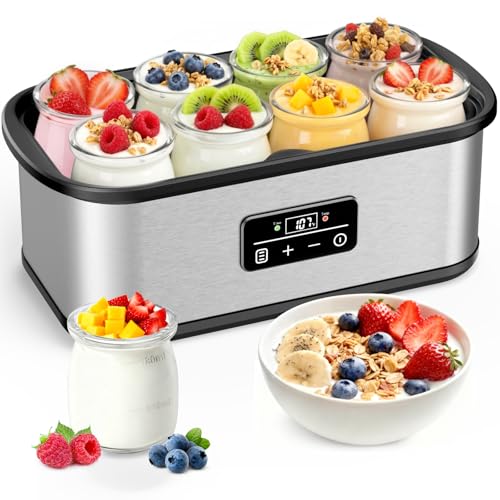
The best yogurt makers for Greek and dairy-free yogurt are the Euro Cuisine YM260 for dependable small batches, the Instant Pot Duo Plus for larger families and versatile temperature control, and the Dash Greek Yogurt Maker for simple straining-focused preparation.
The right choice depends less on the word “yogurt” on the box than on four practical questions: how much you make, how precisely the machine controls heat, whether Greek-style straining is built in, and how well its program suits non-dairy cultures.
Our top picks


As an Amazon Associate we earn from qualifying purchases at no extra cost to you. Ratings are shown as listed on Amazon.
Best yogurt makers at a glance
| Model or type | Batch capacity | Temperature and timing | Greek-yogurt setup | Best for |
|---|---|---|---|---|
| Euro Cuisine YM260 | 2 quarts | Adjustable temperature dial; up to about 24 hours | Included stainless-steel strainer | Small households wanting direct control |
| Euro Cuisine YM80 | 2 quarts total; seven 6-ounce jars | Timed fermentation; temperature indicator | Separate straining method required | Portioned dairy yogurt |
| Dash Greek Yogurt Maker | About 2 quarts | Simple timed fermentation | Dedicated strainer basket | First-time Greek-yogurt makers |
| Instant Pot Duo Plus, 6-quart | Up to 4 quarts of milk in the inner pot | Automated yogurt program; manual control varies by model | Cheesecloth, basket, or separate strainer | Frequent large batches and multipurpose cooking |
| Dedicated temperature-controlled fermenter | Typically 1–2 quarts | Adjustable digital temperature, commonly about 86–110°F | Usually separate | Dairy-free cultures and repeatable experiments |
Capacities are approximate usable or advertised capacities and can vary by configuration. Leave headroom for mixing, and check the manual before fermenting in a pressure-cooker insert or glass container.
Our picks by situation
Best for most small batches: Euro Cuisine YM260
The YM260 is a strong choice when consistency matters but you do not need a pressure cooker, rice cooker, or large appliance. Its adjustable temperature control is more useful than a collection of preset buttons because different cultures and plant milks can need different incubation conditions. The included stainless-steel strainer also makes Greek-style yogurt without buying a separate basket.
Its approximately 2-quart capacity suits one or two people who make yogurt weekly. The main limitation is that it is a single-container design, so you portion the yogurt after fermentation rather than taking individual jars from the refrigerator.
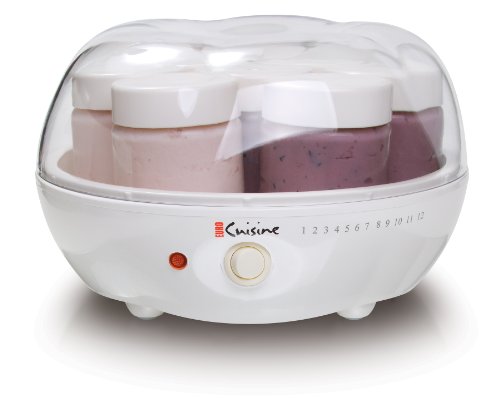
Best for portioned yogurt: Euro Cuisine YM80
The YM80 uses seven 6-ounce glass jars, giving you roughly 42 ounces of finished yogurt before any straining. Individual jars reduce repeated opening of one large container and make serving convenient. The glass is also easier to inspect and does not retain odors as readily as some plastics.
This model is better for regular dairy yogurt than for thick Greek yogurt unless you add a separate strainer. It is also less flexible than a model with a temperature dial when you are working with dairy-free starters. Choose it when portion control and straightforward operation are more important than experimentation.
Best simple Greek-yogurt option: Dash Greek Yogurt Maker
The Dash Greek Yogurt Maker is designed around the step many buyers actually care about: fermenting and then draining yogurt until it becomes thick. Its strainer basket simplifies that transition and avoids balancing a colander over a bowl with improvised cloth.
It is a sensible entry point for occasional users who want a compact appliance and do not need detailed temperature programming. Before choosing it for coconut, soy, oat, or nut-based yogurt, confirm that the culture instructions match the appliance’s fixed heating cycle. Plant-based mixtures can be less predictable than dairy, and a fixed program leaves less room for adjustment.
Best for large batches: Instant Pot Duo Plus, 6-quart
A 6-quart Instant Pot can ferment substantially more yogurt than countertop machines, although you should not fill it to the maximum line for every recipe. A practical batch may use 2 to 4 quarts of milk, depending on the recipe and desired working space. The yogurt program also handles the initial heating step on compatible models, which can reduce saucepan washing.
Its advantage is capacity and versatility rather than purpose-built straining. For Greek yogurt, you will need a separate fine-mesh basket, cheesecloth, or yogurt strainer. The silicone sealing ring can also absorb savory aromas, so owners who use the pot for chili or curry may prefer a spare ring dedicated to yogurt.
Why temperature control matters for dairy-free yogurt
Many dairy cultures are forgiving within a reasonably warm incubation range, while dairy-free batches vary more because plant milks differ in protein, starch, fat, and added thickeners. A machine that only maintains one warm setting may work well with one recipe and poorly with another.
- Soy milk: Often the easiest plant base to thicken because it contains comparatively more protein.
- Coconut milk: Can become rich and thick but may separate as it cools; full-fat formulations generally behave differently from beverages.
- Oat and nut beverages: Often need a compatible thickener or a formulation designed for fermentation.
- Starter culture: Use a culture labeled for the base you are fermenting. A spoonful of finished dairy yogurt is not automatically suitable for a dairy-free batch.
For dairy-free experiments, prioritize adjustable temperature, a long timer of at least 24 hours, and containers that can be sterilized easily. The machine does not replace the culture manufacturer’s instructions: the correct temperature and incubation time are culture-specific.
Greek yogurt is a straining decision, not just a machine decision
Fermentation produces yogurt; straining creates the thicker Greek-style texture. A built-in basket saves space and makes the process more repeatable, but it also adds another part to wash. If a machine has no strainer, a separate fine-mesh basket can work just as well, provided it is large enough for the batch and stable in the refrigerator.
Straining time changes both texture and yield. Start with 2 quarts of fermented yogurt. If straining removes about 20 percent as whey, the result is approximately:
2 quarts × 0.80 = 1.6 quarts of Greek-style yogurt.
A longer drain may reduce the volume further while producing a spoonable or spreadable texture. This is why a larger fermenter is not equivalent to the same-size Greek-yogurt output. If your household eats 1 quart per week, a 2-quart fermenter may give enough finished yogurt for one batch, while a 6-quart appliance provides useful reserve but takes more refrigerator space.
Decision matrix: which type fits your routine?
| Your situation | Recommended type | Why | Trade-off |
|---|---|---|---|
| Budget-conscious and making yogurt once or twice monthly | Basic 1–2 quart timed maker | Low purchase cost and simple operation | Less control for dairy-free recipes |
| New to Greek yogurt | Model with an included strainer | Fewer improvised steps and more predictable draining | Extra basket to clean and store |
| Making yogurt weekly for one or two people | Adjustable 2-quart machine | Good balance of capacity, control, and counter space | Usually one large container rather than individual jars |
| Making 3–4 quarts at a time | 6-quart multicooker | Large working volume and useful secondary cooking functions | Requires separate straining equipment |
| Trying several plant-milk cultures | Digital fermenter with adjustable temperature | Allows controlled changes to time and heat | Results still depend heavily on the milk and starter |
| Very limited kitchen storage | Compact single-container machine | Fewer jars and a smaller footprint | Less convenient serving and cooling |
How to get more consistent results
- Clean and heat-treat the equipment. Wash the container, lid, spoon, and strainer thoroughly. For dairy recipes, heating the milk before inoculation can improve body by changing the milk proteins, but follow the recipe and culture directions.
- Cool before adding the starter. Starter cultures can be damaged if mixed into milk that is too hot. Use a reliable kitchen thermometer rather than judging by touch.
- Measure the starter. More starter does not necessarily mean faster or thicker yogurt. Excess culture can produce a sharper flavor or an unstable texture.
- Keep the container still. Moving the batch during incubation can disturb the developing gel and leave a loose result.
- Chill before straining. Refrigeration firms the yogurt, making the straining stage easier to control.
- Drain in the refrigerator. Cold straining slows further fermentation and makes it easier to stop at the texture you want.
Ownership, cleaning, and common failure points
The container or strainer basket is usually the first part to become inconvenient rather than the heater itself. Check whether replacement jars, lids, baskets, and seals are available before buying. Glass jars can break, plastic lids can warp in high heat, and fine mesh can retain residue if it is not rinsed immediately.
Do not assume every removable part is dishwasher-safe. Hand-wash mesh strainers and inspect silicone seals for trapped milk solids. Never seal an actively fermenting container in a way that prevents the manufacturer’s intended venting or pressure behavior.
Thin yogurt commonly results from an unsuitable starter, weak plant-milk base, insufficient heating, excessive movement, or stopping fermentation too early. Separation is not always a machine defect; some whey release is normal, particularly with dairy-free mixtures. If repeated batches fail despite following the culture instructions, change one variable at a time instead of extending the program indefinitely.
Final verdict
Choose the Euro Cuisine YM260 if you want a compact machine with temperature adjustment and convenient Greek-yogurt straining. Choose the Euro Cuisine YM80 for individual dairy-yogurt jars, or the Dash Greek Yogurt Maker if a simple built-in straining workflow is your priority. For families and high-frequency cooks, the 6-quart Instant Pot Duo Plus offers the most useful capacity, while a dedicated adjustable-temperature fermenter is the better long-term platform for dairy-free culture experiments.