Key takeaways
- Compare the best walking pads for working while you walk, with quiet picks, folding designs and pads that fit small desks and apartments well.
As an Amazon Associate we earn from qualifying purchases.
A walking pad will not turn your home office into a gym, and it is not supposed to. These slim, low-speed treadmills exist for one job: letting you stroll at an easy pace while you read email, join calls, and get through the parts of the workday that used to mean sitting still for hours. Done well, a pad disappears into your routine. You step on in the morning, wander through a few thousand steps between meetings, and step off without feeling like you trained for anything.
The catch is that walking pads look almost identical in product photos, yet they differ a lot in the details that decide whether you use one daily or shove it under the couch by March. Belt size, motor honesty, noise, storage height, and how the pad behaves at typing speed all matter more than the headline speed figure. This guide explains how to choose, then covers five pads that each suit a different kind of home office: a folding model for tight spaces, a straightforward workhorse, a 2-in-1 that can jog on weekends, a high-capacity pad, and a compact incline model for very small desks.
Disclosure: This article contains affiliate links. If you make a purchase through these links, we may earn a commission at no extra cost to you.
How to Choose
Start with the most important fact about this entire category: a walking pad is built for strolling at roughly 1 to 4 mph, not for running. Most people settle between 1.5 and 2.5 mph while working, because that is the pace where typing stays accurate and you can still talk on a call without sounding winded. A pad that tops out at 3.8 or 4 mph is not limited in any way that matters for desk work. Save the higher speeds for a real treadmill with a frame, a safety key, and a deck designed for impact.
Motor figures need a skeptical eye. The horsepower numbers printed on these products are peak figures, not the output the motor sustains for hours, and makers of compact pads often suggest session limits in the fine print — an hour or two of walking, then a rest for the motor. If you plan to walk most of the day, look for a brushless motor, a stated duty cycle, and honest guidance about daily use rather than the biggest HP number on the box. A pad that overheats and shuts down mid-afternoon teaches you to stop using it.
Belt size decides comfort more than almost anything else. A walking surface around 16 inches wide and 40 or more inches long suits most strides at desk pace. Shorter belts near 34 inches feel fine if you are under about six feet tall, but taller walkers with a long stride can feel like they are mincing. Width matters too: a narrow belt demands more attention to foot placement, which is exactly the attention you want to spend on your work instead.
Noise is the make-or-break spec in apartments and shared homes. At 2 mph, a decent pad is quieter than normal conversation, and the motor is rarely the problem. Footfall thump traveling through the floor is. A dense mat underneath helps, as does walking in soft shoes or socks designed for indoor use. If people live below you, mid-day walking on a mat is a far better neighbor strategy than early-morning sessions on bare flooring.
Controls should be reachable without breaking stride. A simple remote is the baseline; app control is a bonus for people who like to glance at step counts and session history on their phone. A display on the pad itself helps you check speed at a glance. Whatever the control scheme, you want speed changes in small steps, because the difference between 1.8 and 2.2 mph is the difference between comfortable typing and a wobble in every keystroke.
Storage separates daily users from occasional ones. Measure the gap under your couch or bed before ordering: many pads stand about 5 inches tall, folding models collapse to roughly half their length, and transport wheels matter more than raw weight because you will roll the pad twice a day. Finally, pair the pad with your desk honestly. Standing on a pad raises you by roughly 5 inches, so your desk must go about 5 inches higher than your normal standing setting to keep your elbows at a comfortable angle. A fixed-height desk that already feels tall is a warning sign. Weight capacity also deserves respect: pick a pad with comfortable headroom above your body weight rather than one you max out.
WalkingPad A1 Pro
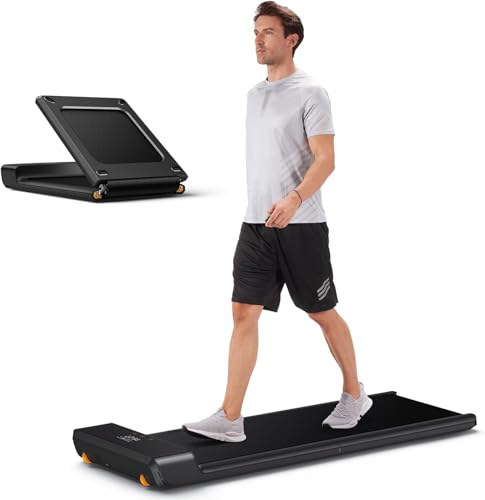
The A1 Pro is the pad to look at when storage space is the whole problem. KingSmith’s folding design hinges in the middle, so the deck folds in half and rolls away at about 32 inches long — short enough for a closet, a gap beside a bookcase, or the space under many sofas. Unfolded, it gives you a full-size walking surface of about 47 by 16.5 inches, which is generous for this category and forgiving for longer strides.
Its brushless motor is tuned for smoothness rather than speed, topping out at 3.7 mph, and the pad includes an adaptive speed mode that responds to where you step on the belt: walk toward the front to speed up, drift back to slow down. In practice most desk workers end up using the remote or the KS Fit app and a fixed pace around 2 mph, but the adaptive mode is pleasant for calls where you are not typing. The current listing supports up to 300 lb, the strongest figure among the folding pads here, and the unit arrives ready to walk on with no assembly. See the WalkingPad A1 Pro on Amazon for the current configuration.
Specs
- Motor: 1.25 HP brushless
- Speed range: 0.5–3.7 mph
- Walking surface: approx. 47 x 16.5 in
- Capacity: 300 lb
- Folded size: approx. 32.3 x 21.5 x 5.1 in; unit weight approx. 62 lb
- Controls: remote, KS Fit app, adaptive speed mode; LED display
UREVO Under Desk Treadmill
UREVO’s standard under-desk model (URTM022) is the straightforward workhorse of this group: no folding trick, no handlebar, just a low, flat pad that slides under a desk and gets out of the way. The 2.25 HP motor carries it to 4 mph, which is the top of the sensible range for desk walking, and the deck adds extra shock-absorbing layers that soften footfalls — a small mercy for downstairs neighbors and for your own ankles over a long day.
The walking surface is a touch narrower than the WalkingPad’s, at roughly 16 by 41 inches, which still suits most users at typing pace. An LED display on the front edge shows speed, time, distance, and step data, and the remote handles start, stop, and pace changes without an app account. At about 54 lb with transport wheels, it is easy to roll against a wall when guests come over. For anyone who wants a pad that simply works every morning without features to manage, the UREVO Under Desk Treadmill is the default recommendation in this roundup.
Specs
- Motor: 2.25 HP
- Speed range: 0.6–4 mph
- Walking surface: approx. 16 x 41 in
- Capacity: 265 lb
- Dimensions: approx. 48.6 x 21.3 x 4.7 in; unit weight approx. 54 lb
- Controls: remote; LED display for speed, time, distance, steps
Goplus 2 in 1 Folding Treadmill
The Goplus 2 in 1 is the pick for households that want one machine to cover two jobs. With the handlebar folded flat, it is an under-desk pad that walks from 0.6 to 4 mph like the others here. Raise the handlebar and the same machine becomes a compact jogging treadmill with speeds up to 7.5 mph for a lunchtime run in the living room. That dual personality is genuinely useful in a small home where a full treadmill and a pad would never both fit.
Under a desk, it behaves well: the 16 by 40 inch belt is wide enough for a natural stride, the remote and app control the pace, and the LED display tracks your session. Be honest with yourself about the compromise, though. At roughly 69 lb it is the heaviest pad here, the raised-handlebar mode is for jogging rather than serious training, and you will never use the running mode while working — it exists for the hours when the desk is closed. If that split matches your life, the Goplus 2 in 1 Folding Treadmill covers both bases in one footprint.
Specs
- Motor: 2.25 HP
- Speed range: 0.6–4 mph under desk; up to 7.5 mph with handlebar raised
- Walking surface: approx. 40 x 16 in
- Capacity: 265 lb
- Unit weight: approx. 69 lb; folding handlebar, transport wheels
- Controls: remote and app; LED display
Sperax Walking Pad
The Sperax Walking Pad (model Q1) earns its place on one headline figure: a 320 lb weight capacity, the highest in this roundup. Heavier walkers are poorly served by pads that cap out at 220 or 250 lb, and running any motorized belt near its limit shortens its life, so the extra headroom here is a practical advantage rather than a spec-sheet flourish. The 2.5 HP motor is also the strongest on paper in this group, and it pushes the belt to 3.8 mph.
Day to day, the Sperax keeps things simple. There is an LED display, a remote for pace changes, and a belt around 16 inches wide that handles desk-pace walking without fuss. It does not fold, so plan on rolling its roughly 50-inch length under a bed or standing it behind a door. Buyers who need capacity first and clever storage second will find the trade fair, and the Sperax Walking Pad is the one to check before settling for a lower limit elsewhere.
Specs
- Motor: 2.5 HP
- Speed range: 0.6–3.8 mph
- Walking surface: approx. 41 x 16.5 in
- Capacity: 320 lb
- Dimensions: approx. 49.6 x 21.6 x 4.7 in; transport wheels fitted
- Controls: remote; LED display
Egofit Walker Pro M1
The Egofit Walker Pro M1 is built around two ideas the rest of this category mostly ignores: a fixed 5 percent incline and the smallest footprint it can manage. The incline is not adjustable — the deck simply sits at a gentle, permanent slope, so every step asks a little more of your legs at the same speed. People who find flat walking at 2 mph too easy to feel worthwhile tend to like it, and because the slope is mild, typing stays comfortable.
The trade for that incline and compact shape is size. The walking surface is about 34 by 16.5 inches and the whole unit is only about 38 inches long, which is wonderful for small desks and tight rooms but snug for taller walkers; Egofit suggests it suits users under about 6 feet 2 inches. Top speed is 3.1 mph, capacity is 220 lb, and control comes from a remote or the FitShow app with an LCD readout on the unit. If your workspace is genuinely tiny and the idea of a built-in slope appeals, the Egofit Walker Pro M1 is the specialist pick.
Specs
- Motor: 2.0 HP
- Speed range: 0.6–3.1 mph
- Incline: fixed 5 percent, non-adjustable
- Walking surface: approx. 34.3 x 16.5 in
- Capacity: 220 lb
- Footprint: approx. 38.4 x 21.7 in; remote and FitShow app control; LCD display
FAQ
How fast should I walk while working?
Most people do their best work between 1.5 and 2.5 mph. Start near 1.5 mph for typing-heavy tasks, and save faster paces for calls, reading, and video meetings where your hands are free. If your accuracy drops or you start gripping the desk, slow down a notch — small speed steps exist for exactly this reason.
Will a walking pad fit under my desk and couch?
Check two measurements before ordering: the knee space under your desk (you need room for the pad’s length plus your stride) and the storage gap where the pad will live, since most pads stand about 5 inches tall. Folding models like the A1 Pro halve their length for storage, and every pad here has wheels, so daily moving is a roll rather than a lift.
How long can I walk on a pad each day?
Comfort usually decides before the motor does: build up gradually, alternate walking with standing and sitting, and wear supportive indoor footwear. On the machine side, respect the maker’s session guidance — many compact pads are happiest with breaks between longer sessions so the motor can cool, and an anti-fatigue mat beside the pad gives your feet a change of surface during standing breaks.
Conclusion
For most home offices, the UREVO Under Desk Treadmill is the balanced pick: honest speed range, a comfortable belt, quiet manners, and nothing to manage. Choose the WalkingPad A1 Pro when storage is tight and a folding deck solves a real space problem. The Goplus 2 in 1 suits homes that also want light jogging from the same machine. The Sperax is the clear pick for heavier walkers who need its 320 lb capacity, and the Egofit Walker Pro M1 is the one for very small desks where a gentle fixed incline sounds better than a flat stroll. Whichever you pick, raise the desk, start slower than you expect, and let the steps accumulate quietly in the background of the workday.
More from Amazon
Programs that pair well with the guide above. Offers and eligibility are set by Amazon and may change.
Free shipping on eligible items, Prime Video and more. Eligible new members can start with a free trial.
Start a Prime free trialAd-free music streaming. Eligible new subscribers can start with a free trial.
Try Music Unlimited freeA Prime membership for ages 18-24 with a trial period. Eligibility is set by Amazon.
See Prime for Young AdultsAudiobooks and podcasts to listen to on the go. Eligible new members can start with a free trial.
Try Audible freeAs an Amazon Associate we earn from qualifying purchases.