Key takeaways
- Compare the best desktop staplers by sheet capacity, jam resistance and effort, with full-strip and electric models for desks, classrooms and offices.
As an Amazon Associate we earn from qualifying purchases.
A stapler is the rare desk tool that only gets noticed when it misbehaves. It crumples a staple into the top sheet of a report, refuses a stack it handled last week, or demands a two-handed slam that leaves your palm stinging. The differences between a stapler that works for a decade and one that frustrates you weekly are mostly invisible in photos: how it loads, how a jam clears, how much force the mechanism needs, and whether the capacity on the box survives real paper.
This guide covers five desktop staplers: a traditional all-metal full-strip model, two reduced-effort mechanisms that genuinely help tired or arthritic hands, a compact half-strip model for small desks, and a corded electric for high-volume work. Every pick uses standard staples, so nothing here locks you into a proprietary refill.
Disclosure: This article contains affiliate links. If you make a purchase through these links, we may earn a commission at no extra cost to you.
How to Choose a Desktop Stapler
Read sheet capacity with suspicion
The capacity figure on the box is measured in sheets of standard 20 lb copy paper under ideal conditions. Treat it as a ceiling, not a working number. Cardstock, glossy paper, and even a slightly misaligned stack of ordinary paper will defeat a stapler working at its stated limit. A practical rule: if you regularly staple 15-page handouts, buy a stapler specified for 20 to 25 sheets so it works in the comfortable middle of its range. Staplers used near their maximum jam more, bend more staples, and wear faster. Leg length matters too: standard 1/4-inch legs suit up to roughly 25 to 30 sheets, and forcing them through thicker stacks leaves the classic half-closed staple that tears the page when removed.
Jam clearing matters more than styling
Every stapler jams eventually; the question is what the jam costs you. On a well-designed model the top latch pops open, the magazine drops or swings clear, and you pick out the mangled staple with a fingertip. On a poor design you are prying with a letter opener while the driver sits bent over a crushed staple. Look for a latch that opens the stapling head fully, a front-loading or drop-in magazine, and an anti-jam mechanism that keeps staples tracking straight. Better electric models let you open the front and clear the channel without fishing with tweezers. In a classroom or shared office, where other people will abuse it, jam clearing is the feature to prioritize.
Reduced effort is a real mechanism, not a slogan
Two distinct designs cut the force your hand supplies. Spring-powered staplers, sold under PaperPro’s One-Finger name and licensed into Bostitch models, cock an internal spring as you press; the spring then drives the staple. The maker claims up to 80 percent less effort, and the honest version of that claim is that stapling a full-capacity stack takes a light finger press instead of a palm slam. Lever-based designs, such as Swingline’s Optima line, rework the linkage so your press travels further with less force, and fold the staple legs flat against the back of the stack. Both designs genuinely help people with arthritis, carpal tunnel symptoms, or a day of handouts to assemble, and neither changes staple compatibility: all still feed on standard strips.
Staples: the unglamorous cause of most jams
Standard desktop staples are the 26/6 size, meaning 26-gauge wire with 6 mm (1/4-inch) legs, sold in strips of 210. Almost every stapler here uses them, and most “stapler problems” are actually staple problems. Bargain strips are often inconsistent in width or glue, so staples tilt in the magazine and fold instead of piercing. Premium strips from the stapler’s own maker are made to tighter tolerances and are the first thing to try when jams start. Store strips flat and dry; a strip left loose in a drawer, picking up dust and bent ends, will misfeed in any machine.
Electric models: power source and noise
Desktop electrics are corded, and that is mostly a virtue: consistent drive force on every staple, no batteries to fade mid-job. Smaller battery or USB models trade that consistency for portability. What surprises first-time buyers is the noise: a sharp mechanical clack, far louder than a manual press, which matters in a quiet office, a library, or a classroom during a test. Electrics earn their place where volume is high and stacks are uniform: mailrooms, front desks, and teachers assembling the same packet forty times. For occasional use they are slower than a manual stapler and add a cord to the desk.
Full strip, half strip, and opening flat
A full-strip stapler holds 210 staples and suits daily use. A half-strip model holds about 105, is meaningfully smaller, and suits a home desk, provided you accept reloading twice as often. Separately, check whether the stapler opens flat: most desktop models swing open 180 degrees for tacking notices to a bulletin board, and some rotate the clinch plate to “pin” papers with a loose, easily removed staple. If you post notices, confirm the model you want opens flat.
The 5 Best Desktop Staplers
1. Swingline 747 Classic Stapler, Black (74701) — Best Traditional Full-Strip Stapler

The 747 is the stapler most offices already own, and its staying power comes from construction rather than features. The all-metal body and die-cast base sit heavily on the desk and do not skitter when you press one-handed. The current version is specified for 30 sheets of standard paper, holds a full strip of 210 standard staples, and opens fully for tacking posters and notices. The clinch plate rotates for pinning, the temporary mode used to hold documents you intend to separate later.
Honest limitations: a full 30-sheet stack takes a firm press, and the maker’s jam-free promise is tied to its own premium S.F. 4 staples; feed it bargain strips and it jams like everything else. The latch does open the head for clearing, which is the main thing. Buy it if you want one stapler that will outlast several desks and you staple moderate stacks through the day.
Specs
- 30-sheet capacity (standard 20 lb paper)
- Full strip: holds 210 standard 1/4-inch staples
- All-metal construction with die-cast base
- Opens 180 degrees for tacking; rotating clinch plate for pinning
- Top-loading magazine with latch release for jam clearing
- Model 74701
2. Bostitch InPower Spring-Powered Desktop Stapler, 20 Sheet — Best Reduced-Effort Pick
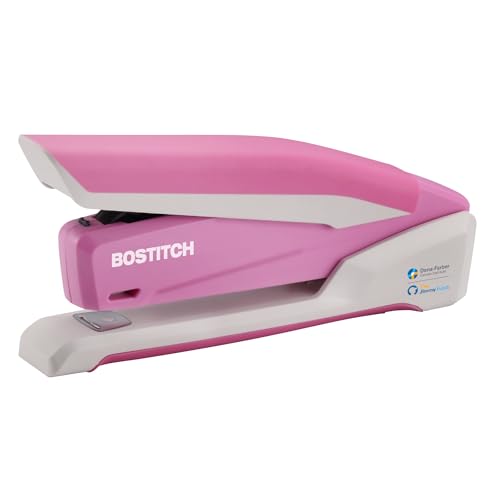
The InPower 20 uses PaperPro’s spring-powered One-Finger mechanism: your press cocks a spring, and the spring fires the staple. A 20-sheet stack, the top of its range, fastens with a genuine one-finger press instead of a palm strike. For anyone with arthritis, weak grip, or a stack of classroom packets to assemble, this is the most meaningful difference in the guide. It holds a full strip of 210 standard staples (one strip included), and its No-Jam design keeps the channel tracking straight.
It opens for tacking like the Swingline, and the body stands upright or lies flat. The honest trade-offs: the housing is plastic rather than metal, so it will not absorb drops the way the 747 does, and the 20-sheet ceiling is firm — this is not the tool for thick reports. Within its range, though, nothing else here asks so little of your hand. This listing is the pink awareness version; the mechanism is identical across InPower 20 colors.
Specs
- 20-sheet capacity (standard 20 lb paper)
- One-Finger spring-powered mechanism; maker rates it 80% easier than standard staplers
- Full strip: holds 210 standard 1/4-inch staples; one strip included
- No-Jam technology for straight staple feeding
- Opens for tacking; stands horizontally or vertically
- Model INP20 (inCOURAGE 20)
3. Swingline Optima 40 Stapler (87845) — Best for Thick Stacks Without the Strain

The Optima 40 takes the other route to easier stapling: a reworked lever mechanism that needs up to 50 percent less force than a traditional stapler at every sheet count, paired with a 40-sheet capacity that is unusually high for a machine using standard-size staples rather than heavy-duty ones. The flat clinch anvil folds staple legs flat against the back sheet, so finished stacks sit neatly instead of nesting on curled staple crowns. The QuickLoad magazine is the other practical win: press a button and the staple tray ejects from the front, so reloading and jam clearing take seconds with no prying.
Two honest caveats. The jam-free guarantee is tied to Swingline’s own Optima Premium or S.F. 4 Premium staples; standard strips work, but the guarantee follows the premium ones. And while the mechanism is metal, the outer housing is plastic, so it feels less dense than the 747 despite out-stapling it. For shared office desks and anyone who binds 25- to 40-page packets daily, it is the strongest manual pick here.
Specs
- 40-sheet capacity using standard-size staples
- Reduced-effort mechanism: up to 50% less force than traditional staplers
- QuickLoad front-loading magazine, button-eject for fast reloads and jam clearing
- Flat clinch anvil forms staples flat for neater stacking
- Full strip: holds 210 staples; works best with Optima Premium or S.F. 4 Premium staples
- Model 87845
4. Bostitch Impulse Drive 30 Electric Stapler — Best Electric for High Volume

The Impulse Drive 30 replaces your arm with a motor. Slide the stack into the throat and the Impulse Drive mechanism fires instantly, fastening up to 30 sheets with identical force every time. That consistency is the real product: no under-driven staples at the end of a long day, no variation between the first packet and the fortieth. It is corded, so it never weakens the way a battery model does, feeds on standard staples, and has a front magazine that reloads quickly plus an adjustable paper guide for repeatable placement.
The trade-offs are the ones flagged above: it is loud, with a sharp clack on every cycle that carries across a quiet room. It is also a fixed station: it lives where you plug it in, and positioning a page precisely in the throat is a touch slower than slapping a manual stapler on top. For a front desk, mailroom, or teacher producing class sets daily, those are easy trade-offs. For occasional home use, they are not.
Specs
- 30-sheet capacity (standard 20 lb paper)
- Corded AC power with Impulse Drive firing mechanism
- No-Jam technology; front-load magazine for easy reloads
- Uses standard 1/4-inch staples
- Adjustable paper alignment guide
- Dimensions: 8.63 x 2.38 x 6.63 in
5. PaperPro Compact Classic Desktop Stapler (3054) — Best Compact Half-Strip

The Compact Classic shrinks the spring-powered idea into a half-strip body for small desks, dorm rooms, and kitchen-junk-drawer duty. It staples up to 15 sheets with the same one-finger press as its full-size relatives, which makes it the gentlest small stapler here for arthritic hands. The compact footprint is the point: roughly half the desk space of the 747, and it stands neatly at the back of a drawer.
Fifteen sheets is a real ceiling, the half-strip magazine holds about 105 staples, so you will reload more often, and it gives up the metal heft of the full-size models. But most home stapling is two to ten sheets — permission slips, receipts, a child’s homework packet — and for that work this is easier on the hand and the desk than any full-size model. If your stapling is light and your space tight, it is the right size of tool.
Specs
- 15-sheet capacity (standard 20 lb paper)
- One-Finger spring-powered mechanism; maker rates it 80% easier than standard staplers
- Half strip: holds about 105 standard 1/4-inch staples
- Compact desktop footprint for small workspaces
- Opens for tacking
- Model 3054
Frequently Asked Questions
Why does my stapler jam even with only a few sheets?
The staples are the first suspect, not the stapler. Off-brand strips vary in width and glue consistency, so staples tilt in the magazine and fold instead of piercing. Try a fresh strip of the stapler maker’s own premium staples first. If jams persist, confirm you are using standard 1/4-inch (26/6) staples, and clear any bent staple left in the channel — one leftover staple causes repeat failures.
Are reduced-effort staplers really easier, or is it marketing?
The mechanisms are real. Spring-powered models store energy in a spring and release it to drive the staple, so your finger supplies a fraction of the force; lever-based designs like the Optima 40 lengthen the lever path to cut required force by up to half. Maker percentages describe best-case comparisons, but the practical difference is obvious the first time you fasten a full-capacity stack: a light press instead of a palm strike. For arthritis or repetitive-strain issues, that difference is the whole purchase.
Can I use an electric stapler in a quiet office or classroom?
You can, but everyone will hear it. A corded electric fires with a sharp clack on every staple, much louder than a manual press, and there is no quiet mode. In an open-plan office it is merely noticeable; in a library reading room or during an exam it is genuinely disruptive. If volume is high and the room is shared, a reduced-effort manual such as the Optima 40 is the considerate middle ground.
What is the difference between full-strip and half-strip staplers?
Only the magazine length and the size of the tool. A full strip is 210 standard staples; a half-strip stapler holds about 105 and is several inches shorter. Per-staple performance is identical when the mechanism is the same. Choose full strip for daily use, and half strip when desk space matters more than reload frequency, as with the PaperPro Compact Classic.
Conclusion
For most desks, the Swingline 747 Classic remains the default: all-metal, full strip, and simple to clear when it jams. Choose the Bostitch InPower 20 if your hands are the limiting factor — its spring-powered press is the easiest here on light to medium stacks. Pick the Swingline Optima 40 for thick packets in a shared office, where its low-force mechanism, flat clinch, and front-loading magazine earn their keep. Go with the Bostitch Impulse Drive 30 when volume is the job and nobody minds the noise, and take the PaperPro Compact Classic for a small home desk where fifteen sheets is plenty. Whichever you choose, feed it good staples; that habit prevents most jams people blame on the machine.
More from Amazon
Programs that pair well with the guide above. Offers and eligibility are set by Amazon and may change.
Free shipping on eligible items, Prime Video and more. Eligible new members can start with a free trial.
Start a Prime free trialAd-free music streaming. Eligible new subscribers can start with a free trial.
Try Music Unlimited freeA Prime membership for ages 18-24 with a trial period. Eligibility is set by Amazon.
See Prime for Young AdultsAudiobooks and podcasts to listen to on the go. Eligible new members can start with a free trial.
Try Audible freeAs an Amazon Associate we earn from qualifying purchases.