Key takeaways
- Joules: 2,500 minimum, 3,500+ if you live in a storm area. Higher numbers mean the protection lasts through more surges before the MOVs are used up.
- VPR: 330V is best, 400V acceptable, 500V weak. This is the let-through voltage from the UL 1449 test and is a better indicator than joules of how much spike reaches your gear.
- Coax and Ethernet protection. Surges come in on cable and network lines too. If your TV or receiver connects to a cable box or a wired network, route those lines through the protector.
- EMI/RFI filtering. Useful for keeping noise from refrigerators and dimmers off audio gear, typically quoted as attenuation in decibels. It will not transform picture quality, but it can reduce hum in some systems.
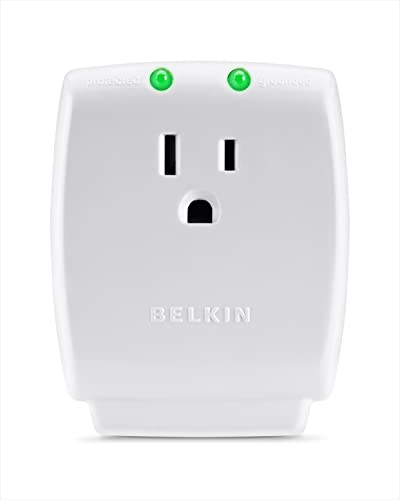
- Status LEDs and auto-shutoff. “Protected” and “grounded” indicators tell you when protection is spent or wiring is wrong.
- Outlet layout. Rotating outlets or several outlets spaced 1.5 inches or more apart keep power bricks from blocking neighbors.
- Cord length and plug. A 6 to 10 foot cord with a flat, right-angle plug lets the unit sit behind furniture without pushing the console away from the wall.
For most living rooms, the best surge protector for a TV and home theater is an 8- to 12-outlet unit with 2,500 to 4,000+ joules, a UL 1449 clamping voltage (VPR) of 330V or 400V, a 15A rating, coaxial and Ethernet protection, and widely spaced outlets for power bricks; wall-mounted TVs are better served by a low-profile wall-tap protector or a recessed in-wall power kit behind the screen. If you run a receiver, powered subwoofer and projector, a rack-style power conditioner with sequenced or filtered banks becomes worth the extra money.
Our top picks


As an Amazon Associate we earn from qualifying purchases at no extra cost to you. Ratings are shown as listed on Amazon.
Start With What You Are Plugging In
Home theater gear draws less than people think, but it adds up, and the subwoofer is the wild card. Add your numbers before choosing an outlet count.
| Component | Typical draw while playing | Peak or rated draw | Outlet notes |
|---|---|---|---|
| 55-65 inch LED/QLED TV | 80-180W | Up to 250W in HDR | Standard plug or small brick |
| 65-77 inch OLED TV | 100-250W | Up to 400W in bright HDR | Standard plug |
| AV receiver (5.1-7.2) | 60-200W at normal volume | 500-900W rated input | Heavy plug; give it its own outlet |
| Powered subwoofer | 30-150W | 300-1,000W on bass peaks | Prefers a non-filtered high-current outlet |
| Soundbar with wireless sub | 20-60W | 150-400W combined | Two outlets (bar and sub) |
| Game console | 100-220W | Up to about 230W | Standard plug |
| Streaming stick or box | 3-10W | Under 15W | Wall wart; needs a spaced outlet or USB port |
| Projector (lamp or laser) | 150-350W | Up to 450W | Often ceiling mounted, separate run |
Worked example: a 65-inch OLED (250W), a 7.2 receiver at movie volume (200W), a sub on bass peaks (400W), a console (200W) and a streamer (10W) total about 1,060W, or roughly 9 amps at 120V. That fits comfortably under a 15A (1,800W) protector, and leaves room for brief peaks. The outlet count is usually the tighter constraint: that list already needs six outlets, two of them for wall warts.
The Specs That Separate Good From Marketing
- Joules: 2,500 minimum, 3,500+ if you live in a storm area. Higher numbers mean the protection lasts through more surges before the MOVs are used up.
- VPR: 330V is best, 400V acceptable, 500V weak. This is the let-through voltage from the UL 1449 test and is a better indicator than joules of how much spike reaches your gear.
- Coax and Ethernet protection. Surges come in on cable and network lines too. If your TV or receiver connects to a cable box or a wired network, route those lines through the protector.
- EMI/RFI filtering. Useful for keeping noise from refrigerators and dimmers off audio gear, typically quoted as attenuation in decibels. It will not transform picture quality, but it can reduce hum in some systems.
- Status LEDs and auto-shutoff. “Protected” and “grounded” indicators tell you when protection is spent or wiring is wrong.
- Outlet layout. Rotating outlets or several outlets spaced 1.5 inches or more apart keep power bricks from blocking neighbors.
- Cord length and plug. A 6 to 10 foot cord with a flat, right-angle plug lets the unit sit behind furniture without pushing the console away from the wall.
Wall-Mounted TVs: Three Clean Approaches
1. Low-profile wall-tap protector behind the TV
If there is already an outlet behind the screen, a slim wall-tap surge protector (usually 3 to 6 outlets, 1,000 to 2,000 joules, roughly an inch deep) gives the TV, a streaming stick and maybe a soundbar protected power without hanging a strip in mid-air. Check the depth against the gap your mount leaves; tilting mounts often leave 2 to 3 inches, ultra-slim mounts sometimes less than 1.5 inches.
2. Recessed in-wall power kit plus a protector
Code-compliant in-wall kits (Legrand and PowerBridge are established names here) run power from a lower box to a recessed box behind the TV through an approved cable assembly. Never run a regular extension or power cord inside the wall; that is not permitted by electrical code. Pair the kit with a surge protector at the lower outlet, or with a recessed surge module where the kit supports it.
3. Protector at the media console, cables run in a raceway
The simplest option for renters: keep a full-size protector at the console and run the TV cord and HDMI up a paintable surface raceway. You give up a perfectly hidden look but keep all protection in one place.
Match the Protector to Your Setup
| Setup | Recommended protector | Key specs | Typical price range |
|---|---|---|---|
| TV plus streaming stick, wall mounted | Slim wall-tap protector | 3-6 outlets, 1,000-2,000 J, 400V VPR or better | $15-$35 |
| TV, soundbar, console on a stand | 8-outlet strip with coax | 2,500-3,500 J, 330-400V VPR, 2+ wide outlets | $25-$60 |
| Receiver, 5.1+ speakers, sub, several sources | 10-12 outlet theater protector with coax and Ethernet | 3,500-4,500 J, 330V VPR, isolated filter banks | $50-$130 |
| Equipment rack or dedicated theater room | Rack-mount power conditioner (Furman and Panamax are well-known) | Voltage display, filtered banks, 15-20A capacity | $120-$400+ |
| Frequent outages or brownouts | Line-interactive UPS for TV and router, protector for the rest | Battery backup only where a clean shutdown matters | $80-$250 |
APC, Eaton Tripp Lite and Belkin all make home-theater-oriented surge strips with coax and network ports. Choose by the published VPR, joules and outlet layout rather than the logo on the box.
Setup Steps That Make the Protection Actually Work
- Use one ground point. Plug every component in the system, and the cable or network line, into the same protector. Splitting gear between two outlets on different protectors can create ground differences that surges exploit and can also cause hum.
- Plug the protector straight into a grounded wall outlet. Confirm the “grounded” light is on.
- Never daisy-chain. Do not plug a protector into another protector or extension cord. It voids most connected-equipment warranties and creates overload risk.
- Give the sub and receiver high-current outlets if the protector labels some outlets that way; some filtered banks limit current.
- Leave airflow. Keep the strip off carpet and away from the receiver’s vents.
Ownership Realities
- Protection is consumable. MOVs degrade with each surge. Replace the unit after a nearby lightning strike, when the protected LED goes out, or every three to five years in stormy regions.
- Power conditioners are not magic. They will not sharpen the picture or widen the soundstage. Their value is protection, organization and noise reduction in problem houses.
- Big storms call for unplugging. No plug-in protector stops a direct lightning hit. Unplugging the TV and disconnecting coax during severe storms is still the most reliable protection.
- Consider whole-home protection too. A panel-mounted surge device handles large utility surges, and the point-of-use protector cleans up what remains.
FAQ
Do OLED TVs need special surge protection?
No special type, but they are expensive enough that a 330V VPR protector with 2,500+ joules is a sensible minimum.
Should the TV go on a UPS?
Not usually. A UPS adds battery replacement costs every three to five years. It is worth it mainly for routers, game consoles mid-download, or areas with frequent brief outages.