Key takeaways
- 16 AWG, 13A: OK for lamps, chargers, monitors up to 25 ft. Avoid for gaming PCs, space heaters, or laser printers.
- 14 AWG, 15A: The sweet spot for most home offices. Safe to 25-50 ft for a PC + dual monitors.
- 12 AWG, 15-20A: Best for workshop-to-office runs over 50 ft, high-watt gaming rigs, or when the cord will sit under a rug or get warm.
An extension cord just delivers power over distance, while a surge protector actively clamps voltage spikes before they reach your PC, TV, or home office gear — if you need both reach and protection, you need a surge protector with a built-in long cord, not a plain extension cord.
Mixing them up is common because they look similar, but they do completely different jobs. A standard extension cord or basic power strip offers zero surge defense. A surge protector looks like a power strip but contains Metal Oxide Varistors (MOVs) that divert excess voltage to ground in nanoseconds. For anything with a motherboard, SSD, or sensitive power supply, that difference matters.
As an Amazon Associate we earn from qualifying purchases at no extra cost to you.


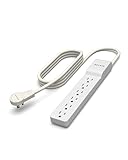

Head-to-head: what each device actually does
| Spec / Feature | Standard Extension Cord | Basic Power Strip (no surge) | Surge Protector |
|---|---|---|---|
| Primary job | Extend reach 6-50 ft | Add outlets at one spot | Add outlets + block spikes |
| Surge energy rating | 0 joules (no protection) | 0 joules (no protection) | 600 to 4,320 joules |
| Clamping voltage (UL 1449) | None – passes 6,000V spike through | None | 330V, 400V or 500V (330V is best for PCs) |
| Response time | N/A | N/A | Less than 1 nanosecond |
| Typical cord gauge | 16 AWG to 12 AWG | 16 AWG to 14 AWG | 14 AWG to 12 AWG |
| Max continuous load (15A / 120V) | 1,875W peak, 1,440W safe (80% rule) | 1,875W peak, 1,440W safe | 1,875W peak, 1,440W safe |
| Overload switch | Usually no | Usually 15A breaker | Almost always 15A breaker |
| EMI/RFI noise filtering | No | No | Yes on most PC-rated models, 20-40 dB |
| Fails after big surge? | No (but gear fries) | No (but gear fries) | Yes by design – MOVs sacrifice themselves |
The key numbers to check on any surge box are joules and clamping voltage. Joules are the total energy it can absorb over its life. A 600-joule travel unit is fine for a phone charger, but for a desktop PC or OLED TV you want 2,000 joules or more. Clamping voltage is the trigger point — UL-listed models clamp at 330V to 500V. Lower is better because your power supply sees less stress.
Why a plain extension cord can’t protect a PC
A surge from lightning, grid switching, or a large appliance cycling off can hit 2,000 to 6,000 volts for microseconds. Your PC power supply has some filtering, but it is designed for 120V nominal, not repeated kilovolt spikes.
An extension cord with 16 AWG or even heavy-duty 14 AWG copper does nothing to reduce that voltage. It just gives the spike a longer path to your computer. That is why fried motherboards and dead SSDs often happen on setups that were “on a power strip” — it was a $15 power strip with no MOVs, no joule rating, and no protected indicator light.
A true surge protector diverts that excess to ground and opens its thermal fuse if the MOVs overheat. Once that happens, on better models from brands like APC, Eaton Tripp Lite, and Belkin, the “Protected” LED goes out to tell you protection is gone, even if power still flows.
Cord thickness matters more than length
Thinner, longer cords create voltage drop and heat. For PC and home theater gear, cord gauge (AWG) is more important than marketing about “heavy-duty.”
- 16 AWG, 13A: OK for lamps, chargers, monitors up to 25 ft. Avoid for gaming PCs, space heaters, or laser printers.
- 14 AWG, 15A: The sweet spot for most home offices. Safe to 25-50 ft for a PC + dual monitors.
- 12 AWG, 15-20A: Best for workshop-to-office runs over 50 ft, high-watt gaming rigs, or when the cord will sit under a rug or get warm.
Never daisy-chain: plugging a surge protector into an extension cord, or vice versa, violates UL and fire codes in most offices and can void insurance. It adds resistance, defeats the breaker coordination, and increases fire risk if one cord is coiled. If you need distance plus defense, buy one unit designed for it — the best extension cord with surge protector built in is simply a surge protector with a 10 to 15-foot 14 AWG cord, not two products linked together.
Worked example: will you overload a 15A strip?
Add up watts, then stay under 1,440W (80% of 1,875W for continuous use):
Gaming PC under load: 550W + 27-inch monitor: 45W + second monitor: 45W + powered speakers + router + laptop charger: ~80W = 720W total / 6.0 amps at 120V. Well within limits.
Now add a 1,500W space heater on the same strip: 720W + 1,500W = 2,220W / 18.5 amps. That will trip the breaker or overheat a 16 AWG cord. Heaters, air conditioners, coffee makers, and laser printers should always get their own direct wall outlet, never share a PC surge protector.
Which setup to buy for your situation
| Your Situation | Pick This | Why |
|---|---|---|
| Desktop PC + dual monitors within 6 ft of wall | 8-12 outlet surge protector, 2,000+ joules, 330V clamping, 6-ft 14 AWG cord | Maximum MOV life, short cord = lowest voltage drop |
| Home office across the room, outlet 10-15 ft away | Best surge protector with long cord: 10-15 ft, 14 AWG, flat plug, 2,500-3,500 joules | One UL-listed unit replaces risky extension + strip combo |
| Living room TV, console, soundbar | Surge protector with coax/ethernet protection, 3,000+ joules, 8-12 ft cord | Surges enter via cable and network lines, not just power |
| Garage, tools, occasional PC use | Heavy-duty 12 AWG single-outlet extension cord for tools + separate wall-plug surge for electronics | Tools need amps, electronics need clamping — different jobs |
| Renter with one outlet behind desk, tight space | Low-profile wall-mount surge with 3-ft cord, 1,200-2,000 joules | Avoids long cord coils that trap heat |
If you search for the best surge protector extension for a PC, prioritize in this order: 1) UL 1449 listed with a published joule and clamping rating, 2) 14 AWG or thicker cord in the length you actually need, 3) protected and grounded indicator lights, 4) spacing for bulky AC adapters. USB-A/USB-C charging ports are convenient for phones but do not affect surge performance — do not pay extra for them thinking they add protection.
Durability and ownership realities
Surge protectors are consumables. Every small spike wears the MOVs a little, one large lightning-nearby spike can finish them instantly. What wears first is almost always the MOV module, not the cord or outlets.
- Check the lights monthly: If “Protected” is off but “Power” is on, the unit is now just an expensive extension cord. Replace it.
- Lifespan: In a typical suburban home, a 2,000-joule unit lasts 3-5 years. In lightning-prone or old-wiring homes, 2-3 years is normal. There is no reset for worn MOVs.
- Common mistake: Covering the strip with dust, paper, or carpet. MOVs run hot when clamping; they need airflow and must be plugged directly into a properly grounded 3-prong outlet. A 2-prong adapter defeats surge diversion.
- Cleaning: Unplug, wipe with dry cloth, vacuum vents. Do not use a coiled cord as a permanent install — uncoil fully to prevent heat buildup, especially with 16 AWG cords over 25 ft.
Extension cords fail differently: prongs loosen, jackets crack where they bend at the plug, and cheap molded plugs overheat under sustained 12-15A loads. If the plug feels warm after 30 minutes, your load is too high or the gauge is too thin. Replace, do not tape.
Bottom line for PCs, TVs, and home office gear
Use a plain, thick-gauge extension cord only for temporary, high-current, dumb loads like power tools or lawn equipment. Use a UL 1449 surge protector for everything with a chip. And when distance is the problem, do not combine them — get the best surge protector with long cord in a single package, sized at 2,000 joules or higher with 330V clamping and 14 AWG wire. It costs in the general range of $25 to $60 for quality home-office models, versus $12 to $20 for a non-protective strip, but that difference is the only thing standing between a grid spike and a dead PC.
FAQ
Can I plug a surge protector into an extension cord to make it longer?
No. Manufacturers, UL, and OSHA all advise against it. The extra resistance can delay breaker tripping and cause overheating. Buy a surge protector with a factory-installed 10-foot, 15-foot, or 25-foot cord instead.
Does a higher joule rating use more electricity?
No. Joules measure how much surge energy it can absorb before wearing out, not power consumption. Higher joules just means longer protective life.
Do I need a surge protector if I have a whole-house suppressor at the breaker panel?
Yes for PCs and TVs. A panel unit knocks a 6,000V surge down to around 600V. A point-of-use protector with 330V clamping handles the rest and also filters internal spikes from AC units and appliances.