Key takeaways
- Compare the best hole punches: single-hole, three-hole and adjustable models, with true sheet capacity, punch sharpness and chip tray guidance.
As an Amazon Associate we earn from qualifying purchases.
A hole punch looks like the simplest tool in the office, right up until a page tears out of a binder because the holes landed a few millimeters off, or a stack jams halfway through a press. The differences that matter are real: how many sheets the punch cuts cleanly instead of chewing, whether holes land in the same place on every sheet, how the heads hold up after thousands of cycles, and whether paper chips stay inside the tool or end up across your desk. This guide covers the formats most people actually need — a single-hole hand punch for tags, tickets and craft work, an adjustable desktop model for non-standard binders, a reduced-effort design for sore hands, a heavy-duty model for thick stacks, and an electric option for high-volume filing — with honest notes on where each one reaches its limit.
Disclosure: This article contains affiliate links. If you make a purchase through these links, we may earn a commission at no extra cost to you.
How to Choose the Right Hole Punch
Start with the hole pattern, not the tool. Standard US three-ring binders use three holes spaced 4.25 inches apart, center to center, and nearly every desktop three-hole punch is built around that spacing. If all you file is letter-size paper in a standard binder, a fixed-head punch is the simplest, sturdiest choice. Adjustable heads earn their keep when your work leaves that standard: two-hole files, A5 and half-letter planner pages, and legal documents all need the heads to slide. Adjustable mechanisms add moving parts, so only accept that complexity if you will genuinely move the heads.
Read sheet capacity with suspicion. The number on the box is measured on fresh 20 lb copy paper, stacked flat and perfectly aligned. A punch that claims 20 sheets will cut 20 — but the last presses at full capacity are where torn holes, half-cut discs stuck in the head, and bent pins come from. Cardstock and laminated pages count far heavier; treat one sheet of cardstock like three or four of plain paper. Work at about three quarters of the stated capacity, and split thick reports into smaller stacks rather than leaning your body weight on the handle.
Hole size and head sharpness decide how pages behave in the binder. The standard hole diameter is 9/32 inch, sized to slip over binder rings without slop. Larger holes turn pages more easily but tear out sooner; smaller holes grip rings and resist turning. A sharp head shears a clean disc, while a dull head pushes a ragged flap that catches on rings. Heads are wear parts, and better punches sell replacements, which restores a dulling punch for a fraction of replacing the tool. Punching aluminum foil can knock a burr off an edge, but it does not restore a genuinely worn head — plan on replacement heads for a punch you expect to keep for years.
Chip trays are a bigger deal than they look. Every press produces paper discs, and where they go determines how tidy the tool is. Enclosed bases swallow hundreds of chips, but the chips are invisible, so they back up into the punch heads and cause mystery jams if you forget them. Open trays show the fill level, yet love to spill the moment you pick the punch up by the wrong end.
A paper guide is only good if it stays put. The edge guide sets how far the holes sit from the edge of the sheet, and consistency here is the whole point of a desktop punch. Look for a guide that locks or clicks into detents rather than sliding freely, because a drifting guide leaves every section of the binder sitting at a slightly different height.
Match the effort design to your hands and volume. Reduced-effort punches use leverage geometry to cut pressing force roughly in half, which matters if you punch many stacks a day. Electric punches remove the effort entirely and keep placement consistent, at the expense of speed per cycle and a dependence on an outlet or batteries. For a few pages a week, any manual punch here will do the job.
Swingline 1 Hole Punch, Chrome (74005)

The classic plier-style single-hole punch has barely changed in decades, and that is its strength. The Swingline 74005 is a chrome-finished metal hand punch that cuts one 1/4 inch hole at a time, through up to five sheets of paper. There is nothing to adjust: you position the hole by eye, squeeze, and move on. That makes it the right tool for jobs a desktop punch cannot do — tags and tickets, a hanging hole in a laminated badge, and a single hole in a gift tag.
The all-metal build is why this design survives in desk drawers for years. The handles are sized for a full hand squeeze, and a small receptacle catches the paper chips so they do not scatter with every punch. Five sheets is a modest, honest ceiling: force a sixth sheet and the hole comes out ragged rather than round. Reach is the other real limit — the shallow throat lands holes near the edge of the sheet, which suits tags and tickets but rules out center-page work.
For crafters, keep one in the project box too: it handles punched borders on card blanks, holes for book rings, and quick work on paper chains and garlands.
Specs
- Single hole, 1/4 inch diameter
- Capacity: 5 sheets of 20 lb paper
- Chrome-plated metal plier construction
- Model 74005 (A7074005S), made by ACCO Brands
- Built-in chip receptacle in the handle
See it on Amazon: https://www.amazon.com/dp/B00006IBK9
Swingline Precision Pro Desktop Punch (74037)
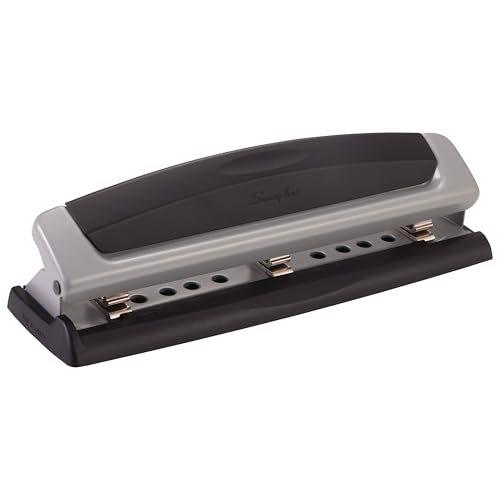
Most desktop punches fix their three heads at standard binder spacing and that is the end of the story. The Precision Pro’s heads are semi-adjustable, sliding so one tool punches either a two-hole or a three-hole pattern — covering standard binders, two-hole file folders, and a range of planner formats. The trade-off is capacity: this is a 10-sheet punch for everyday filing, not thick reports.
The detail that lifts the Precision Pro above other light-duty punches is its replaceable heads. Swingline sells them separately, so when a head starts leaving ragged holes after a few years of use, you swap the head instead of binning the whole punch. The patented pin mechanism delivers a clean cut with a smooth press, and the metal construction feels reassuringly solid.
Setup matters with an adjustable punch: slide the heads to your pattern, set the paper guide, then punch a test sheet and check it against your binder before running a stack. If your work mixes formats, this is the most versatile manual punch in this guide.
Specs
- Semi-adjustable heads for 2-hole or 3-hole patterns
- Capacity: 10 sheets of 20 lb paper
- Hole diameter: 9/32 inch
- Metal construction, black and silver finish
- Replaceable punch heads (Swingline replacement head A7074870)
See it on Amazon: https://www.amazon.com/dp/B0006HUPHU
Bostitch EZ Squeeze 3-Hole Punch, 20 Sheet

If pressing a standard punch through a full stack leaves your palm aching, the EZ Squeeze design is the fix. Bostitch reshaped the leverage so this three-hole punch needs roughly half the force of a conventional model to cut the same 20-sheet stack, with anti-jam engineering that keeps a press from stalling mid-pile. For teachers prepping handouts, office staff filing daily paperwork, and anyone with grip or wrist complaints, that reduced effort is the difference between a tool that gets used and one that gets avoided.
The punch itself is a fixed-head desktop model set to standard 4.25 inch binder spacing, cutting 9/32 inch holes. The metal construction keeps it planted on the desk, an integrated ruler and paper guide handle alignment, and a rubberized footing keeps the unit from skating across the desk when you press.
Honest limits: 20 sheets is the ceiling on copy paper, and this punch is happiest at 15 or below. Its heads are not replaceable like the Precision Pro’s, so you are buying it for the mechanism — and for high-frequency, moderate-stack work it is the most comfortable manual punch here.
Specs
- Fixed 3-hole pattern at standard binder spacing
- Capacity: 20 sheets of 20 lb paper
- Hole diameter: 9/32 inch
- EZ Squeeze reduced-effort mechanism with No Jam technology
- Metal construction with integrated ruler and paper guide
See it on Amazon: https://www.amazon.com/dp/B004I2EB24
Bostitch EZ Squeeze Heavy Duty 3-Hole Punch, 40 Sheet

Some filing jobs are simply thick: training manuals, financial reports, course packs, a semester of worksheets. The heavy-duty EZ Squeeze doubles the working capacity to 40 sheets per press while keeping the reduced-effort mechanism, so a 120-page document becomes three calm presses instead of six strained ones. The heavier metal body stays put under the extra load, and the leverage makes a 40-sheet press feel closer to a normal punch handling 20.
This is the model to choose when the standard advice — split the stack — stops being practical. It keeps the same fixed spacing and 9/32 inch holes as its smaller sibling, with an adjustable paper guide and a larger chip chamber. Because it produces chips twice as fast, empty the tray on a schedule; backed-up chips are the number one cause of heavy-duty punches feeling dull when they are actually just full.
Two honest cautions. First, 40 sheets of copy paper is the stated limit — add a cardstock cover and the job gets much harder, so punch covers separately. Second, this is a stay-on-the-desk tool; if your punching happens in three different rooms, the lighter models above serve you better. For a copy room, front office, or a teacher’s desk that processes paper all day, this is the heavy-duty pick.
Specs
- Fixed 3-hole pattern at standard binder spacing
- Capacity: 40 sheets of 20 lb paper
- Hole diameter: 9/32 inch
- EZ Squeeze reduced-effort mechanism, heavy-duty metal body
- Adjustable paper guide with enlarged chip chamber
See it on Amazon: https://www.amazon.com/dp/B00UCBJIG4
Swingline Electric Hole Puncher, 3 Hole (74515)
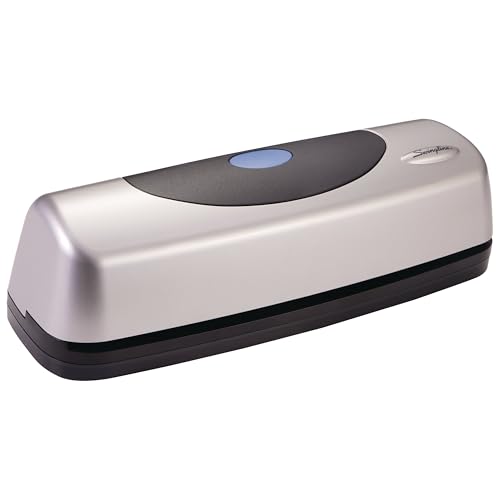
The electric option trades raw capacity for total consistency. The Swingline 74515 punches three holes through up to 15 sheets at the touch of a button, the motor delivering the same force on the fiftieth stack as on the first — no tired hands, no half-pressed holes at the end of a long filing session. It runs on the included AC adapter or on batteries, so it can live on a desk or travel to wherever the paper is — handy for registration packets, conference materials, and shared office stations.
Placement is fixed at standard binder spacing with 9/32 inch holes, and a built-in guide keeps sheets registered the same way every time. Feed the stack square and let the cycle finish before removing the paper. Pulling the stack mid-cycle is how torn holes happen with this format.
Be clear about what it is not. At 15 sheets it has less capacity than the heavy-duty model above, and each cycle takes a few seconds, so one enormous report is faster on the 40-sheet Bostitch. The electric punch wins on repeatability across many medium stacks, and on accessibility for users who cannot press a manual punch at all. Batteries drain faster under heavy stacks, so use the adapter at a permanent station.
Specs
- Electric 3-hole punch, fixed standard spacing
- Capacity: 15 sheets of 20 lb paper
- Hole diameter: 9/32 inch
- Dual power: AC adapter or battery operation
- Black and silver desktop housing, model 74515
See it on Amazon: https://www.amazon.com/dp/B001CE75D8
Frequently Asked Questions
Why do my punched holes tear out of the binder so easily?
Usually the holes sit too close to the edge of the sheet, or the punch heads are getting dull. Check the paper guide first: if it has drifted, holes land nearer the edge and the thin strip of paper rips under the weight of the page. Reset the guide, punch a test sheet, and check it in the binder. If placement is right but holes look ragged rather than cleanly cut, the heads are worn — replace them if your model supports it, and add reinforcement rings to pages handled constantly.
How many sheets can I really punch at once?
Work at roughly three quarters of the number on the box. That figure is measured on 20 lb copy paper; cardstock covers and laminated sheets each count for several sheets. If the handle needs your body weight, the stack is too thick — split it. Staying under the limit also keeps heads sharp: forcing maximum stacks is the fastest way to bend a pin or dull an edge, and the main reason punches start tearing instead of cutting.
Can one punch handle both US binders and planner pages?
Yes, if the heads adjust. Standard US binders use three holes 4.25 inches apart, while many planners, A5 inserts and two-hole files use different patterns. A semi-adjustable punch like the Precision Pro in this guide slides its heads between two-hole and three-hole layouts. Truly non-standard patterns, such as disc-bound or multi-ring planner systems, need a dedicated punch — check your planner’s pattern before assuming an adjustable punch will match it.
How do I stop paper chips from going everywhere?
Empty the tray before it is full, over a bin, with the punch held level — most spills happen when a full punch is tilted on the way to the trash. Models with an enclosed base or viewing window help because you can see the fill level. If chips keep appearing on the desk, check the base cover is fully seated; a tray that is not clicked shut leaks a few discs with every press.
Conclusion
For most desks, the Bostitch EZ Squeeze 20-sheet is the punch to buy: standard spacing, comfortable reduced-effort pressing, and enough capacity for everyday filing. If your binders and planners mix two-hole and three-hole formats, choose the Swingline Precision Pro and keep spare replaceable heads in the drawer. Thick, frequent stacks belong to the Bostitch EZ Squeeze Heavy Duty 40-sheet, while high-volume, zero-effort work is the natural home of the Swingline Electric 74515. For tags, tickets and craft projects, nothing replaces the little Swingline 1 Hole Punch. Whichever you choose, respect the honest capacity and empty the chips before they remind you.
More from Amazon
Programs that pair well with the guide above. Offers and eligibility are set by Amazon and may change.
Free shipping on eligible items, Prime Video and more. Eligible new members can start with a free trial.
Start a Prime free trialAd-free music streaming. Eligible new subscribers can start with a free trial.
Try Music Unlimited freeA Prime membership for ages 18-24 with a trial period. Eligibility is set by Amazon.
See Prime for Young AdultsAudiobooks and podcasts to listen to on the go. Eligible new members can start with a free trial.
Try Audible freeAs an Amazon Associate we earn from qualifying purchases.