Our Short List of 3
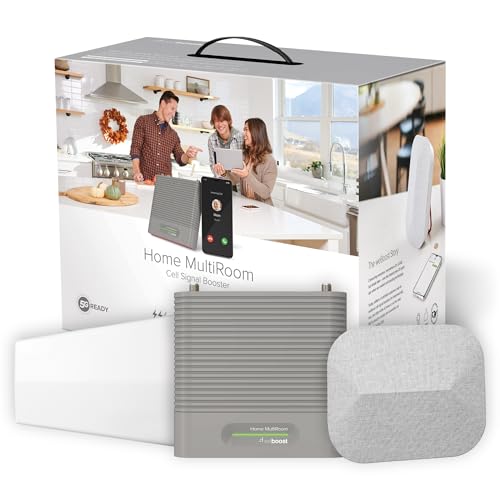
- Best for: Multi-room houses where several carriers are in use at once.
- Coverage: up to 5,000 sq ft, up to 3 to 4 rooms
- Carriers: all U.S. carriers, including Verizon, AT&T and T-Mobile
- Networks: 5G and 4G LTE
- Booster dimensions: 6.5 x 6 x 2.63 in; weight 1.9 lb

- Best for: Cabins and rural homes that can aim a directional antenna at a known tower.
- Coverage: up to 3,500 sq ft, 2 to 4 rooms, scaled by outside signal strength
- Max gain: 72 dB
- Outdoor antenna: Yagi directional; indoor antenna built into the base unit
- In the box: booster, Yagi antenna, coax cable, power cord, user manual

- Best for: Commuters and road-trippers driving through rural dead zones.
- Max gain: 50 dB
- Bands supported: 12/17, 13, 5, 4 and 25/2
- Outside antenna: 4-inch magnet-mount; inside antenna: slim low-profile
- Kit contents: booster, magnet-mount antenna, slim low-profile antenna, power supply
All 4 Picks at a Glance
| Product | Specs | Action |
|---|---|---|
| weBoost Home MultiRoom (470144) |
| Check price on Amazon |
| SureCall Flare 3.0 |
| Check price on Amazon |
| weBoost Drive Reach (470154) |
| Check price on Amazon |
 weBoost Drive Reach Overland (472061) |
| Check price on Amazon |
Key takeaways
- Five cell phone signal boosters compared for homes, cabins and vehicles, with coverage area, max gain, supported bands and antenna types checked first.
A booster cannot invent signal. It takes the weak signal already reaching your roof or vehicle, amplifies it, and rebroadcasts it inside, so the real buying decision is matching the kit to the signal you have and the space you need to cover. Pick the wrong type, too little gain, or a kit missing your carrier’s main band, and the bars on your phone will not move.
This guide compares five FCC-approved booster kits for the three places signal usually fails: multi-room houses, rural cabins and offices, and vehicles that cross weak-signal country. The picks come from Amazon listing titles and specification tables, and they work with all major U.S. carriers. Two kits are built for the road, three for buildings, and each entry states its coverage, gain and antenna setup so you can shortlist by situation first.
Quick Picks
As an Amazon Associate we earn from qualifying purchases
| Product | Best for | Key spec from title |
|---|---|---|
| weBoost Home MultiRoom | Multi-room houses | Boosts 5G and 4G LTE up to 5,000 sq ft |
| SureCall Flare 3.0 | Homes with a usable outdoor signal | Yagi outdoor antenna, up to 3,500 sq ft |
| HiBoost 10K Pro Home Booster | Large homes and offices | Covers 7,000 sq ft with 2 indoor antennas |
| weBoost Drive Reach | Cars, trucks and SUVs | Magnetic roof antenna, 50 dB max gain |
| weBoost Drive Reach Overland | Off-road and overland rigs | Rack-mount antenna for 4×4 vehicles |
How to Choose
Start With the Signal Outside
Every kit in this guide amplifies an existing signal rather than creating one, so the first check happens before you spend anything. Walk to the spot where the outside antenna would sit, usually the roof or the highest exterior wall, and look at your phone. One or two bars there is a workable starting point for a home kit, and a directional antenna can reach farther towers than the omni-directional type. If the phone shows no service at all at that spot, no booster on this page will fix the problem, and a different antenna position or a carrier conversation comes first.
Match the Coverage Rating to Your Space
Headline coverage figures assume a strong signal at the outside antenna, and real rooms shrink them fast. SureCall is unusually transparent about this: its Flare 3.0 rating of 3,500 sq ft assumes five bars outside, while one or two bars outside delivers roughly 1,500 sq ft inside. Interior walls, metal siding and foil-backed insulation all eat into the result as well. Measure the area where calls actually drop, then size one tier up if your home sits near the top of a kit’s rating, especially for two-storey layouts or separated wings.
Confirm Bands and Carrier Support
All five kits amplify signal for Verizon, AT&T, T-Mobile and the smaller carriers that share their networks, and they do it for every phone in range at the same time. What differs is the band list. The vehicle kits and the HiBoost cover bands 12/17, 13, 5, 4 and 25/2, which carry most U.S. 4G LTE and the widely deployed form of 5G. Check your carrier’s main band in your area against the kit’s list before ordering, and stick to FCC-approved boosters like these, since unapproved amplifiers can interfere with the network and draw a carrier shutdown request.
Plan the Antenna Run Before Ordering
A booster kit is only as good as its installation. The outside and inside antennas need physical separation, with a wall or roof between them, or the system feeds back on itself and throttles its own gain; HiBoost’s instructions call for more than 35 ft between the two antennas on its home kit. Home kits need a cable path from the roof antenna down to the booster, while vehicle kits need either a steel panel for a magnet mount or a rack or rail for a bolt-on bracket. Walk the route and measure it first, because cable length and mounting hardware decide which kit fits your building or vehicle.
The 5 Best Options
weBoost Home MultiRoom (470144)
- Best for: Multi-room houses where several carriers are in use at once.
- Coverage: up to 5,000 sq ft, up to 3 to 4 rooms
- Carriers: all U.S. carriers, including Verizon, AT&T and T-Mobile
- Networks: 5G and 4G LTE
- Booster dimensions: 6.5 x 6 x 2.63 in; weight 1.9 lb
Multi-room houses where several carriers are in use at once.
The 5,000 sq ft figure assumes a solid signal at the outside antenna, so a careless roof placement can cut real coverage down to a room or two.
The Home MultiRoom is the default pick for a house where calls die in the back bedrooms but hold up near a front window. It is rated for up to 5,000 sq ft across three to four rooms and boosts every U.S. carrier at once, which suits households where one person is on Verizon and another on T-Mobile. The weBoost app helps find the nearest tower and check signal before and after installation, and the fabric-covered inside antenna is designed to sit visibly on a shelf rather than hide in an attic. It is made in the U.S. and carries FCC approval.
SureCall Flare 3.0
- Best for: Cabins and rural homes that can aim a directional antenna at a known tower.
- Coverage: up to 3,500 sq ft, 2 to 4 rooms, scaled by outside signal strength
- Max gain: 72 dB
- Outdoor antenna: Yagi directional; indoor antenna built into the base unit
- In the box: booster, Yagi antenna, coax cable, power cord, user manual
Cabins and rural homes that can aim a directional antenna at a known tower.
The Yagi must be pointed at the tower and may need re-aiming if you change carriers, so budget some ladder time during setup.
The Flare 3.0 suits homes and cabins that have a usable but weak signal outside and a known tower to aim at. Its Yagi directional outdoor antenna adds reach toward distant towers, while the booster and indoor antenna are combined in one tabletop base unit, which keeps the indoor half of the install simple. SureCall publishes honest scaled coverage numbers, from about 1,500 sq ft with one or two bars outside up to 3,500 sq ft with a full-strength signal, and the kit includes a 50 ft RG-6 coaxial cable. A 3-year warranty and lifetime U.S.-based support round out the package.
HiBoost Cell Phone Booster for Home, 7,000 Sq Ft
This HiBoost kit carries the largest coverage rating in the guide, up to 7,000 sq ft, and spreads it with two indoor antennas, which helps in long or split floor plans where a single indoor antenna leaves the far rooms behind. Maximum gain is 65 dB, the band list covers the main U.S. LTE and 5G bands, and the Signal Supervisor app support makes it easier to position the outdoor antenna and check the system after installation. It is the natural step up when a mid-size home kit would be working at the edge of its rating in a big house or a busy office.
Specs
- Coverage: up to 7,000 sq ft, about 3 to 4 rooms
- Max gain: 65 dB
- Antennas: 1 outdoor antenna and 2 indoor antennas, 1 built in
- Bands supported: 2, 4, 5, 12, 13, 17 and 25, covering 2G, 3G, 4G LTE and 5G
- Monitoring: Signal Supervisor app support; FCC approved
- Carriers: all U.S. carriers, including Verizon, AT&T and T-Mobile
Best for: Large homes and offices that need signal pushed into separated wings or floors.
Watch out for: Keep the outdoor and indoor antennas well apart; the listing calls for more than 35 ft of separation to avoid self-oscillation.
ASIN: B07VP46KRB
weBoost Drive Reach (470154)
- Best for: Commuters and road-trippers driving through rural dead zones.
- Max gain: 50 dB
- Bands supported: 12/17, 13, 5, 4 and 25/2
- Outside antenna: 4-inch magnet-mount; inside antenna: slim low-profile
- Kit contents: booster, magnet-mount antenna, slim low-profile antenna, power supply
Commuters and road-trippers driving through rural dead zones.
The magnet antenna needs a steel panel to grip, so aluminium or fibreglass roofs need a different mounting plan before you order.
The Drive Reach is the straightforward vehicle pick for cars, trucks and SUVs that regularly cross rural dead zones. Its outside antenna is a 4-inch magnet mount that sticks to a steel roof with no tools, and the slim low-profile inside antenna sits near the console. Gain reaches 50 dB, the maximum the FCC allows for this class, and the booster strengthens signal for multiple devices and passengers at the same time rather than a single cradled phone. The kit is made in the U.S. by Wilson Electronics and runs from the vehicle’s power supply, so there is nothing to recharge between trips.
weBoost Drive Reach Overland (472061)
- Best for: Overland and off-road vehicles that travel far beyond tower range.
- Use: 4×4 and off-road vehicles
- Outside antenna mounting: rail, rack or direct body mount with bracket
- Bands supported: 12/17, 13, 5, 4 and 25/2
- Carriers: all U.S. carriers, including Verizon, AT&T and T-Mobile
Overland and off-road vehicles that travel far beyond tower range.
Installation is a moderate DIY job, since the external antenna must be bolted to the body or rack rather than dropped on with a magnet.
The Drive Reach Overland takes the same vehicle-booster idea and hardens it for 4×4 and off-road use, where a magnet antenna would not survive the trail. Its rugged outdoor antenna mounts to a roof rack, rails or the vehicle body with a versatile bracket, so it stays put on corrugated tracks and low branches. It boosts 5G and 4G LTE for all U.S. carriers and multiple devices inside the cabin, which matters when a group is navigating from downloaded maps and needs calls to work at the trailhead. Installation takes longer than the magnet-mount version, but it is a one-time job.
Which One Fits Your Situation
A House Where Signal Dies in the Back Rooms
Start with the weBoost Home MultiRoom, whose panel-style inside antenna and multi-room rating are built for exactly this pattern. If your outside signal is decent and you want the extra reach of a directional antenna, the SureCall Flare 3.0 is the alternative, provided you can aim its Yagi at the tower.
A Rural Cabin With One or Two Bars
The SureCall Flare 3.0 fits best here because its published coverage scales honestly with weak outside signal and its Yagi antenna pulls from distant towers. For a larger cabin or a small lodge, step up to the HiBoost kit and use its second indoor antenna for the far rooms.
Daily Driving Through Weak-Signal Country
Choose the weBoost Drive Reach. The magnet-mount antenna installs in minutes on a steel roof, the 50 dB gain is the strongest allowed in this class, and passengers share the boost instead of taking turns with a cradle. It moves between vehicles easily if your household shares one kit.
A Trail Rig That Sleeps Off-Grid
Pick the weBoost Drive Reach Overland. Its bracket-mounted antenna survives racks, branches and corrugations that would strip a magnet mount, and the install is done once and forgotten. Regular Drive Reach owners who later add a roof rack often end up re-mounting; the Overland kit skips that step.
Common Mistakes
- Buying a booster when there is no usable signal at the antenna location, since amplification cannot create signal from nothing.
- Mounting the inside and outside antennas too close together, which causes feedback and makes the booster cut its own gain.
- Chasing the largest coverage number without checking how much signal actually reaches your roof.
- Ignoring the band list and discovering later that your carrier’s main local band is not covered.
- Buying an unapproved booster with no FCC certification, which risks network interference and a carrier shutdown request.
Frequently Asked Questions
Do these boosters work with every carrier at the same time?
Yes. All five kits amplify the supported bands for every carrier that uses them, so phones on Verizon, AT&T, T-Mobile and smaller carriers in the same house or vehicle share the boost at once. There is no per-carrier setup and no subscription, since the booster works with the plan you already have.
Will a booster work if I have no bars at all?
No. A booster needs at least a weak signal at the outside antenna to amplify. If your phone shows no service at the roof or wherever the antenna would mount, move the antenna higher or to another side of the building first. If there is still nothing, a booster is the wrong tool and the carrier or a different connection type is the answer.
What is the difference between a home and a vehicle booster?
Home kits use a mains-powered amplifier, a roof or wall-mounted outside antenna and one or more indoor antennas to cover rooms. Vehicle kits run on vehicle power, use a small roof antenna and cover the cabin only. Their electronics pursue the same goal, but the antennas, power supplies and coverage areas are not interchangeable.
Do I have to register a booster with my carrier?
Under FCC rules, consumer signal boosters must be FCC approved and registered with your carrier, which is a free process handled through the carrier’s website. Every kit in this guide is FCC approved, so registration is a short form rather than a barrier, and it keeps your installation legal and protected if the network flags interference.
More from Amazon
Programs that pair well with the guide above. Offers and eligibility are set by Amazon and may change.
Free shipping on eligible items, Prime Video and more. Eligible new members can start with a free trial.
Start a Prime free trialAd-free music streaming. Eligible new subscribers can start with a free trial.
Try Music Unlimited freeA Prime membership for ages 18-24 with a trial period. Eligibility is set by Amazon.
See Prime for Young AdultsAudiobooks and podcasts to listen to on the go. Eligible new members can start with a free trial.
Try Audible freeAs an Amazon Associate we earn from qualifying purchases.