Our Short List of 3
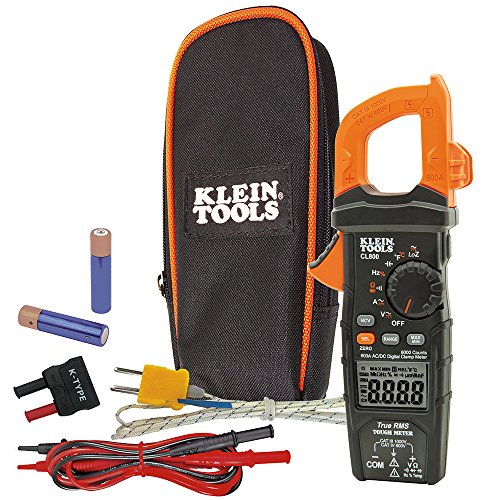
- Best for: electricians and advanced DIYers working in panels and on service equipment.
- Auto-ranging True RMS digital clamp meter
- AC/DC current up to 600 A through the clamp jaw
- AC/DC voltage up to 1000 V
- LoZ low-impedance mode for identifying ghost voltages

- Best for: homeowners and technicians who want a single durable meter for house and workshop.
- True RMS clamp meter, model FLUKE-325
- AC and DC current ranges of 40 A and 400 A
- AC/DC voltage up to 600 V
- Resistance up to 40 kilohms with continuity detection

- Best for: solar, automotive and workshop users who need 1000 A DC capacity at a modest price.
- True RMS digital clamp meter with 6000-count display
- AC/DC current up to 1000 A through the clamp jaw
- Inrush current measurement for motor starting surges
- VFD mode and LoZ mode
All 5 Picks at a Glance
| Product | Specs | Action |
|---|---|---|
| Klein Tools CL800 |
| Check price on Amazon |
| Fluke 325 |
| Check price on Amazon |
| AstroAI Inrush Digital Clamp Meter |
| Check price on Amazon |
 UNI-T UT210E |
| Check price on Amazon |
 Klein Tools CL390 |
| Check price on Amazon |
Key takeaways
- Compare five clamp meters for panel work, solar and automotive DC, and electronics benches, checked for current range, True RMS, CAT rating and jaw size.
A clamp meter earns its place in the bag when you need to know how much current a circuit is actually drawing without cutting it open. The real decision is not the brand on the case but whether the meter reads DC as well as AC, how much current its jaw can handle, and whether its safety rating matches the panel, battery bank or circuit board in front of you.
This guide serves four kinds of buyers: homeowners tracing a tripping breaker, solar and automotive users chasing DC current, electronics hobbyists measuring small DC loads, and working electricians who need a meter that survives daily site use. Every pick below was chosen from its Amazon listing details, with the current range, safety category and included accessories checked against the stated specifications.
Quick Picks
As an Amazon Associate we earn from qualifying purchases
| Product | Best for | Key spec from title |
|---|---|---|
| Klein Tools CL800 | Professional panel and service work | 600 A AC/DC current, 1000 V, LoZ mode |
| Fluke 325 | Buyers who want one long-term meter | 400 A AC/DC current with temperature |
| AstroAI Inrush Clamp Meter | High-current DC on a budget | 1000 A AC/DC with inrush capture |
| UNI-T UT210E | Electronics benches and small DC loads | 100 A mini clamp with a 2 A range |
| Klein Tools CL390 | General AC/DC work with an easy-read screen | 400 A AC/DC with reverse-contrast display |
How to Choose
Decide Whether You Need DC Current
Many entry-level clamps read AC current only, which is fine for household wiring but useless on a car battery lead, a solar charge line or an LED strip feed. If any of your work touches batteries, vehicles, solar gear or DC power supplies, the clamp itself has to sense DC, and that requirement alone removes a large share of the market. Check the listing for DC current through the jaw, not just DC voltage through the test leads, because the two are often listed side by side and are easy to confuse at a glance.
Match the CAT Rating to the Job
The CAT number on a clamp meter describes where in an electrical system it is safe to use, and it matters more than most headline features. CAT III covers distribution wiring such as breaker panels and fixed installations, while CAT IV is the rating intended for service entrances and utility-side work. A meter rated CAT II belongs on receptacle-level circuits and electronics, not inside a main panel. Ratings also pair a category with a voltage, so a CAT III 1000 V meter and a CAT III 300 V meter are not interchangeable even though both say CAT III.
Understand True RMS and Extra Modes
True RMS measurement keeps readings honest on the distorted waveforms produced by variable-speed drives, dimmers, LED drivers and switching power supplies, where an averaging meter can drift noticeably. Beyond that, a few modes solve specific problems: inrush capture records the surge a motor draws at startup, LoZ mode drains ghost voltages on idle runs so they stop masquerading as live circuits, and a low-pass VFD mode steadies readings taken on drive outputs. None of these is essential for simple breaker checks, but each one replaces a workaround or a second instrument when the job calls for it.
Check Jaw Size, Ranges and Resolution
The jaw has to physically fit around your conductor with room to close, and crowded panels punish oversized clamps, so compare the stated jaw opening with the cables you actually meet. Range structure matters just as much: a meter whose lowest current range is 40 A cannot tell a 300 milliamp draw from zero, which is why low-current work calls for a small range with fine resolution. Finally, look at what the leads add, since voltage, resistance, capacitance and temperature all come through the probes rather than the clamp on most models.
The 5 Best Options
Klein Tools CL800
- Best for: electricians and advanced DIYers working in panels and on service equipment.
- Auto-ranging True RMS digital clamp meter
- AC/DC current up to 600 A through the clamp jaw
- AC/DC voltage up to 1000 V
- LoZ low-impedance mode for identifying ghost voltages
electricians and advanced DIYers working in panels and on service equipment.
the listing also shows a newer CL810 version, so confirm which model the offer covers before ordering.
Working electricians and serious remodelers are the natural audience for the CL800, because it pairs a 600 A AC/DC jaw with the CAT IV 600 V and CAT III 1000 V ratings that service and distribution work demand. The LoZ mode settles arguments about ghost voltage on long parallel runs, the non-contact voltage tester in the jaw gives a first warning before leads come out, and the thermocouple input covers quick temperature checks on motors and HVAC equipment. It is built to survive a 6.6-foot drop, and the pouch, leads, thermocouple and batteries are all in the box.
Fluke 325
- Best for: homeowners and technicians who want a single durable meter for house and workshop.
- True RMS clamp meter, model FLUKE-325
- AC and DC current ranges of 40 A and 400 A
- AC/DC voltage up to 600 V
- Resistance up to 40 kilohms with continuity detection
homeowners and technicians who want a single durable meter for house and workshop.
there is no inrush mode, so motor startup surges need a different tool.
The Fluke 325 suits buyers who would rather purchase one meter and keep it for a decade than cycle through budget replacements. Its 40 A and 400 A AC/DC ranges cover household circuits, small motors and vehicle electrics, while temperature, capacitance and frequency measurement handle the HVAC and appliance checks that a current-only clamp cannot. The body is slim, the display is large, and the 30 millimeter jaw fits the conductors found in most residential and light commercial panels. Fluke rates it CAT IV 300 V and CAT III 600 V, which fits distribution-level troubleshooting without overselling it as a utility-side tool.
AstroAI Inrush Digital Clamp Meter
- Best for: solar, automotive and workshop users who need 1000 A DC capacity at a modest price.
- True RMS digital clamp meter with 6000-count display
- AC/DC current up to 1000 A through the clamp jaw
- Inrush current measurement for motor starting surges
- VFD mode and LoZ mode
solar, automotive and workshop users who need 1000 A DC capacity at a modest price.
confirm the jaw opening against your thickest cable, since high-capacity clamps run large.
Budget shoppers who still need serious current capacity are the target for this AstroAI meter, which reads AC and DC current all the way to 1000 A and adds the inrush capture that motor and compressor diagnosis depends on. A VFD mode steadies readings on variable-frequency drive outputs, LoZ mode deals with phantom voltage, and the 6000-count True RMS display covers voltage, resistance, capacitance, frequency, temperature and continuity through the leads. For solar arrays, RV electrics, automotive work and workshop machinery, it delivers the measurement set that usually costs considerably more, making it the value anchor of this guide.
UNI-T UT210E
- Best for: electronics benches, maker projects and tracing small DC loads or parasitic draws.
- Mini digital clamp meter, True RMS, 2000-count display
- AC/DC current up to 100 A, with a 2 A low range
- AC/DC voltage up to 600 V
- Resistance, capacitance, continuity and diode test
electronics benches, maker projects and tracing small DC loads or parasitic draws.
the CAT rating excludes panel work, so pair it with a higher-rated meter for mains distribution.
Electronics hobbyists and makers should look first at the UT210E, because its smallest current range is 2 A, which lets it resolve the small DC draws of circuit boards, LED strips and standby loads that a 40 A floor cannot register. It still clamps AC and DC current up to 100 A, measures voltage to 600 V, and adds resistance, capacitance, continuity and non-contact voltage detection in a 170-gram body whose 17 millimeter jaw fits between crowded wires. The trade is the safety rating: CAT II 600 V and CAT III 300 V keep it on the bench and on receptacle-level circuits, away from panel interiors.
Klein Tools CL390
- Best for: DIYers and maintenance users who want AC/DC coverage with an easy-read display.
- Auto-ranging True RMS digital clamp meter
- AC/DC current up to 400 A through the clamp jaw
- NCVT non-contact voltage tester integrated in the jaw
- Reverse-contrast, high-visibility LCD display
DIYers and maintenance users who want AC/DC coverage with an easy-read display.
one dated Amazon crawl showed no featured offer while later checks showed active sales, so confirm a current offer on the listing before relying on it.
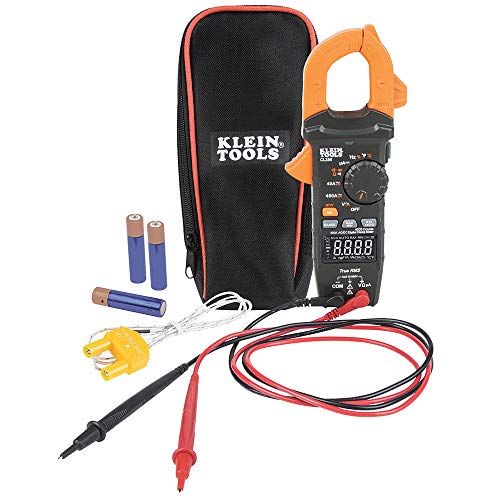
The CL390 fits general-purpose users who split their time between house wiring and vehicle or hobby DC circuits and want a screen they can read at any angle. Its reverse-contrast, high-visibility display stays legible in bright bays and dim basements, the clamp reads AC and DC current to 400 A with the non-contact voltage tester built into the jaw, and the leads add DC microamps for control-circuit work alongside voltage, resistance, frequency, capacitance and temperature through the included thermocouple. It ships with a carrying case, leads, thermocouple and batteries, so it is ready to use on arrival.
Which One Fits Your Situation
You Are Tracing a Tripping Breaker at Home
Start with the Fluke 325 or the Klein Tools CL390. Both read AC current on household circuits, carry safety ratings suited to panel work, and add the voltage and continuity checks through their leads that breaker hunting actually involves. The Fluke is the calmer long-term buy, while the Klein’s reverse-contrast screen helps when the panel sits in a dark corner and you are reading the display from below.
You Work on Solar, RV or Automotive DC
The AstroAI inrush meter is the natural fit, since its jaw reads DC current to 1000 A and captures the startup surge of motors and compressors. The Klein Tools CL800 is the step up when the same work happens around service equipment and you want CAT IV 600 V headroom plus a LoZ mode. Either way, an AC-only clamp would leave the DC side of these systems completely invisible.
You Measure Small Currents on a Bench
Choose the UNI-T UT210E. Its 2 A range resolves the milliamp-level draws of boards, strips and standby circuits that disappear under the floor of a panel meter, and the small jaw threads between wires on a crowded bench. Keep its CAT II and CAT III 300 V limits in mind and treat it as a bench instrument rather than a panel tool.
You Test Circuits for a Living
The Klein Tools CL800 covers the widest spread of paid work: 600 A AC/DC, 1000 V, CAT IV 600 V, LoZ for ghost voltage and a thermocouple input for temperature checks. The Fluke 325 makes sense as the second meter or the truck spare, trading some range for a slimmer body and the temperature, capacitance and frequency set that appliance and HVAC calls keep asking for.
Common Mistakes
- Buying an AC-only clamp for battery, solar or automotive work, then discovering the jaw cannot see DC current at all.
- Clamping around both conductors of a cord at once, which cancels the magnetic fields and reads near zero on a healthy circuit.
- Ignoring the CAT rating and using a bench-rated meter inside a service panel because the voltage number looked high enough.
- Judging a meter by its maximum current alone and missing that its lowest range cannot resolve the small draws being hunted.
- Assuming every function works through the clamp, when voltage, resistance and capacitance are measured through the test leads.
Frequently Asked Questions
Can a clamp meter measure DC current?
Only models whose jaw uses a Hall-effect sensor can measure DC current, and the listing will state AC/DC current explicitly when it does. AC-only clamps rely on transformer action and read nothing on a DC conductor. If you work on vehicles, solar or battery systems, treat DC current through the jaw as a non-negotiable line in the specifications, separate from DC voltage through the leads.
What does the CAT rating on a clamp meter mean?
The CAT category describes the part of an electrical installation the meter is built to be used on safely, from CAT II at receptacles and portable equipment up to CAT IV at the service entrance. It is always paired with a voltage rating. Matching the category to the location matters more than matching voltage alone, because fault energy rises sharply closer to the supply.
Do I need True RMS for household work?
For simple resistive loads such as heaters and incandescent lamps, an averaging meter reads close enough. As soon as variable-speed motors, dimmers, LED lighting or switching power supplies enter the picture, their distorted waveforms can push an averaging meter noticeably off, and True RMS keeps the reading accurate. Since most modern homes are full of those loads, True RMS is worth having.
Why does my clamp meter read zero on a plugged-in appliance?
The clamp is probably around the whole cord, where the outgoing and return currents cancel each other out. A clamp must surround a single conductor to read its current. Split the conductors with a line splitter accessory or clamp one wire inside the appliance or junction box instead, and make sure the jaw is fully closed around that one conductor before trusting the display.
More from Amazon
Programs that pair well with the guide above. Offers and eligibility are set by Amazon and may change.
Free shipping on eligible items, Prime Video and more. Eligible new members can start with a free trial.
Start a Prime free trialAd-free music streaming. Eligible new subscribers can start with a free trial.
Try Music Unlimited freeA Prime membership for ages 18-24 with a trial period. Eligibility is set by Amazon.
See Prime for Young AdultsAudiobooks and podcasts to listen to on the go. Eligible new members can start with a free trial.
Try Audible freeAs an Amazon Associate we earn from qualifying purchases.