Key takeaways
- Compare the best ceiling fans for quiet, steady airflow, with smart picks, low-profile models for low ceilings and outdoor-rated designs included.
As an Amazon Associate we earn from qualifying purchases.
A good ceiling fan quietly changes how a whole house feels. In summer it lets you nudge the thermostat up while staying comfortable; in winter, run in reverse, it pushes pooled warm air back down where you can feel it. The trouble is that fan specs are easy to misread. Blade span gets treated like a power figure, airflow numbers are quoted at full speed only, and motor type — the thing that decides how a fan sounds and how you control it — is buried at the bottom of the listing.

This guide explains the handful of specs that actually matter, then picks five fans for five different jobs: full smart control, low ceilings, a design-led flush mount, an everyday living room, and a covered patio that sees real weather.
Disclosure: This article contains affiliate links. If you make a purchase through these links, we may earn a commission at no extra cost to you.
How to Choose
Match the blade span to the room — honestly. A 42- to 44-inch fan suits rooms up to about 100 square feet: bedrooms, home offices, kitchens, nurseries. A 52-inch fan is the workhorse size for living rooms and primary bedrooms of roughly 144 to 400 square feet. Go beyond 52 inches — 56, 60, even 72 inches — only for great rooms and open-plan spaces. Oversizing a small room produces a harsh, buffeting downdraft, while undersizing a big room leaves the corners still. When a room is long rather than square, two smaller fans often beat one large one.
Read airflow numbers with care. CFM figures are measured on the highest speed, but you will live on low and medium. A 52-inch fan delivering more than about 4,000 CFM on high is strong; what matters day to day is how smooth and quiet the lower speeds are. Blade pitch (around 12 to 14 degrees is typical) and motor strength matter as much as span.
DC versus AC motors. DC motors are quieter, sip power, and allow many speed steps — six, or even twelve — plus extras like breeze modes. The trade-offs: nearly all control runs through a remote or app, so a lost remote is a real problem, and the wall switch usually has to stay on for the electronics to work. AC motors are the older design: typically three speeds, a faint hum on low in some models, but simple, durable, and happy with pull chains and standard wall controls. Neither is automatically better; pick based on how you want to control the fan.
Flush mount versus downrod. Blades should sit between 7 and 9 feet above the floor, with at least 8 to 10 inches between the blades and the ceiling so the fan can draw air properly. On an 8-foot ceiling that means a flush or low-profile mount. On ceilings of 9 feet or more, a short downrod usually improves airflow and looks better. Sloped ceilings need an angled mount adapter and often a longer rod.
Reversible motors earn their keep in winter. Run counterclockwise in summer for a cooling downdraft. In winter, reverse to clockwise on the lowest speed: the fan pulls cool air up and sends warm air down along the walls without creating a draft. Reverse on the remote saves you climbing a step stool to find a tiny switch on the motor housing.
Light kits and dimming. Integrated LED modules keep profiles slim and dim smoothly, but when the module eventually fails you replace a part, not a bulb. Bulb-based kits let you choose and swap standard bulbs. Either way, check that the fan and light can be switched independently — you do not always want both — and that dimming goes low enough for a bedroom.
Smart controls and your wall switch. Wi-Fi fans add app control, schedules, and Alexa or Google Home voice commands. Before buying, check what happens when someone flips the wall switch off: most smart fans simply go dark and offline until power returns, and they remember their last settings when it does. If your fan location is controlled by a standard switch, a wall-control model or a remote fan plus a smart bridge may fit your wiring better than a fully app-dependent fan. Never put a fan motor on a standard light dimmer; use a control made for fan speeds.
Location certification matters outdoors. Indoor-only fans belong in dry rooms. For bathrooms and covered patios, choose a fan certified for damp locations. For an open porch that takes wind-driven rain, you need certification for wet locations and blades — usually ABS — that will not warp, sag, or delaminate in humidity.
Dreo Smart Ceiling Fan with Lights, 52 Inch (CLF521S)
If you want the fan to join your smart home properly, the Dreo CLF521S is the most complete package in this roundup. Its brushless DC motor offers twelve speeds and three modes — Normal, Natural, which varies the breeze to mimic outdoor air, and Sleep — and Dreo quotes airflow up to 5,673 CFM, the strongest figure here. Control comes from the included remote, the Dreo app, or voice through Alexa and Google Home, and there is a timer that runs up to 12 hours.
The light is equally flexible: an integrated LED with stepless dimming from 1 to 100 percent and color temperature you can tune from a warm 2700K to a crisp 6500K, so the same fixture handles evening ambience and daytime tasks. The motor reverses for winter use, and the box includes both 4-inch and 6-inch downrods, covering most standard and slightly taller ceilings. The honest caveats are the usual smart-fan ones: full features depend on the app and your Wi-Fi, and the wall switch needs to stay on. For a living room or primary bedroom in an Alexa or Google household, it is the easiest fan here to live with.
Specs
- 52-inch sweep, five blades
- Brushless DC motor, 12 speeds, three modes (Normal, Natural, Sleep), reversible
- Airflow up to 5,673 CFM
- Integrated LED light, stepless dimming from 1 to 100 percent, 2700K to 6500K color tuning
- Remote, Dreo app, and Alexa / Google Home voice control; timer up to 12 hours
- 4-inch and 6-inch downrods included
Hunter Dempsey Low Profile 44 Inch (50282)
Eight-foot ceilings rule out most fans with downrods, and that is exactly the problem the Hunter Dempsey Low Profile solves. It mounts flush against the ceiling and is designed for rooms with ceilings under 9 feet, while its 44-inch span is sized for bedrooms, home offices, and kitchens rather than great rooms. Hunter’s WhisperWind AC motor is built for quiet, wobble-free running, with three speeds and a reverse function for winter.
Four reversible blades give you two finish looks in one box — this brushed nickel version pairs with Black Oak or Dark Walnut blade faces. The light kit uses two standard E26 LED bulbs (800 lumens each, 3000K), which is a practical choice: when a bulb eventually fails, you swap a bulb, not a proprietary module. The handheld remote adjusts speed and dims the light. Airflow peaks at 3,691 CFM on high — modest next to the Dreo, but well matched to the smaller rooms this fan is meant for. It is an indoor fan, so keep it in dry rooms.
Specs
- 44-inch sweep, four reversible blades
- WhisperWind AC motor, three speeds, reversible
- Airflow up to 3,691 CFM on high
- Two dimmable E26 LED bulbs included, 800 lumens each, 3000K
- Handheld remote with light dimming
- Low-profile flush mount for ceilings under 9 feet; indoor use
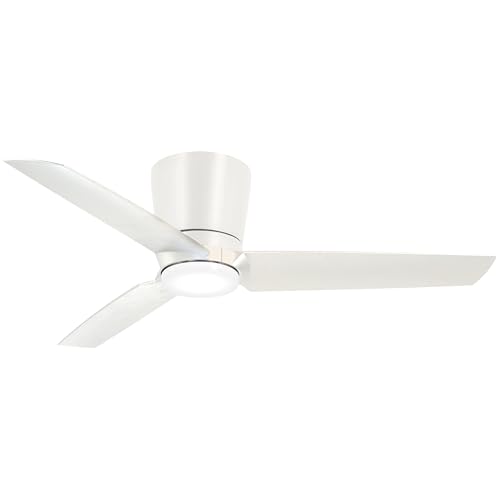
Minka-Aire Pure 48 Inch Flush Mount (F671L-WHF)
The Minka-Aire Pure is the design pick: three broad ABS blades, a flat white finish, and a hugger body that keeps the whole fan just 10 inches from ceiling to lowest point. It suits modern rooms where a traditional five-blade fan looks fussy, and its 48-inch span lands between the compact 44-inch class and full-size 52-inch fans — a good match for bedrooms and living spaces up to roughly 225 square feet.
Under the styling it is a serious fan. The AC motor drives four speeds and moves up to 3,891 CFM, and the integrated 20W LED delivers about 1,590 lumens at 3000K with a high CRI of 94, so colors under it look natural. Control is refreshingly old-school: an included wall control handles four speeds and full-range dimming, with no remote to lose. If you later want voice control, the fan is compatible with the Bond Bridge hub. Note the trade-offs: there is no handheld remote in the box, and it is an indoor fan for dry locations.
Specs
- 48-inch sweep, three ABS blades at a 12-degree pitch
- AC motor (153 x 17 mm), four speeds, reversible
- Airflow up to 3,891 CFM on high
- Integrated 20W LED, about 1,590 delivered lumens, 3000K, CRI 94, full-range dimming
- Wall control included (fan speeds plus dimmer); compatible with Bond Bridge for app and voice control
- Flush mount; 10 inches from ceiling to lowest point; indoor use
Prominence Home Emporia 52 Inch (51022-01)

The Prominence Home Emporia is the straightforward living-room fan: a 52-inch, five-blade design in a warm bronze finish that works with traditional and transitional decor, with dual-finish blades so you can flip them to change the look. It covers medium to large rooms and keeps the controls simple — a handheld remote runs the fan and its LED light kit.
Two mounting options are included: mount it close to the ceiling for lower rooms, or use the standard downrod position for taller ones, which makes it a flexible choice for older homes where ceiling heights vary from room to room. The motor reverses, so it helps redistribute warm air in winter as well. There is no app and no voice control here, and that is the point — for a family room, guest room, or a home where the fan should just work from a remote anyone can pick up, the Emporia covers the essentials without a setup process.
Specs
- 52-inch sweep, five dual-finish blades
- AC motor, three speeds, reversible
- LED light kit included
- Handheld remote control
- Dual mounting options: close mount or standard downrod
- Bronze finish (model 51022-01); indoor use
Honeywell Palm Island 52 Inch (50207-01)
Outdoor fans fail in predictable ways — warped blades, rusted hardware, motors that were never meant for humid air — and the Honeywell Palm Island is built specifically to avoid them. It is certified for wet locations, so it can handle a covered patio or porch that catches wind-driven rain, and its five palm-leaf blades are made to shrug off moisture instead of sagging. The tropical styling will not suit every home, but on a porch or sunroom it looks intentional rather than apologetic.
Performance is honest: 3,516 CFM on high from the 52-inch sweep, three speeds, and a reversible motor so the fan can help on cool evenings too. Control is by pull chain — simple, weatherproof, and nothing electronic to fail outdoors. Three mounting options (close, standard, and angled) help with sloped porch ceilings. There is no light kit on this version, so plan on separate outdoor lighting; Honeywell sells a lit sibling if you need both. For patios, this is the pick that is actually built for the location.
Specs
- 52-inch sweep, five palm-leaf blades at a 12-degree pitch
- Three-speed motor, reversible, pull chain control
- Airflow of 3,516 CFM on high
- Certified for wet locations; indoor and outdoor use
- Tri-mount options: close, standard downrod, and angled
- No light kit; bronze finish (model 50207-01)
FAQ
What size ceiling fan do I need for a 12-by-12-foot bedroom?
A 44-inch fan is the textbook fit for a room of about 144 square feet, and it will feel gentle and quiet. If you like a stronger breeze or the room gets afternoon sun, stepping up to a 52-inch model is fine — just make sure you have the ceiling height for its mount, and use the lower speeds at night.
Can I install a ceiling fan where a light fixture hangs now?
Usually, yes — but the electrical box is the catch. A fan is heavy and vibrates, so it must hang from a ceiling box listed for fan support and braced to a joist or a fan brace. If your existing box is a standard lighting box, swap it for a fan-support box first; it is a small job that prevents wobble and worse.
Should I run my ceiling fan in winter?
Yes, in reverse. Flip the direction (on the remote, wall control, or the switch on the motor housing) and run it on the lowest speed clockwise. That pulls cool air upward and washes the warm air pooled at the ceiling down the walls, evening out the room so you can set the thermostat a degree or two lower without feeling a draft.
Conclusion
There is no single best ceiling fan here — there is a best match for each room. Choose the Dreo CLF521S if you want smart control, twelve speeds, and tunable light in a living room or primary bedroom. Choose the Hunter Dempsey Low Profile for bedrooms and offices with ceilings under 9 feet. Choose the Minka-Aire Pure if you want a clean, modern flush mount with a proper wall control and excellent light quality. Choose the Prominence Home Emporia for a no-fuss living room fan with a remote and flexible mounting. And for a covered patio or porch, choose the Honeywell Palm Island — the one fan in this list certified for wet locations. Match the span to the room, respect the mounting height, and any of these will move air quietly for years.
More from Amazon
Programs that pair well with the guide above. Offers and eligibility are set by Amazon and may change.
Free shipping on eligible items, Prime Video and more. Eligible new members can start with a free trial.
Start a Prime free trialAd-free music streaming. Eligible new subscribers can start with a free trial.
Try Music Unlimited freeA Prime membership for ages 18-24 with a trial period. Eligibility is set by Amazon.
See Prime for Young AdultsAudiobooks and podcasts to listen to on the go. Eligible new members can start with a free trial.
Try Audible freeAs an Amazon Associate we earn from qualifying purchases.