Key takeaways
- Spend long stretches reading, scrolling or doing light clicking work.
- Have a thin desk edge or a metal desk that feels hard and cold under the forearm.
- Use a medium or tall mouse whose palm rest sits higher than the desk surface.
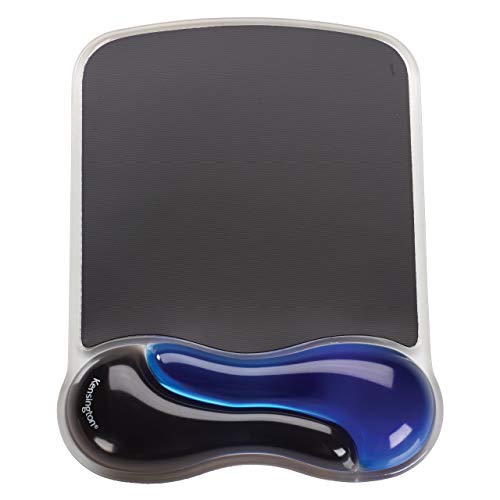
A mouse mat with gel wrist support is worth buying if your mouse sits on a hard desk edge and you rest your wrist while scrolling or reading, but it only helps when the cushion height roughly matches your mouse’s palm height, typically about 0.6–1 inch. Pick one that is too tall or that you lean on while moving the mouse, and it can add pressure instead of relieving it. This guide covers the sizes, fill types and setup details that decide whether one of these pads actually suits your desk.
Our top picks


As an Amazon Associate we earn from qualifying purchases at no extra cost to you. Ratings are shown as listed on Amazon.
What the Gel Cushion Is For (and Not For)
The cushion is a rest, not an anchor. Ergonomic guidance generally suggests keeping the wrist fairly straight and moving the mouse from the elbow and shoulder, then resting the heel of the palm on the cushion during pauses. Pressing the underside of the wrist into a cushion while pivoting the mouse is the habit to avoid, because it concentrates pressure on a small area.
That makes the gel pad most useful for people who:
- Spend long stretches reading, scrolling or doing light clicking work.
- Have a thin desk edge or a metal desk that feels hard and cold under the forearm.
- Use a medium or tall mouse whose palm rest sits higher than the desk surface.
If you have ongoing wrist, hand or forearm pain, numbness or tingling, an accessory is not a fix; it is worth seeing a doctor or physical therapist for an assessment of your setup and symptoms.
Height and Size: Match the Pad to Your Mouse
Most cushioned mouse mats share a similar layout: a tracking surface around 8–10 inches wide and 7–9 inches deep, with the cushion forming the front edge. The cushion height is what varies most.
| Mouse type | Typical mouse height | Cushion height that fits | Notes |
|---|---|---|---|
| Low-profile travel or slim mouse | 1.0–1.3 in | 0.4–0.6 in | Tall cushions push the wrist upward |
| Standard office mouse | 1.4–1.6 in | 0.6–0.8 in | The most common gel pad height suits this |
| Larger ergonomic right-hand mouse | 1.7–2.0 in | 0.8–1.0 in | Check the cushion is wide enough for a full palm |
| Vertical mouse | 2.5–3.5 in | Low pad or a separate small rest | Hand rests on its side; a flat gel pad may not align |
| Trackball (thumb-operated) | 1.6–2.0 in | Often none needed | The device stays still; a forearm rest can matter more |
A quick fit check: rest your hand on your mouse normally. The cushion should sit under the heel of your palm at roughly the same height, so the back of your hand stays level with your forearm rather than bending up or down.
Gel vs Memory Foam vs Firm Pads
| Cushion type | Feel | Recovers shape | Temperature | Common wear point |
|---|---|---|---|---|
| Gel (encapsulated) | Soft, slightly wobbly, molds under pressure | Instantly | Cool to the touch at first | Fabric or vinyl skin can split, gel can flatten after years |
| Memory foam | Softer, sinks slowly | Slowly, over seconds | Warms up with use | Compresses permanently in the spot you rest most |
| Firm foam or rubber | Supportive, little sink | Instantly | Neutral | Cover pills or peels |
Gel suits people who want a soft surface that does not bottom out, while memory foam suits those who like a slow sink. Pads from established office-accessory makers such as Fellowes and 3M are offered in both gel and foam versions, and keyboard-length matching rests are common in the same lines.
Surface Quality for Tracking
Many gel mouse mats are built as office products, so the tracking area is often a smooth fabric or hard polymer finish that works with standard optical and laser mice. A few points to check:
- Fabric surfaces give more control and are quiet, but stain more easily.
- Hard, smooth surfaces wipe clean and glide fast, but can feel slippery for precise work.
- Base grip matters: a rubber or non-slip base keeps the pad from creeping as you lean on the cushion.
- Size for gaming: typical gel pads are small. Low-sensitivity gamers who sweep across a desk usually need a large cloth mat and a separate cushion instead.
Matching Keyboard and Mouse Wrist Support
If you add a mouse rest, consider the keyboard side too. A keyboard wrist rest should be roughly the height of the keyboard’s front edge, about 0.5 inch for low-profile keyboards and 0.8–1.2 inches for full-height mechanical keyboards, and roughly as long as the keyboard: about 17–18 inches for full size, 14–15 inches for tenkeyless, and 11–12 inches for 60–75 percent boards. Combo sets that pair a keyboard rest with a gel mouse mat give a consistent height and feel across both hands.
The same rule applies on both sides: rest during pauses, keep the wrists level while actively typing or mousing.
Ownership Realities
- Lifespan: gel pads used daily often last two to four years before the cushion flattens, the cover cracks or the edge peels from the base.
- Cleaning: wipe with a damp cloth and mild soap. Do not soak, machine wash or use alcohol on vinyl or lycra-covered gel, which can dry out the skin.
- Puncture risk: sharp watch clasps, bracelets and pens can split a thin cover; once gel leaks, the pad should be replaced.
- Heat and sun: leaving a pad in direct window sun can soften adhesive and deform gel.
- Price: most gel wrist mouse mats sell in the $10–$30 range; keyboard-and-mouse matching sets usually run $20–$45.
Common Setup Mistakes
- Desk too high. If your elbow is below the desk surface, any wrist rest will push your wrist upward. Adjust the chair or desk height first so forearms are roughly level.
- Pad too far from the keyboard. Reaching sideways strains the shoulder; keep the mouse close to the keyboard’s right edge, or consider a compact keyboard without a number pad.
- Anchoring and flicking. Planting the wrist and swiveling the hand for every movement is the habit that undermines the benefit.
- Cushion under the wrist crease. Position the cushion under the fleshy heel of the palm instead.
Who Should Choose What
| Your situation | Better choice |
|---|---|
| Office work with a standard mouse | Gel mouse mat with 0.6–0.8 in cushion |
| Prefer slow sink, cooler room | Memory foam pad |
| Vertical mouse or trackball user | Skip the gel mat; use a flat pad or a small separate palm rest |
| Gamer with wide arm movements | Large cloth desk mat; rest arm on the desk or an armrest |
| Want matching left and right support | Keyboard rest and mouse mat set at the same height |