Key takeaways
- Tab: Moves between fields in forms or inserts an indentation in many text editors.
- Caps Lock: Keeps alphabetic characters uppercase until switched off.
- Enter or Return: Confirms a command, submits a form, or starts a new paragraph.
- Backspace: Deletes the character immediately to the left of the text cursor.
- Spacebar: Inserts a space and is usually the widest key.
What's inside
- Parts of the Computer Keyboard: Every Section and Key Explained
- Keyboard sections at a glance
- 1. The alphanumeric section: the main typing area
- 2. The function row and escape key
- 3. Modifier keys: the shortcut controls
- 4. The navigation cluster: moving through content
- 5. Arrow keys: precise movement
- 6. The numeric keypad: speed over compactness
- Which keyboard layout fits your situation?
- Ownership realities: what wears out first
- Bottom line
Parts of the Computer Keyboard: Every Section and Key Explained
The main parts of the computer keyboard are the function row, alphanumeric section, modifier keys, navigation cluster, arrow keys, and numeric keypad; each group has a different job, and understanding that layout makes it easier to choose the right keyboard for work, gaming, coding, or limited desk space.
- Parts of the Computer Keyboard: Every Section and Key Explained
- Keyboard sections at a glance
- 1. The alphanumeric section: the main typing area
- 2. The function row and escape key
- 3. Modifier keys: the shortcut controls
- 4. The navigation cluster: moving through content
- 5. Arrow keys: precise movement
- 6. The numeric keypad: speed over compactness
- Which keyboard layout fits your situation?
- Ownership realities: what wears out first
- Bottom line
Keyboard sections at a glance
| Keyboard section | Typical keys | Primary purpose | Best reason to prioritize it |
|---|---|---|---|
| Alphanumeric section | A–Z, numbers, punctuation | Typing words, commands, and symbols | Everyday writing, coding, and general computer use |
| Function row | F1–F12, Esc, media keys | Shortcuts and application-specific commands | Productivity, software control, and gaming |
| Modifier keys | Ctrl, Alt, Shift, Windows, Fn | Change what another key does | Keyboard shortcuts and alternate commands |
| Navigation cluster | Insert, Delete, Home, End, Page Up, Page Down | Move through or edit documents and interfaces | Long documents, spreadsheets, and text editing |
| Arrow-key cluster | Up, Down, Left, Right | Move a cursor, selection, or game character | Editing, menus, spreadsheets, and games |
| Numeric keypad | 0–9, decimal, operators, Enter | Fast numerical entry and calculations | Accounting, data entry, and frequent number work |
1. The alphanumeric section: the main typing area
The alphanumeric section is the largest and most frequently used part of a keyboard. It contains the alphabet, number keys along the top, punctuation, and several control keys arranged around the familiar QWERTY layout. On most full-size keyboards, the letter keys use a staggered arrangement rather than a perfect grid because the design developed from mechanical typewriters.
As an Amazon Associate we earn from qualifying purchases at no extra cost to you.


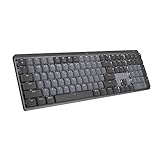
The number row does more than enter digits. Holding Shift usually produces the symbols printed above the numbers, such as !, @, #, and %. The punctuation keys supply commas, periods, quotation marks, brackets, slashes, and other characters needed for writing and programming.
- Tab: Moves between fields in forms or inserts an indentation in many text editors.
- Caps Lock: Keeps alphabetic characters uppercase until switched off.
- Enter or Return: Confirms a command, submits a form, or starts a new paragraph.
- Backspace: Deletes the character immediately to the left of the text cursor.
- Spacebar: Inserts a space and is usually the widest key.
For typing comfort, look at key spacing, keycap shape, and the position of the Enter and Backspace keys. A compact keyboard may preserve the same letter layout while reducing gaps between groups, whereas an ergonomic model may split or angle the alphanumeric area.
2. The function row and escape key
The function row sits above the number row. It normally includes Esc followed by F1 through F12. These keys do not have one universal meaning: their action depends on the operating system, application, and keyboard firmware.
- Esc: Cancels a menu, closes a dialog, exits full-screen views, or stops certain operations.
- F1: Commonly opens help, although applications can assign another command.
- F2: Often renames a selected file in Windows or edits a spreadsheet cell.
- F5: Commonly refreshes a webpage or application view.
- F11: Frequently toggles full-screen browsing.
- F12: May open developer tools in a browser or perform a program-specific function.
Laptops often layer brightness, volume, playback, microphone, or wireless controls onto F1–F12. The Fn key selects those secondary actions. When shopping, check whether the keyboard lets you switch between standard function keys and media controls without holding Fn; this matters if you use shortcuts in creative software, terminals, or games.
3. Modifier keys: the shortcut controls
Modifier keys do not usually produce a character by themselves. They alter the result of another key pressed at the same time. Their location is important because shortcuts are faster when the modifier can be reached without moving the entire hand.
- Shift: Produces uppercase letters and the upper symbol on a key. It also helps select text or select multiple items.
- Ctrl: Enables commands such as Ctrl+C to copy, Ctrl+V to paste, Ctrl+S to save, and Ctrl+Z to undo in many desktop applications.
- Alt: Accesses menus, alternate commands, and special character input. On some systems, AltGr produces additional symbols.
- Windows key: Opens the Start menu and combines with other keys for system shortcuts. On Apple keyboards, the comparable key is Command.
- Fn: Selects a secondary hardware function, particularly on laptops and compact keyboards.
- Menu or Application key: Opens a context menu on keyboards that include it.
Keyboard layouts differ by region. A US layout generally has a wide left Shift key and a horizontal Enter key, while UK and other layouts may rearrange punctuation and use a different Enter shape. Verify the printed layout before buying replacement keycaps or an imported keyboard.
4. The navigation cluster: moving through content
The navigation cluster is normally positioned between the alphanumeric keys and the numeric keypad. It is especially useful when editing long documents, navigating spreadsheets, or moving through code without relying on a mouse.
- Insert: Switches between inserting and overwriting text in applications that support both modes.
- Delete: Removes the selected item or the character to the right of the cursor.
- Home: Moves to the beginning of a line, document, or page depending on the application.
- End: Moves to the end of a line, document, or page depending on context.
- Page Up and Page Down: Move through content by roughly one screen at a time.
The navigation keys are often missing from 60% and 65% keyboards. A 75% or tenkeyless keyboard may retain them while removing the number pad. If you regularly edit text, manage files, or work with spreadsheets, this cluster can be more valuable than a row of decorative media controls.
5. Arrow keys: precise movement
The four arrow keys move a cursor, selection, camera, menu highlight, or game character. Left and Right commonly move one character or cell at a time, while Up and Down move lines, rows, or menu choices.
Holding Ctrl, Shift, or another modifier changes their behavior in many programs. For example, Shift plus an arrow key selects text, while Ctrl plus an arrow can jump between words or spreadsheet regions. Full-size and tenkeyless keyboards usually provide a separated inverted-T layout, which is easier to identify by touch than the tightly packed arrow keys on some compact boards.
6. The numeric keypad: speed over compactness
The numeric keypad is the right-hand block found on most full-size keyboards. It resembles a calculator and usually includes digits 0 through 9, a decimal point, arithmetic operators, a separate Enter key, and Num Lock.
Num Lock switches the keypad between number entry and navigation functions. When it is off, keys such as 7, 1, and 3 may act as Home, End, and Page Down on traditional layouts. The keypad’s wide zero key and double-height Enter key are designed for repeated entry with the right hand.
Choose a numeric keypad if your work involves invoices, spreadsheets, inventory, measurements, or data entry. Skip it if desk width, mouse placement, or portability matters more. A full-size keyboard is typically about 43–46 cm wide, while a tenkeyless model is commonly about 35–37 cm wide. Removing the keypad can save roughly 8–10 cm of desk space, although exact dimensions vary by bezel and layout.
Which keyboard layout fits your situation?
| Your situation | Recommended format | What you keep | What you give up |
|---|---|---|---|
| Frequent numerical entry | Full-size, 104/105-key type | All sections and a dedicated keypad | More width and less mouse space |
| Gaming with limited desk space | Tenkeyless, about 87/88 keys | Function row, arrows, and navigation cluster | Dedicated numeric keypad |
| Very small desk or travel | 75% or 65% layout | Most typing keys; 75% usually keeps function keys | Separate navigation keys or spacing |
| Maximum portability | 60% layout, about 61 keys | Core alphanumeric keys and modifiers | Dedicated function, navigation, arrow, and keypad rows |
| Heavy spreadsheet or accounting work | Full-size or separate USB numeric keypad | Fast numbers and one-handed operations | Compactness if integrated |
Ownership realities: what wears out first
Keycaps usually develop shine before the switches stop working. The spacebar, Enter, Backspace, and frequently used letter keys receive the most contact. Stabilizers under long keys can become noisy or feel uneven, while dust and crumbs may cause intermittent presses. Wireless models add batteries or rechargeable cells as another ownership concern; battery capacity gradually declines, and some designs permit easier replacement than others.
Disconnect a wired keyboard or switch off a wireless model before cleaning. Shake out loose debris, use short bursts of air at an angle, and wipe keycaps with a lightly damp microfiber cloth. Do not flood the switches with liquid, and do not pull long keys aggressively because their stabilizer clips can break. For a deeper clean, remove keycaps only when the manufacturer permits it and photograph the layout first.
Bottom line
Prioritize the alphanumeric area and comfortable modifiers for general typing, the function row and navigation cluster for productivity, and the numeric keypad for repeated number entry. If space is tight, a tenkeyless keyboard is usually the most practical compromise; smaller 75%, 65%, and 60% layouts save more room but make common commands dependent on Fn layers. The best choice is therefore determined less by the total key count than by which sections you use every day.