Our Short List of 3

- Best for: Racers who want one load cell set that survives a wheel upgrade and still works on console.
- Pedals: 3 (throttle, brake, clutch)
- Brake sensor: load cell rated up to 100 kg (220 lb)
- Throttle and clutch sensors: H.E.A.R.T magnetic, 16-bit resolution
- Brake tuning: 6 interchangeable springs included

- Best for: Cockpit owners who brake hard and want the highest force ceiling in this guide.
- Pedals: 2 (throttle, brake); clutch module sold separately
- Brake sensor: load cell rated up to 200 kg
- Secondary sensor: 15-bit angle sensor on the brake
- Construction: CNC aerospace-grade aluminum with carbon fiber heel plate
- Best for: PC-only racers on rigid cockpits who want load cell feel on the clutch as well as the brake.
- Pedals: 3 (throttle, brake, clutch)
- Brake: 200 kg load cell, up to 140 kg at the footplate as listed, with hydraulic damping
- Sensors: load cell assemblies on all three pedals, 12-bit ADC capture as listed
- Brake elastomers: 3 sets in 60, 80 and 90 hardness as listed
All 5 Picks at a Glance
| Product | Specs | Action |
|---|---|---|
| Thrustmaster T-LCM Pedals |
| Check price on Amazon |
| MOZA CRP2 Load Cell Pedals |
| Check price on Amazon |
| Simjack UT Sim Racing Pedals (UT-P3-H3) |
| Check price on Amazon |
 Thrustmaster T3PA Pro Add-On |
| Check price on Amazon |
 DOYO Racing Wheel Pedals |
| Check price on Amazon |
Key takeaways
- Compare the best sim racing pedals for PC rigs, from a first 100 kg load cell set to 200 kg cockpit pedals, with mounting and platform checks.
The pedals bundled with most racing wheels measure how far your foot travels, so the same corner rarely gets the same braking twice. A standalone pedal set fixes that at the source: a load cell brake reads how hard you press, which turns braking into a pressure habit your legs can repeat lap after lap. Choosing a set means matching that brake to your rig, your platform and the wheel you already own, because the strongest pedal here is only an upgrade if it stays planted and actually connects to your setup.
This guide is for PC racers moving up from a bundle, console drivers who need pedals that run through their wheel base, and rig owners chasing higher brake forces. The five sets below were picked from current Amazon listings and spec sheets, spanning a first load cell step, two high-force rig sets, an all-metal ecosystem add-on and a light spring set for desks that cannot brace a heavy brake.
Quick Picks
As an Amazon Associate we earn from qualifying purchases
| Product | Best for | Key spec from title |
|---|---|---|
| Thrustmaster T-LCM Pedals | First load cell set for mixed PC and console racing | 100 kg load cell brake with magnetic sensors |
| MOZA CRP2 Load Cell Pedals | Rig owners who want the highest brake ceiling | 200 kg load cell in a CNC aluminum frame |
| Simjack UT Sim Racing Pedals (UT-P3-H3) | PC racers who want load cells on all three pedals | 200 kg load cell brake with hydraulic damping |
| Thrustmaster T3PA Pro Add-On | Thrustmaster wheel owners upgrading inside the ecosystem | All-metal build with two swappable brake mods |
| DOYO Racing Wheel Pedals | Desk setups that cannot brace a heavy brake | HallEffect sensors with a light spring brake |
How to Choose
Brake sensing decides consistency
A potentiometer or Hall sensor brake measures pedal travel, so your braking point shifts whenever your seating position moves a little. A load cell measures force instead, and pressure is far easier for your leg to repeat than distance. Most sets put the load cell only under the brake while the throttle and clutch use contactless magnetic sensors, which is the sensible split for almost everyone. The Simjack UT goes further with load cell assemblies on all three pedals. Ratings run from 75 kg to 200 kg; a higher ceiling gives finer control at maximum effort, but only if your mount can take the force.
Mounting and bracing come before force
A strong load cell brake pushes back hard, and an unbraced set answers by sliding across the floor or tipping forward mid-corner. Before choosing by sensor rating, decide where the set will live: bolted to a cockpit pedal plate, clamped on a wheel stand with a braced tray, or loose under a desk. High-force sets such as the CRP2 and the Simjack UT assume a rigid mount, and the two SIMSONN-style steel sets in this class often ship without a baseplate at all. If your pedals sit loose on carpet, a lighter spring brake is not a compromise; it is the only setup that stays where you put it.
Connection and platform fit
Standalone USB sets appear on a PC as their own controller, so they mix freely with wheels from other brands in games that accept multiple devices. Ecosystem add-ons take the opposite route: the T3PA Pro plugs into a Thrustmaster wheel base, which is also how it reaches consoles, and standalone PC use needs a separate adapter. Console support almost always travels through the wheel base rather than the pedals themselves, so a set that is PC-only over USB stays PC-only. Read the platform line on the listing for the exact set, because two-pedal and three-pedal versions of one family can differ.
Pedal count and tuning range
Two-pedal sets cover the throttle and brake that modern paddle-shift cars use, and most families sell the clutch later as an add-on module. Three-pedal sets suit H-pattern driving, older road cars and anyone who heel-and-toes. Beyond the count, look at how the brake feel changes: swappable springs on the T-LCM, stackable elastomers on the MOZA and Simjack sets, and software curves in MOZA Pit House or SimJack Control for dead zones and output shape. Face angle, spacing and height adjustment matter on long stints, because a pedal deck you cannot align to your feet will fatigue your ankles before the race ends.
The 5 Best Options
Thrustmaster T-LCM Pedals
- Best for: Racers who want one load cell set that survives a wheel upgrade and still works on console.
- Pedals: 3 (throttle, brake, clutch)
- Brake sensor: load cell rated up to 100 kg (220 lb)
- Throttle and clutch sensors: H.E.A.R.T magnetic, 16-bit resolution
- Brake tuning: 6 interchangeable springs included
Racers who want one load cell set that survives a wheel upgrade and still works on console.
Confirm the seller and current offer on the listing before ordering, because stock on this set fluctuates between sellers.
The T-LCM is the load cell step that asks the fewest questions of the rest of your setup. Its brake reads up to 100 kg of pressure while the throttle and clutch run on contactless magnetic sensors, and the set connects to a PC over USB with any wheel brand, or to PlayStation and Xbox through a Thrustmaster base. Six included springs let you stiffen or soften the brake without tools or extra parts. Drivers leaving a bundled G-series or T150 pedal set behind get a metal, three-pedal unit that keeps working if they change wheels later, which is why it anchors this list.
MOZA CRP2 Load Cell Pedals
- Best for: Cockpit owners who brake hard and want the highest force ceiling in this guide.
- Pedals: 2 (throttle, brake); clutch module sold separately
- Brake sensor: load cell rated up to 200 kg
- Secondary sensor: 15-bit angle sensor on the brake
- Construction: CNC aerospace-grade aluminum with carbon fiber heel plate
Cockpit owners who brake hard and want the highest force ceiling in this guide.
Check the current offer carefully before ordering, because availability on this listing has been intermittent and third-party listings vary in configuration.
The CRP2 is MOZA’s rig-grade set, built around a 200 kg load cell that doubles the ceiling of the T-LCM above. The frame is CNC-machined aerospace-grade aluminum with a carbon fiber heel plate, and the brake pairs the load cell with a 15-bit angle sensor so the first part of travel and the pressure phase blend smoothly. It ships as a two-pedal set aimed at paddle-shift driving, with the clutch sold as a separate module, and it supports inverted mounting for cockpits built that way. This is the pick for drivers who already own a stiff pedal plate and want headroom their leg strength, not the sensor, limits.
Simjack UT Sim Racing Pedals (UT-P3-H3)
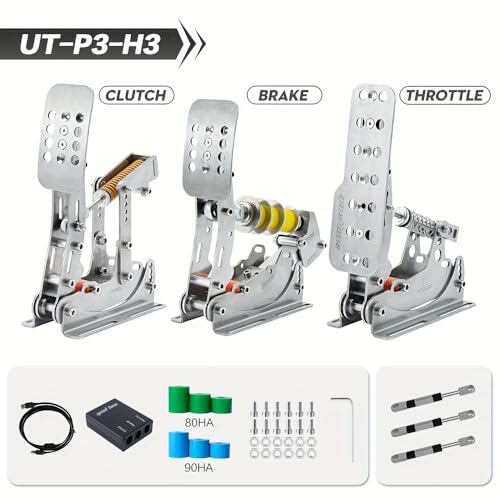
- Best for: PC-only racers on rigid cockpits who want load cell feel on the clutch as well as the brake.
- Pedals: 3 (throttle, brake, clutch)
- Brake: 200 kg load cell, up to 140 kg at the footplate as listed, with hydraulic damping
- Sensors: load cell assemblies on all three pedals, 12-bit ADC capture as listed
- Brake elastomers: 3 sets in 60, 80 and 90 hardness as listed
PC-only racers on rigid cockpits who want load cell feel on the clutch as well as the brake.
The listing rules out consoles and Linux, so confirm your platform and mounting plan before ordering.
The Simjack UT is the hardware-heavy route for PC racers who want sensors everywhere. Its brake runs a 200 kg load cell with hydraulic damping and a dual-stage feel, and unusually, the throttle and clutch also use load cell assemblies, the clutch adding a two-way hydraulic damper. Three elastomer sets in different hardness grades shape the brake curve, and SimJack Control software handles output curves, dead zones and brake force per car. The trade is commitment: this is a Windows PC set built from thick steel plate, and forces near the top of its range will shove an unmounted set across the room.
Thrustmaster T3PA Pro Add-On
- Best for: Thrustmaster T-Series owners who want a heavier, fully adjustable pedal unit without leaving the ecosystem.
- Pedals: 3 (throttle, brake, clutch)
- Construction: all-metal pedals and internal structure, as listed
- Mounting positions: floor-mounted or suspended, as listed
- Brake mods: spring brake mod and conical rubber brake mod included
Thrustmaster T-Series owners who want a heavier, fully adjustable pedal unit without leaving the ecosystem.
There is no load cell here, so if pressure-based braking is the goal, choose the T-LCM instead.
The T3PA Pro skips the load cell entirely and wins on metal and adjustability inside one ecosystem. Every pedal and the internal structure are metal, the unit mounts in floor or suspended positions, and brake feel comes from two included mechanical mods: a spring mod for a mid-weight pedal and a conical rubber mod for a much firmer one. Spacing, angle and height adjust across several positions per pedal, which few sets at any level match. It is an add-on in the strict sense, though: it connects through a compatible Thrustmaster T-Series base, and standalone PC use requires the T.RJ12 USB adapter sold separately.
DOYO Racing Wheel Pedals
- Best for: Desk and carpet setups that cannot brace against a high-force load cell brake.
- Pedals: 3 (throttle, brake, clutch)
- Sensors: HallEffect AccuRate technology on all three pedals, as listed
- Brake: two adjustable tension springs, listed range of 2.9 to 6.2 kg
- Construction: metal pedal plates, as listed
Desk and carpet setups that cannot brace against a high-force load cell brake.
The listing states the set works with games that support multi-device control, so check your main titles before ordering.
The DOYO set is the answer for the setup most pedal guides ignore: pedals loose on the floor in front of a desk chair. All three pedals use HallEffect AccuRate sensing, which reads position magnetically with no contact parts to wear, and the brake works against two adjustable tension springs with a light listed range of 2.9 to 6.2 kg. The set will not slide away under braking, needs no cockpit, and connects to the PC as a USB device, so it pairs with any wheel brand. Racers chasing realism will outgrow it, but as a first metal three-pedal set it fits rooms that rule out load cells.
Which One Fits Your Situation
You are upgrading from a bundled wheel set
Start with the Thrustmaster T-LCM. It replaces the travel-based pedals that came with your wheel with a 100 kg load cell brake, keeps a clutch for manual cars, and connects over USB on PC with whatever wheel you own now. If your next step is a dedicated cockpit, the same money logic points one rung up to the MOZA CRP2.
You race on console as well as PC
Pedals reach consoles through the wheel base, so your base decides the shortlist. Thrustmaster owners can take the T-LCM for a load cell brake or the T3PA Pro for an all-metal unit with mechanical brake mods. The MOZA, Simjack and DOYO sets here are PC devices and will not follow you to a PlayStation or Xbox.
Your pedals sit loose under a desk
Take the DOYO set. Its spring brake tops out at a listed 6.2 kg, light enough that the set stays put on carpet without a stand, a wall brace or a cockpit. Every load cell set in this guide needs something solid behind it, so bolting a CRP2 or Simjack UT to nothing turns a strong brake into a sliding one.
You already own a rigid cockpit
Put the mount to work with the MOZA CRP2 or the Simjack UT. Both carry 200 kg load cells that a braced pedal plate can actually exploit, the CRP2 adding inverted mounting and an aluminum frame, the UT adding a load cell clutch and hydraulic damping. Between them, choose the UT if a sensed clutch matters to your driving.
Common Mistakes
- Buying a 200 kg load cell set for a desk setup, then braking gently forever because full pressure slides the pedals across the floor.
- Assuming a USB pedal set works on console, when console support almost always depends on the wheel base it plugs into.
- Ordering an ecosystem add-on such as the T3PA Pro for a wheel base from a different brand or an incompatible series.
- Forgetting that clutch pedals, baseplates and adapters are often separate purchases, so the set in the box is not the whole setup.
- Leaving the brake on its factory software curve instead of setting dead zones and the load cell engagement point in the tuning app.
Frequently Asked Questions
Do I need a cockpit to use load cell pedals?
No, but you need bracing of some kind. A wheel stand with a solid pedal tray, a bolted floor plate, or a wall brace behind the set all work. What fails is a bare floor: a 100 kg or 200 kg brake will push an unbraced set away long before you reach full pressure, which ruins the consistency the load cell was bought for.
Can I mix a pedal set with a wheel from another brand?
On PC, yes, for standalone USB sets. The T-LCM, CRP2, Simjack UT and DOYO each appear as their own controller and pair with any wheel in games that accept multiple input devices. Add-on sets are the exception: the T3PA Pro only works through a Thrustmaster base, and console play always follows the base brand.
What does the load cell rating in kilograms actually mean?
It is the maximum brake force the sensor can register, not a force you must reach. A 200 kg ceiling gives finer resolution across very hard braking, while a 75 kg or 100 kg set covers the full range most drivers use. Match the rating to your leg strength and your mount rather than treating the biggest number as automatically better.
Is a clutch pedal worth adding later?
Only if your driving uses it. H-pattern gearboxes in older road cars, rally stages and drifting reward a real clutch, while modern GT and formula series shift with paddles and never touch one. Two-pedal sets such as the CRP2 keep the option open with a separate clutch module, so you can start without it and add the pedal when a car you love demands it.
More from Amazon
Programs that pair well with the guide above. Offers and eligibility are set by Amazon and may change.
Free shipping on eligible items, Prime Video and more. Eligible new members can start with a free trial.
Start a Prime free trialAd-free music streaming. Eligible new subscribers can start with a free trial.
Try Music Unlimited freeA Prime membership for ages 18-24 with a trial period. Eligibility is set by Amazon.
See Prime for Young AdultsAudiobooks and podcasts to listen to on the go. Eligible new members can start with a free trial.
Try Audible freeAs an Amazon Associate we earn from qualifying purchases.