Key takeaways
- Compare the best hiking boots for day hikes and backpacking, with ankle support, waterproof membranes, traction and fit guidance explained for trails.
As an Amazon Associate we earn from qualifying purchases.
A hiking boot has one job: to keep your feet comfortable and steady from the trailhead to the last descent of the day. Everything else — the membrane, the cut, the lugs — serves that job, and the right choice depends on the walking you actually do. A boot built for a week under a heavy pack is wasted on groomed park trails, and a light day hiker will leave you under-supported on a rocky multi-day route.
The five boots below cover the main shapes of the category: a waterproof mid-cut for day hikes, a lightweight breathable boot for warm trails, a high-cut backpacking boot for heavy loads, a wide-fit option, and a simpler boot for occasional hikers. All five are men’s versions; most of these models are also sold in women’s versions on separate listings, with lasts shaped for women’s feet, so check which listing you are on before ordering.
Disclosure: This article contains affiliate links. If you make a purchase through these links, we may earn a commission at no extra cost to you.
Our top picks
How to Choose the Right Hiking Boots
Fit comes before every feature
Try boots late in the day, when your feet are slightly swollen, and wear the socks you hike in — sock thickness changes the fit more than most people expect. You want firm heel hold with no lifting at the back as you walk, and room in front of your toes: on a descent your foot slides forward, and toes that touch the front of the boot on the way down will be sore by the bottom. A working check is a finger’s width of space behind your heel when you push your foot forward in the unlaced boot, and no toe contact when you kick the toe against the floor once laced. Width matters as much as length. A boot that squeezes the forefoot will not stretch into comfort, which is why the wide-fit pick below exists.
What a waterproof membrane can and cannot do
Every waterproof boot here relies on a membrane the maker builds into the upper, and the claim is the maker’s own: it describes a barrier tested to the brand’s standard, not a guarantee for your hike. Water still enters over the top of the collar in a deep stream crossing, and it works in through seams and worn flex points as the boot ages, because membranes degrade with dirt, flexing and time. A membrane also slows the escape of sweat, so in hot weather a non-waterproof boot with mesh panels dries faster and often feels cooler. Choose waterproofing for wet, muddy or cold conditions; choose breathability for dry, warm trails.
Cut, stiffness and the load you carry
Mid-cut boots end around the ankle bone. They are lighter, flex more easily and suit day hikes and light overnight loads. High-cut boots wrap further up the ankle and pair that taller collar with a stiffer midsole, which spreads the pressure of a heavy pack and gives the ankle more support on uneven ground. Stiffness has a trade-off: a rigid backpacking boot protects your feet over rock and distance but needs a longer break-in, while a soft day hiker feels comfortable almost immediately and wears out sooner under big loads. Match the boot to the heaviest load you realistically carry, not the lightest walk you take.
Outsoles: lugs, rubber and where you walk
Deep, widely spaced lugs shed mud and bite into soft ground; shallower, broader lugs grip rock and hardpack better and feel steadier on pavement and stone slabs. Sticky rubber compounds hold on wet rock but wear faster, while harder compounds last longer and slide more easily on smooth wet surfaces. No single outsole does everything, so read the pattern against your usual terrain: mud and forest floors call for open lugs, dry rocky trails for broad contact rubber, and mixed routes for something in between.
1. Merrell Moab 3 Mid Waterproof — Waterproof Mid-Cut for Day Hikes

The Moab line is Merrell’s long-running day-hiking staple, and the third version keeps the formula that made it popular: a pigskin leather and mesh upper over the maker’s waterproof membrane, on a Vibram TC5+ rubber outsole. The listing linked below is the men’s version, in the Black/Beluga colourway; other colours and sizes sit on the same listing family, and each combination has its own page, so confirm the size and colour at the top of the listing before ordering.
Merrell’s manufacturer copy for this version points to a more supportive insole, a softer and more cushioned midsole than the previous model, and partially recycled fabrics in the upper. The mid-cut collar sits at ankle height, the closure is a standard lace-up, and the insole material is EVA. It is a boot shaped for day hikes and light overnight trips on maintained trails rather than heavy packs: the flex is forgiving, the fit is known for suiting average to slightly wide feet, and the break-in is short compared with a stiff backpacking boot.
The waterproofing is the maker’s membrane claim, with the limits described above: it handles rain, wet grass and shallow puddles, but a crossing that reaches the collar will still wet your socks, and the barrier weakens as the upper ages.
Specs
- Upper: Pigskin leather and mesh
- Waterproofing: Maker’s waterproof membrane (listing marks the model waterproof)
- Outsole: Vibram TC5+ rubber
- Insole: EVA
- Shaft height: Ankle (mid-cut)
- Closure: Lace-up
- Version linked: Men’s
ASIN: B0FCYLJHPG
2. Merrell Moab 3 Mid — Lightweight and Breathable for Warm Trails
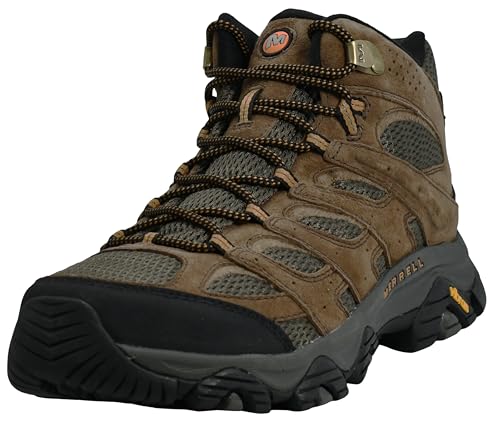
This is the non-waterproof sibling of the boot above, built on the same last and the same Vibram TC5+ outsole, and it earns its own place here because removing the membrane changes the boot’s character. The pigskin leather and mesh upper uses open mesh panels that let heat and sweat escape as you walk, and when the boot does get wet — stepping through a stream, say — it dries far faster than a membrane boot, which holds water in its lining.
The trade is absolute: with no membrane, rain and puddles come straight through the mesh. On dry, warm trails that is the right exchange, because the waterproof version’s barrier also traps the moisture your own feet produce, and over a hot afternoon that can mean damper socks than the breathable boot collects. The mid-cut collar, EVA insole and forgiving flex match the first pick, so the choice between the two is purely about climate: this one for heat and dry ground, its sibling for wet forecasts. The listing linked below is the men’s version in Earth; as with the first pick, confirm size and colour on the listing itself.
Specs
- Upper: Pigskin leather and mesh, with open mesh ventilation panels
- Waterproofing: None — breathable construction, no membrane
- Outsole: Vibram TC5+ rubber
- Insole: EVA
- Shaft height: Ankle (mid-cut)
- Closure: Lace-up
- Version linked: Men’s
ASIN: B0DHHHPXKN
3. Asolo TPS 520 GV EVO — High-Cut Backpacking Boot for Heavy Loads
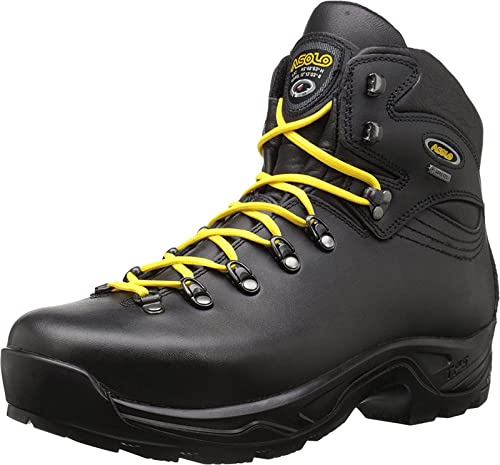
Asolo builds the TPS 520 GV EVO the traditional way: a full-grain leather upper over a Gore-Tex lining, on a Vibram outsole, in a tall, stiff pattern made for long-distance backpacking and trekking on technical terrain. In Asolo’s own naming, explained on the listing, GV marks a Gore-Tex lining paired with a Vibram outsole. The listing linked below is the men’s version, in black.
Everything about this boot is scaled for weight on your back. The high collar and rigid sole support the ankle and spread pack pressure over rough ground, and the thick leather shrugs off rock scrapes that would shred a mesh upper. The costs of that build are real: it is the heaviest style of boot in this guide, it asks for the longest break-in — plan a gradual build-up of shorter walks before any multi-day trip — and the Gore-Tex lining carries the usual membrane limits, shedding rain and shallow water while still wetting through at the collar in deep crossings. Buy it for loaded multi-day routes; for day hikes it is more boot than the trail asks for.
Specs
- Upper: Full-grain leather
- Lining: Gore-Tex (the maker’s waterproof membrane claim)
- Outsole: Vibram
- Intended use: Long-distance backpacking and trekking on technical terrain, per the maker
- Cut: High-cut backpacking pattern
- Version linked: Men’s
ASIN: B0DC6BXHTP
4. Lowa Renegade GTX Mid Wide — The Wide-Fit Option

The Renegade is Lowa’s multifunction staple — the maker notes the model has been setting its fit standard for 25 years — and it is here in its wide version. The listing linked below is the men’s boot in a W width, Dark Grey/Navy: a nubuck leather upper over a Gore-Tex lining, in a mid-cut pattern, and Lowa states that every boot it sells is handcrafted in Europe.
A dedicated wide last is the correct fix for a wide foot. Sizing up in a medium boot adds length you do not need, which lets the heel lift and the foot slide forward into the toe box on descents; the Renegade’s wide fitting instead adds room across the forefoot and midfoot while keeping the length and heel hold where they belong. The support level suits day hikes and moderate overnight loads rather than the heaviest packs, and the Gore-Tex lining is the maker’s membrane claim, with the same wet-through limits at the collar described earlier. If standard boots pinch across the toes but feel right in length, start here.
Specs
- Upper: Nubuck leather
- Lining: Gore-Tex (the maker’s waterproof membrane claim)
- Width: Wide (W) in the linked listing; medium widths also sold
- Shaft height: Mid-cut
- Origin: Handcrafted in Europe, per the maker
- Version linked: Men’s
ASIN: B002MPPVTG
5. Columbia Newton Ridge Plus II Waterproof — The Simpler Boot for Occasional Hikers

The Newton Ridge Plus II is built the straightforward way: a leather and suede upper, a seam-sealed waterproof construction, a cushioned midsole and a lugged rubber outsole, without the layered adjustment systems or exotic materials of the boots above it. The listing linked below is the men’s version in black. Columbia describes the boot as waterproof-breathable, with an all-terrain outsole — treat the waterproofing as the maker’s claim, subject to the same limits as every membrane boot in this guide.
That simpler construction is exactly the point for an occasional hiker. There is little to adjust and little to learn: lace them, walk, and expect a short break-in on easy and moderate trails. The support and stiffness are matched to day walks rather than heavy packs, and the outsole is a general all-terrain pattern rather than the deep, technical tread of the backpacking pick above. For a few hikes a season on maintained paths, that trade is a sensible one; for regular rough terrain, step up to one of the boots above.
Specs
- Upper: Leather and suede
- Construction: Seam-sealed waterproof-breathable build, per the maker
- Cut: Mid-cut men’s hiking boot
- Outsole: Lugged rubber, all-terrain pattern, per the maker
- Version linked: Men’s, black
ASIN: B0CLW718Q6
Frequently Asked Questions
Should I buy hiking boots a size bigger than my shoes?
Not automatically. What you need is length in front of your toes, roughly a thumb’s width, so your toes stay clear of the front on descents. Some hikers get that room in their usual size; others need half a size more, and it varies by brand because lasts differ. Width is the other half of the decision: if a boot pinches your forefoot in your normal size, a wide version of the same model is usually a better answer than a longer boot that lets your heel lift.
Are waterproof hiking boots worth it?
They earn their place in rain, mud, wet grass and cold conditions, where keeping water out keeps feet warm as well as dry. They are the weaker choice for hot, dry trails, where the membrane slows sweat escaping and a breathable boot feels cooler and dries faster after a crossing. Remember that waterproof is a maker’s membrane claim with real limits: water comes over the collar in deep water, and the barrier fades as seams flex and the upper wears.
How long do hiking boots take to break in?
Soft day hikers like the first pick here often feel fine within a few short walks. Stiff, high-cut backpacking boots need a gradual build-up: wear them around the house, then on short walks, then on a half-day hike before trusting them with a full pack. The stiffer the midsole and the thicker the leather, the longer this takes, and skipping it is the classic route to blisters on the first long day.
Mid-cut or high-cut: which do I actually need?
Choose mid-cut for day hikes, groomed trails and light packs: it is lighter, flexes naturally and needs little break-in. Choose high-cut when you carry heavier loads, walk rough or steep ground regularly, or know your ankles roll easily, because the taller collar and stiffer sole support the ankle and spread the load. The honest middle answer is that terrain and pack weight decide, not ankle anxiety alone.
Conclusion: Which Boot Fits Your Walking?
For most day hikers in mixed weather, the Merrell Moab 3 Mid Waterproof is the balanced starting point: a familiar mid-cut shape, a grippy Vibram outsole and the maker’s membrane for wet trails. Warm, dry routes belong to the non-waterproof Moab 3 Mid, which trades the membrane for airflow. Heavy packs and rough multi-day terrain are the Asolo TPS 520 GV EVO’s territory, and it asks for a patient break-in in return. If standard boots squeeze your forefoot, go straight to the Lowa Renegade in its wide fitting rather than sizing up into heel slip. And if your hiking is a few easy trails a season, the Columbia’s simpler construction covers that honestly, with nothing extra to pay attention to. Whichever you choose, fit them with your hiking socks and test the toe room on a slope before the boots meet a real descent.
More from Amazon
Programs that pair well with the guide above. Offers and eligibility are set by Amazon and may change.
Free shipping on eligible items, Prime Video and more. Eligible new members can start with a free trial.
Start a Prime free trialAd-free music streaming. Eligible new subscribers can start with a free trial.
Try Music Unlimited freeA Prime membership for ages 18-24 with a trial period. Eligibility is set by Amazon.
See Prime for Young AdultsAudiobooks and podcasts to listen to on the go. Eligible new members can start with a free trial.
Try Audible freeAs an Amazon Associate we earn from qualifying purchases.