Key takeaways
- Compare the best soccer goals by size, frame material and setup time, with guidance on pop up, steel and training goals for kids and adult practice.
As an Amazon Associate we earn from qualifying purchases.
A backyard soccer goal has to do two jobs at once: stand up to daily shooting practice, and stay exactly where you put it while kids swarm around it. Those jobs pull in opposite directions. The lightest goals are the easiest to carry to the park but the easiest to knock over, and the sturdiest framed goals take up real space and setup time. The five goals below cover the main designs a family is likely to choose between: a pop-up pair ready in seconds, a full steel-frame backyard goal, a weatherproof PVC youth goal, a folding aluminum training goal, and a mini indoor set for the youngest players.
Every dimension, material, and included accessory below comes from the makers’ own product information. One topic runs through the whole guide and matters more than any feature list: anchoring. Movable soccer goals have tipped over and caused fatal injuries, and the safety guidance here follows the rules the U.S. Consumer Product Safety Commission (CPSC) publishes for movable goals.
Disclosure: This article contains affiliate links. If you make a purchase through these links, we may earn a commission at no extra cost to you.
Our top picks
How to Choose a Soccer Goal
Anchor every goal, every time — this is the rule that matters most. The CPSC has documented dozens of deaths and many serious injuries from movable soccer goals tipping over, most of them involving children, and many involving goals that were being climbed on, hung from, or moved. The agency’s guidance is consistent: anchor or stake every movable goal exactly as its maker directs, in every session, even a short one. Never let anyone climb on a goal frame or hang from a crossbar — that is how most tip-overs happen. When high winds are forecast, take lightweight goals down or lay them flat and secure them, because a goal that acts like a sail can blow over onto a child or a fence. Supervise young players around any goal, and check stakes, anchors, and frame joints regularly, since a stake worked loose in soft soil no longer counts as an anchor. Every goal below ships with stakes or ground anchors for this reason; use all of them, every time.
Match the goal size to the player’s age. As a general reference, U.S. Soccer’s small-sided game standards scale the goal to the age group: roughly 4 ft wide by 6 ft high goals or pop-up goals for players under 8, about 6.5 ft by 18.5 ft for under-10 play, about 7 ft by 21 ft for under-12, and the full adult 8 ft by 24 ft from under-13 upward. Backyard practice need not follow match standards exactly, but the logic is sound — a goal that dwarfs a seven-year-old teaches nothing about placement, and one that is too small frustrates an older player. The picks below range from a 22-inch mini goal for toddlers to a 12 ft by 6 ft frame for older youth and adult practice.
Pick the frame material for how the goal will live. Pop-up goals use a flexible one-piece frame that twists open and folds flat; nothing is faster, but the frame is light and depends entirely on its stakes. Steel tube frames are the backyard workhorses — rigid and durable once staked, at the expense of longer assembly. PVC and UPVC frames never rust and shrug off rain, suiting goals that live outside all year, though the material is less rigid than steel under hard adult shots. Aluminum is the training-ground material: strong, light for its size, and rustproof, and folding aluminum goals pack down between sessions.
Check net depth and what is in the box. A deeper net catches hard shots without the ball bouncing straight back out; a shallower training net keeps the ball close for repetition drills. Confirm the listing includes the net, net clips, and — critically — the full set of ground stakes or anchors.
1. GoSports Portable Pop Up Soccer Goals (Set of Two, 4 ft) — Best Pop-Up Pair
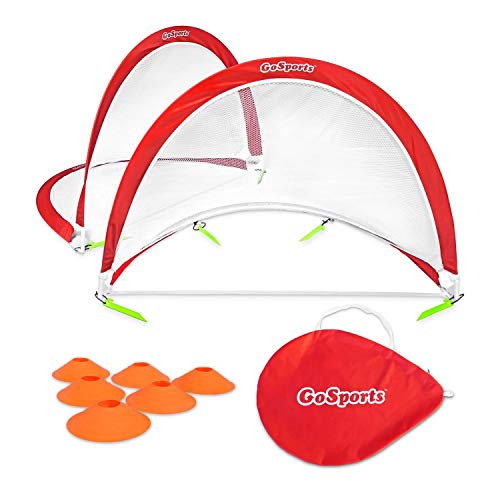
A pair of goals is what turns shooting practice into an actual game, and this GoSports set is built around that idea: two 4 ft pop-up goals that twist open in seconds with no parts to assemble and no tools to lose. Each goal folds completely flat, the whole set weighs about 3 lb on the maker’s listing, and everything travels in the included carrying case, so the set is as realistic for a park or beach session as it is for the backyard.
The box goes beyond the two goals. Six agility cones are included for marking out a small pitch or setting up dribbling lines, and ground stakes are included to anchor each goal on grass. Those stakes are not optional decoration: a 4 ft pop-up goal is light enough for a gust or a hard shot to shift, so stake both goals down before play starts, and bring them inside or lay them flat and secured when storms are forecast. The listing also offers 2.5 ft and 6 ft versions; the 4 ft size covered here is the middle option, sized for young players’ small-sided games and finishing drills.
Specs
- Set of two pop-up goals, 4 ft size (model PUG-4-01); 2.5 ft and 6 ft versions also listed
- Includes 6 agility training cones and a carrying case
- Folds flat for storage and transport; set weight about 3 lb per the maker listing
- Ground stakes included for anchoring on grass
- One-piece pop-up frame; no assembly required
See the GoSports Portable Pop Up Soccer Goals on Amazon
2. Franklin Sports Competition Soccer Goal (12 ft x 6 ft) — Best Steel-Frame Backyard Goal

For a goal that stays set up in the yard and takes daily shooting from older kids and adults, a steel frame is the traditional answer, and Franklin’s Competition goal is the classic version of it. The 12 ft wide by 6 ft high mouth is a genuine practice target — close to the under-12 match width — and the alloy steel frame gives it the rigidity that pop-up and plastic goals cannot match when a teenager strikes the ball hard.
Franklin includes an all-weather net and six ground stakes in the box, and all six stakes belong in the ground before the first shot. A steel goal of this size is exactly the category the CPSC warnings were written for: it is heavy and tall, and it must never be climbed on, hung from, or left unanchored, because its weight is what makes a tip-over dangerous. Assemble it where it will live, stake it down, and teach every player that the crossbar is not a chin-up bar. The same design is also listed in a 6 ft by 4 ft size for younger players and smaller yards.
Specs
- Goal mouth measures 12 ft wide x 6 ft high; also listed in 6 ft x 4 ft
- Alloy steel frame (Franklin part number 30148X)
- All-weather net included
- 6 ground stakes included for anchoring
- Non-folding frame design for a semi-permanent backyard setup
See the Franklin Sports Competition Soccer Goal on Amazon
3. KATARUS Soccer Goal (6 ft x 4 ft, UPVC) — Best PVC Youth Goal

Rain is the slow enemy of backyard goals: steel rusts at the joints and nets rot, so a goal that lives outside permanently wants a frame that ignores weather. The KATARUS goal is built from UPVC tubing — 68 mm (about 2.7 in) diameter pipes per the maker — which cannot rust and is treated for UV exposure, so the maker positions it as a goal that can stay outdoors year-round. The 6 ft by 4 ft size suits youth training and smaller yards, and the same design is listed in sizes up to 12 ft by 6 ft.
Assembly is tool-free: the pipes are numbered and join with a locking-button system, and the maker estimates about fifteen minutes for two people. Stability comes from a reinforced back-bracket structure plus six U-shaped ground stakes, and the safety rule is unchanged — drive in all six stakes, check them after wet weather softens the soil, and never let players climb or hang on the frame. UPVC flexes more than steel under the hardest adult shots, the honest trade-off for a rustproof frame; for youth practice, that trade favors PVC.
Specs
- Goal mouth measures 6 ft x 4 ft; range also listed up to 12 ft x 6 ft (model KT-SGPVC-6X4)
- UPVC frame tubes, 68 mm (2.7 in) diameter, UV protected and weatherproof per the maker
- 6 U-shaped ground stakes and reinforced back-bracket structure included
- Numbered pipes with locking-button joints; tool-free assembly
- Maker-estimated assembly time of about 15 minutes with two people
See the KATARUS Soccer Goal on Amazon
4. FORZA Alu80 Pro Folding Training Soccer Goal — Best Aluminum Training Goal

FORZA’s Alu80 Pro is a different class of product from the backyard goals above: a folding training goal built on an 80 mm reinforced aluminum frame, the material clubs use because it combines real rigidity with low weight and complete rust resistance. The frame carries a white powder coating for weather and scratch protection, and the side supports fold inward on hinges, so a goal with a rigid metal frame can still be collapsed for transport and storage between sessions — the format coaches want for training fields and serious home practice.
The maker’s manual is explicit about the routine this goal demands: unfold the goal fully, lock the folding mechanism, and drive in the included ground anchors before use, every use. The same manual states plainly that no one should climb on the goal or hang from the crossbar, and that children should be supervised around it. The listing record covers the 1.5 m by 1 m size, a finishing and target-practice format rather than a match goal; the box includes the net, net clips or bungee cords, anchors, and assembly hardware.
Specs
- 80 mm reinforced aluminum frame with white powder coating, per the maker
- Folding frame with locking hinges for transport and compact storage
- Ground anchors (stakes) included; maker instructs anchoring before every use
- Net, net clips or bungee cords, and assembly hardware included
- Size in the listing record: 1.5 m x 1 m training format
- Maker manual safety instruction: never climb on the goal or hang from the crossbar
See the FORZA Alu80 Pro Folding Training Soccer Goal on Amazon
5. Franklin Sports Kids Mini Soccer Goal Set (22 in x 17 in) — Best for Toddlers and Indoor Play

The youngest players need a goal scaled to a toddler’s kick, and Franklin’s mini set is exactly that: a 22 in by 17 in goal with a polypropylene plastic frame and easy-fold corner joints that pop up for play and fold down in seconds. It is light and soft-edged enough for a playroom or basement — the one pick here that genuinely works indoors — and it folds flat enough to take to a grandparent’s house or a park picnic.
The set is a starter kit rather than just a goal: a rotation-molded soccer ball and an inflation pump are in the box, along with four ground stakes for the days it moves outside onto grass. Use those stakes outdoors — even a mini goal should not be left free-standing in wind — and keep the same household rule as for the big goals: it is a target for the ball, not something to climb on. For children in the roughly three-to-five age range taking their first kicks, this is the appropriate scale; graduate to the 4 ft pop-up pair once they start striking the ball with intent.
Specs
- Goal measures 22 in wide x 17 in high, sized for the youngest players
- Polypropylene plastic frame with easy-fold corner joints
- Includes a rotation-molded soccer ball and an inflation pump
- Includes 4 ground stakes for outdoor use
- Folds down in seconds for storage and travel
See the Franklin Sports Kids Mini Soccer Goal Set on Amazon
Frequently Asked Questions
What size soccer goal should I buy for my child’s age?
Use the small-sided standards as a general reference. Toddlers do best with a mini goal like the 22 in Franklin set. Players under 8 usually play toward goals around 4 ft wide — pop-up pairs and small frames — while under-10 and under-12 players progress toward goals in the 6.5 ft by 18.5 ft and 7 ft by 21 ft range, and teenagers use the full 8 ft by 24 ft. In a backyard, err one size smaller than the match standard: it keeps practice focused on placement and keeps the frame manageable to anchor and store.
How do I stop a portable soccer goal from tipping over?
Anchor it with every stake or ground anchor the maker supplies, driven fully into the ground, before every session — not just on windy days. Keep all climbing and hanging off the frame and crossbar, since that is the most common cause of tip-overs. Place the goal on level ground, re-check stakes after rain softens the soil, and take lightweight goals down or lay them flat and secured when strong winds are forecast.
Can I leave a backyard soccer goal outside all year?
It depends on the frame. UPVC and aluminum frames are built for permanent outdoor life and will not rust, though nets still age under sun and weather. Steel frames tolerate outdoor storage but should be checked at the joints for rust, and pop-up goals last longest when folded and stored indoors between sessions, as their makers direct. Whatever the frame, an outdoor goal still needs its anchors checked regularly and should be secured or taken down ahead of severe storms.
What is the difference between a pop-up goal and a framed goal?
A pop-up goal is a single flexible frame that twists open and folds flat; setup takes seconds and the whole set can weigh only a few pounds, which makes it ideal for travel and small-sided games, but it depends completely on its stakes to stay put. A framed goal — steel, PVC, or aluminum — is assembled from rigid tubes, takes longer to put together, and offers a truer, more stable target for repeated shooting. Choose pop-ups for portability and young players, and framed goals for a dedicated practice space.
Conclusion
For most families, the right answer depends on where the goal will live. Choose the GoSports pop-up pair for an instant small-sided game at home, the park, or the beach. Choose the Franklin Competition 12 ft x 6 ft if older kids or adults need a rigid steel target that stays up in the yard. Choose the KATARUS UPVC goal if the goal will live outdoors permanently and rust is your main concern. Choose the FORZA Alu80 Pro for coached training sessions where a folding aluminum frame earns its keep. And choose the Franklin mini set for a toddler’s first kicks, indoors or out. Whichever one comes home, the routine is identical: anchor it fully, keep climbers off it, secure it in high wind, and check the stakes before every game.
More from Amazon
Programs that pair well with the guide above. Offers and eligibility are set by Amazon and may change.
Free shipping on eligible items, Prime Video and more. Eligible new members can start with a free trial.
Start a Prime free trialAd-free music streaming. Eligible new subscribers can start with a free trial.
Try Music Unlimited freeA Prime membership for ages 18-24 with a trial period. Eligibility is set by Amazon.
See Prime for Young AdultsAudiobooks and podcasts to listen to on the go. Eligible new members can start with a free trial.
Try Audible freeAs an Amazon Associate we earn from qualifying purchases.