Key takeaways
- The best monoculars for hiking, travel and watching wildlife, comparing magnification, objective size, coatings and pocket-friendly designs for all uses.
As an Amazon Associate we earn from qualifying purchases.
A monocular does with one tube what binoculars do with two: it brings distant subjects closer, at roughly half the size and weight. That trade suits hikers counting pack ounces, travelers who want an optic that lives in a jacket pocket, and bird watchers who raise a tube with one hand while the other holds a field guide or a leash. The compromise is real — one eye does the work and the view is narrower — but for quick looks at wildlife, trail signs and shorelines, a good monocular is often the optic that actually comes along.
The five monoculars below span the main shapes the category takes. There is a pocket 10×25 from a major optics maker, a 10×42 with ED glass for lower light, a high-power 12×50 for reach, a 12×55 kit built around a smartphone adapter, and an ultralight 10×25 that focuses unusually close. Every figure quoted here comes from the makers’ own published specifications and listing details.
Disclosure: This article contains affiliate links. If you make a purchase through these links, we may earn a commission at no extra cost to you.
How to Choose
Start with the two numbers. Every monocular is described by a pair such as 10×42. The first number is magnification: 10x makes a subject look ten times closer. The second is the objective lens diameter in millimeters, which sets how much light the tube can gather. Higher magnification is not automatically better. At 12x, hand shake is magnified along with the subject, and the field of view narrows, while 8x and 10x are easier to hold steady and quicker to aim. Most hikers and bird watchers settle at 8x or 10x; 12x earns its place for stationary viewing and open country.
Work out the exit pupil. Divide the objective diameter by the magnification. A 10×25 gives a 2.5 mm exit pupil, a 10×42 gives 4.2 mm, and a 12×55 gives about 4.6 mm. The exit pupil is the beam of light that reaches your eye, so a larger figure keeps the image brighter at dawn, at dusk and under tree canopy. A small exit pupil is no problem at midday; compact 25 mm tubes are daylight tools first.
Compare field of view. Makers print this as feet at 1,000 yards. A wide figure — 315 to 352 feet on several models here — makes it easier to find a bird in a tree and follow it when it moves. High magnification squeezes the figure down; the 12×50 in this guide lists 246 feet. If you mostly scan for moving wildlife, weight field of view heavily; if your subjects sit still, reach matters more.
Check the prism and the coatings. Most monoculars use a roof prism. BAK-4 prism glass is the better-specified material; BK-7 is the plainer alternative in lighter, simpler models. Fully multi-coated lenses carry anti-reflective coatings on every air-to-glass surface and pass more light than lenses described as merely coated or multi-coated. Two upgrades appear on the stronger models here: phase coating on the roof prism, which keeps resolution and contrast up, and ED (extra-low dispersion) glass, which reduces color fringing around edges such as a bird against bright sky.
Look at eye relief and close focus. Eye relief is how far your eye can sit from the eyepiece while still seeing the full field. Glasses wearers should look for roughly 14 mm or more, plus a twist-up eyecup. Close focus is the nearest distance the tube can focus on, and it varies widely: the models here range from 4 feet to 16.4 feet. If you watch butterflies or read museum exhibits, a short close focus matters as much as magnification.
Decide how much sealing you need. Nitrogen purged and O-ring sealed bodies keep internal fogging and rain out; the strongest sealing here carries an IPX7 designation. Rubber armor adds grip and bump protection.
Match size and weight to the carry. Pocket monoculars weigh between about 4 and 6 ounces and disappear into a coat. Full-size 42 mm and 50 mm tubes run from about 13 ounces upward and ride better in a pack or on a belt.
Consider a phone kit if you want photos. Some monoculars ship with a smartphone adapter that clamps over the eyepiece so the phone camera can record what the tube sees. Alignment takes a minute of patience, and at 12x a tripod socket is worth having, because the phone records every tremor your hand makes.
Vortex Optics Solo Monocular 10×25
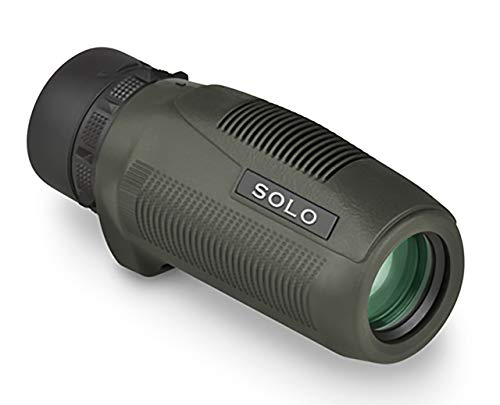
The Vortex Optics Solo Monocular 10×25 is the pocket pick from a maker known for field optics. At 4.4 inches long and 5.6 ounces, it is small enough for a jacket pocket or a glove box, yet it is a complete outdoor optic: the lenses are fully multi-coated, the body is rubber armored, and the tube is nitrogen purged and O-ring sealed for waterproof and fogproof performance. An adjustable eyecup twists up and down so the monocular can be used with or without glasses.
The listed field of view is 315 feet at 1,000 yards, a generous figure for a 10x tube, which helps when you are trying to pick up a moving bird or follow a boat across a harbor. The 2.5 mm exit pupil suits daylight far better than dusk, and the 16.4-foot close focus is long, so this is not the tube for butterflies or close exhibits. It does the everyday job well: a sealed, coated, pocketable 10x that is ready whenever a quick look presents itself. Vortex lists the Solo with its unlimited, unconditional lifetime VIP warranty.
Specs
- Magnification: 10x
- Objective lens diameter: 25 mm
- Field of view: 315 ft at 1,000 yards (6.0 degrees)
- Eye relief: 14.5 mm
- Exit pupil: 2.5 mm
- Close focus: 16.4 ft
- Length: 4.4 in
- Weight: 5.6 oz
- Lenses: fully multi-coated; nitrogen purged and O-ring sealed
ASIN: B002UQ71HC
Bushnell Legend 10×42 Ultra HD Monocular
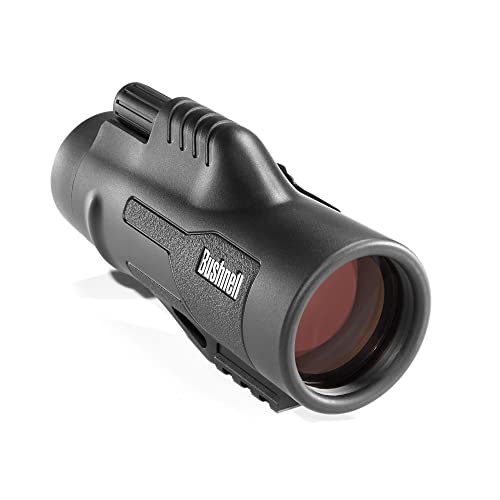
The Bushnell Legend 10×42 Ultra HD Monocular is the step up in glass. Its objective uses ED Prime extra-low dispersion glass, the BaK-4 roof prism carries a PC-3 phase coating, and the lenses are fully multi-coated with Bushnell’s Ultra Wide Band coating, a combination that keeps the image bright and color-true as light fades. An EXO Barrier coating on the outer surfaces sheds water, oil and dirt. For bird watchers who work the first and last hour of the day, this is the specification set built for those hours.
The 42 mm objective and 10x magnification produce a 4.2 mm exit pupil, the listed field of view is 340 feet at 1,000 yards, and close focus is a short 6.6 feet, so the same tube handles a distant hawk and a nearby warbler. Eye relief is 15.2 mm behind a twist-up eyecup, comfortable for glasses wearers. The body is sealed to IPX7, measures 5.4 inches long and weighs 13.2 ounces — pack or belt carry rather than pocket carry, with a carry clip for quick access.
Specs
- Magnification: 10x
- Objective lens diameter: 42 mm
- Glass: ED Prime extra-low dispersion
- Prism: BaK-4 roof with PC-3 phase coating
- Coatings: fully multi-coated with Ultra Wide Band coating; EXO Barrier outer protection
- Field of view: 340 ft at 1,000 yards
- Eye relief: 15.2 mm; exit pupil 4.2 mm
- Close focus: 6.6 ft
- Sealing: IPX7 waterproof and fogproof
- Length: 5.4 in; weight: 13.2 oz
ASIN: B006U3ZIVC
Wingspan Optics Explorer High Powered 12X50 Monocular

The Wingspan Optics Explorer High Powered 12X50 Monocular is the reach pick, built by a maker that designs specifically for bird watching. The 12x magnification and 50 mm objective pull in subjects that sit beyond comfortable 10x range — shorebirds on a far mudflat, raptors on a ridge, boats on open water. Inside are a BAK-4 prism and fully multi-coated lenses; the focus wheel is shaped for single-hand operation, so the other hand stays free for a hiking pole or a dog lead. The body is waterproof and fogproof, and the maker positions the Explorer for daytime use; formerly sold under the Polaris Optics name.
The listed field of view is 246 feet at 1,000 yards, noticeably narrower than the 10x models here, and 12x shows every tremor in your hands, so bracing against a tree, a railing or your pack is part of using it well. Eye relief is listed at 14 mm and close focus at 2.5 meters, which keeps near subjects — a feeder, a nest box — within reach of the same tube. For watchers whose subjects are far and mostly stationary, those are trades worth making.
Specs
- Magnification: 12x
- Objective lens diameter: 50 mm
- Prism: BAK-4
- Lenses: fully multi-coated
- Field of view: 246 ft at 1,000 yards
- Eye relief: 14 mm
- Close focus: 2.5 m
- Sealing: waterproof and fog proof
- Focus: single-hand focus wheel
ASIN: B00K9SYPAE
Gosky 12×55 HD Monocular Telescope with Smartphone Adapter
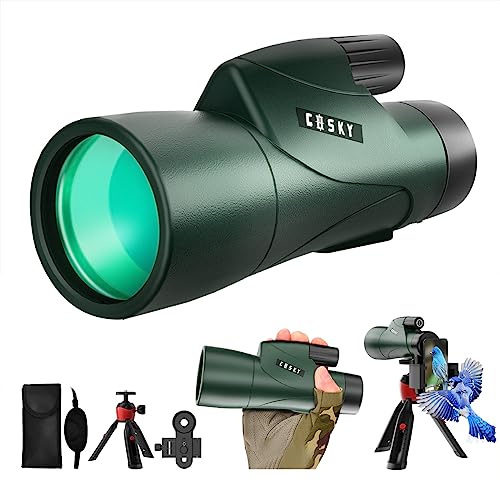
The Gosky 12×55 HD Monocular Telescope is the kit pick, sold with accessories that turn a monocular into a simple camera telephoto. The box includes a quick-alignment smartphone holder that clamps over the eyepiece and fits most phones, along with a carrying case, hand strap, lens caps and a cleaning cloth. The monocular body is tripod adaptable, and for phone photos at 12x that matters: mounting the tube removes the hand shake the phone would otherwise record.
The optic itself is a full-size tube. Magnification is 12x through a 55 mm objective, the largest in this guide, working through an 18 mm BAK-4 prism and fully multi-coated lenses. The listed field of view is 352 feet at 1,000 yards, wide for a 12x design, and the exit pupil works out to about 4.6 mm, the largest here, which helps in flat morning and evening light. The body is nitrogen filled and sealed to IPX7, with a twist-up eyecup. It is also the heavyweight of the five, at 1.54 pounds as listed and 6.95 inches long — a pack item, chosen for the kit and the big objective rather than a pocket.
Specs
- Magnification: 12x
- Objective lens diameter: 55 mm
- Prism: 18 mm BAK-4
- Lenses: fully multi-coated (FMC)
- Field of view: 352 ft at 1,000 yards
- Sealing: IPX7, nitrogen filled
- Weight: 1.54 lb as listed
- Length: 6.95 in
- In the box: smartphone adapter, carrying case, hand strap, lens caps, cleaning cloth
ASIN: B07B8XTS3Z
Carson BlackWave 10x25mm Waterproof Monocular (WM-025)

The Carson BlackWave 10x25mm Waterproof Monocular (WM-025) takes the compact idea in a different direction from the Solo: it is the close-focus and low-weight pick. Carson lists a close focus of just 4 feet, the shortest in this guide, which makes the BlackWave useful for butterflies, dragonflies, flowers and museum pieces as well as distant signs and shorelines. At 4.3 ounces it is also the lightest monocular here, light enough to wear on a neck strap all day.
The optical specification is simpler than the larger tubes: a BK-7 prism, a listed field of view of 273 feet at 1,000 yards, and a nitrogen filled, waterproof body, which is not a given at this size. Eye relief is a short 12 mm, so glasses wearers will lose some field at the edges. A soft pouch, strap and lens cloth are included, and Carson backs the BlackWave with its No Fault warranty as listed. For a traveler or hiker who wants one small tube for both the far ridge and the butterfly on the near bush, this configuration covers both.
Specs
- Magnification: 10x
- Objective lens diameter: 25 mm
- Prism: BK-7
- Field of view: 273 ft at 1,000 yards
- Eye relief: 12 mm
- Close focus: 4 ft
- Weight: 4.3 oz
- Sealing: waterproof, nitrogen filled
- Included: soft pouch, strap and lens cloth
ASIN: B00MCACUD6
FAQ
Is a monocular better than binoculars for hiking?
Neither is better outright; they split the difference between view and carry. A monocular is about half the size and weight of a binocular of the same configuration, works one-handed, and fits pockets that binoculars cannot. A binocular gives a wider, more relaxed two-eye view for long scanning sessions. Many hikers choose the monocular because the best optic is the one that gets carried, and a 5.6-ounce tube like the Vortex Solo comes along on hikes where a full binocular would stay home.
What do the numbers 10×42 mean, and which size should I choose?
The first number is magnification and the second is the objective lens diameter in millimeters. Divide the second by the first to get the exit pupil, a quick guide to low-light brightness: 10×25 gives 2.5 mm, 10×42 gives 4.2 mm. Choose a 25 mm tube for daylight and minimum weight, a 42 mm tube if you watch at dawn and dusk, and a 12x model with a 50 mm or larger objective when distance is the whole point and you can brace the tube.
Can I take photos through a monocular with my phone?
Yes, with an adapter that holds the phone camera over the eyepiece. The Gosky 12×55 in this guide includes a quick-alignment smartphone holder for exactly that. Alignment is the fiddly part: the phone lens must sit centered on the eyepiece, and a little digital zoom clears the dark circle at the frame’s edge. At 12x, mounting the monocular on a tripod steadies the shot far better than hand-holding, and the Gosky body is tripod adaptable for that reason.
How close can a monocular focus?
It varies far more than the magnification figures suggest. Listed close focus here runs from 4 feet on the Carson BlackWave to 16.4 feet on the Vortex Solo 10×25. A long close focus is no problem for landscapes, water and sky, but it rules out butterflies, insects and close exhibits. If near subjects are part of your watching, check close focus before magnification.
Conclusion
Each of these five answers a different version of the same question. Choose the Vortex Optics Solo 10×25 for a sealed, fully multi-coated pocket optic, ready for quick daylight looks. Choose the Bushnell Legend 10×42 Ultra HD for the strongest glass here — ED Prime, phase coating and a 4.2 mm exit pupil for early and late light. Choose the Wingspan Optics Explorer 12X50 when subjects sit far off and 12x reach is worth a narrower field. Choose the Gosky 12×55 if you want the phone kit and the biggest objective in the guide. And choose the Carson BlackWave for the lightest carry and a 4-foot close focus that covers near subjects the others cannot. Match the configuration to the light and the distance you watch most, and the choice makes itself.
More from Amazon
Programs that pair well with the guide above. Offers and eligibility are set by Amazon and may change.
Free shipping on eligible items, Prime Video and more. Eligible new members can start with a free trial.
Start a Prime free trialAd-free music streaming. Eligible new subscribers can start with a free trial.
Try Music Unlimited freeA Prime membership for ages 18-24 with a trial period. Eligibility is set by Amazon.
See Prime for Young AdultsAudiobooks and podcasts to listen to on the go. Eligible new members can start with a free trial.
Try Audible freeAs an Amazon Associate we earn from qualifying purchases.