Key takeaways
- Compare the best DJ controllers for mixing at home and events, with deck counts, jog wheels, software bundles, and outputs explained in full detail.
As an Amazon Associate we earn from qualifying purchases.
A DJ controller replaces a pair of players and a separate mixer with one surface that plugs into a laptop. The jog wheels, faders, and pads on the hardware map to the decks inside DJ software, and a built-in sound card sends the mix to speakers while a second channel feeds your headphones for cueing. The five controllers below cover the main ways people get into this format: a guided first controller from Hercules, a rekordbox-focused Pioneer DJ model, a four-channel Pioneer DJ machine in white, a palm-sized Numark built for parties and travel, and a Roland unit that folds a drum machine and sequencer into the layout.
Disclosure: This article contains affiliate links. If you make a purchase through these links, we may earn a commission at no extra cost to you.
Our top picks
How to Choose a DJ Controller
Start with the software, because it shapes everything else. Controllers are designed around one main program: rekordbox is Pioneer DJ’s platform, Serato DJ is the other big name, Traktor belongs to Native Instruments, and some Hercules models also run the maker’s own DJUCED. A hardware unlock device switches on the full performance mode of its software when you plug it in, while other models include a license for the Lite version of a program and treat the Pro version as a separate upgrade. Decide which library you want to live in first, because moving prepared cue points and playlists between platforms later is tedious work.
Count channels and decks. Two-channel controllers handle two tracks at once, which covers most mixing. Four-channel models let you layer extra tracks, samples, or a backup deck, and some two-channel units still control four software decks by switching layers with a deck select button.
Look at the jog wheels and pads. Small capacitive wheels suit basic cueing and pitch bending. Larger wheels feel closer to club players, and the biggest models match the platter size of flagship media players and add an on-jog display showing the playhead position inside the wheel itself. If scratching matters to you, wheel diameter and a touch-sensitive top plate are the details to compare. Pads trigger hot cues, loops, samples, and effects: eight per deck is the full-size layout, while compact controllers often carry four per deck with several modes sharing the same pads.
Match the outputs to your speakers. Nearly every controller here has an unbalanced RCA master output for powered speakers or an amplifier. A separate booth output, found on the four-channel pick below, runs a monitor speaker with its own level. Headphone sockets come in 3.5 mm, full-size 6.35 mm, or both. Microphone inputs vary just as much: some models give the mic its own EQ, one routes mic audio into the computer feed for streaming, and the smallest controller here has no mic input at all. All five run from USB bus power, and weights run from under a kilogram for the travel pick to nearly four kilograms for the four-channel model, which decides whether a unit lives on a desk or rides in a backpack.
1. Hercules DJControl Inpulse 500

The DJControl Inpulse 500 is the beginner-focused controller in this group, and its signature feature is a set of light guides called the Beatmatch Guide. A tempo guide and a beat align guide light up beside each jog wheel to show whether the incoming track needs to run faster or slower and whether its beats line up with the playing track.
The layout is a full-size two-deck design with a metal backing plate, two large touch-detection jog wheels measuring 5.5 inches across, and 16 backlit RGB rubber pads, eight per deck. A dedicated Filter/FX area combines filter sweeps with effects, and retractable feet lift the unit to 3.1 inches tall so cables run underneath. The box includes licenses for Serato DJ Lite and DJUCED, with streaming support through TIDAL and SoundCloud GO+ in Serato DJ Lite and Beatport LINK and Beatsource LINK in DJUCED.
Connections are the most complete of the two-channel models here. Master output is offered on both 6.35 mm jacks and RCA, headphones can use either a 3.5 mm or a 6.35 mm socket, and an auxiliary input on RCA and 3.5 mm takes a phone or media player, passing through a hardware input mixer with its own filter knob, independent of the software. The balanced 6.35 mm microphone input has high and low EQ knobs and also works without software running. Audio resolution is 24-bit at 44.1 kHz, and the body measures 21.3 by 11.7 by 2.8 inches at 7 pounds.
Specs
- 2 decks / 2 channels with built-in audio interface (24-bit, 44.1 kHz)
- Jog wheels: 5.5 in (14 cm) diameter with touch detection
- 16 backlit RGB performance pads (8 per deck)
- Software: Serato DJ Lite and DJUCED licenses included; Beatmatch Guide light guides
- Master output: 2 x 6.35 mm jack + 2 x RCA; headphones: 3.5 mm + 6.35 mm
- Microphone input: balanced 6.35 mm jack with 2-band EQ; auxiliary input on RCA + 3.5 mm
- Dimensions: 21.3 x 11.7 x 2.8 in; weight: 7 lb (3.2 kg); USB powered
2. Pioneer DJ DDJ-FLX4
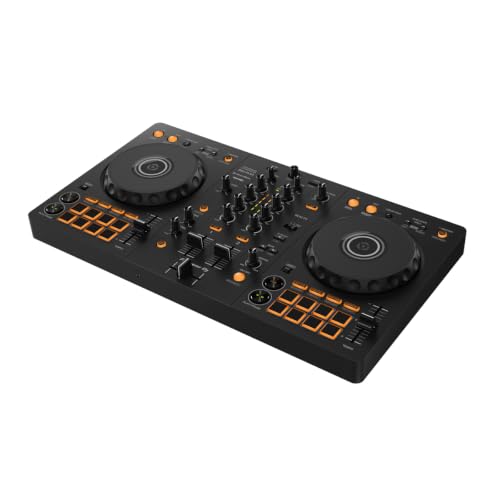
The DDJ-FLX4 is the rekordbox entry point in the Pioneer DJ range, and it doubles as a Serato controller. Pioneer DJ describes it as a hardware unlock device for rekordbox, which means connecting it switches on rekordbox performance mode on Mac, Windows, and the iOS and Android apps. It also unlocks Serato DJ Lite when connected; Serato DJ Pro is supported, but Pioneer DJ states that a separate license or subscription is required for the Pro version. That makes this the natural pick for someone who wants the rekordbox library system used across the Pioneer DJ ecosystem, with a Serato fallback in the same box.
Two features aim at smoother transitions. Smart Fader adjusts tempo, volume, and bass as you move the crossfader so the two tracks blend without a clash, and Smart CFX applies sound color effects from a single knob per channel. The deck sections carry 111.6 mm capacitive jog wheels and eight back-lit rubber performance pads per deck.
The built-in sound card handles 16-bit and 24-bit audio at 44.1 and 48 kHz. Outputs are kept simple: one RCA master pair and a 3.5 mm headphone socket. The microphone input is a 6.35 mm TS jack, and Pioneer DJ routes the mic signal into the USB audio feed, so a livestream carries voice and music over the single computer connection. Two USB-C ports sit on the back, one for the computer connection and power and one for power only, and the unit runs on USB bus power or a 9 V USB power adapter with a phone or tablet. Bluetooth connects it to rekordbox on iOS and Android. The body measures 482 by 272.8 by 59.2 mm and weighs 2.1 kg.
Specs
- 2 channels / 2 decks with built-in sound card (16-bit/24-bit, 44.1/48 kHz)
- Jog wheels: 111.6 mm capacitive touch
- 8 back-lit rubber performance pads per deck
- Software: hardware unlock for rekordbox; unlocks Serato DJ Lite (Serato DJ Pro requires a separate license or subscription)
- Master output: 1 x RCA; headphones: 1 x 3.5 mm stereo mini jack
- Microphone input: 1 x 6.35 mm TS jack, routed into the USB audio feed
- Dimensions: 482 x 272.8 x 59.2 mm; weight: 2.1 kg; USB bus powered via USB-C
3. Pioneer DJ DDJ-FLX6-W

The DDJ-FLX6-W is the four-channel step up, finished in the white colorway of the DDJ-FLX6 line. It unlocks both rekordbox and Serato DJ Pro, and the box includes license keys for the Serato Pitch ‘n Time DJ and Serato FX Pack expansion packs. Four mixer channels with four-deck control let you keep extra tracks or samples ready, and the layout follows the club-style arrangement of Pioneer DJ players and mixers.
The jog wheels are the headline hardware: at 206 mm they match the platter size of the flagship CDJ-3000 player, they are capacitive touch models, and each carries an on-jog display that shows the playhead position. Three performance features are built around those wheels. Merge FX builds a transition from selectable effect elements with one knob, Jog Cutter applies one of ten scratch patterns by moving the wheel over the last cue point, and Sample Scratch loads a sampler slot onto a deck for scratching.
Output options grow with the channel count. Alongside the RCA master output there is a separate RCA booth output for a monitor speaker, and headphone listeners get both a 6.35 mm stereo jack and a 3.5 mm mini jack. The microphone input is a single 6.35 mm jack. The sound card runs at 24-bit and 44.1 kHz, and the unit measures 676 by 345.7 by 68.7 mm at 3.8 kg, so it is a desk or event-table piece rather than a backpack one.
Specs
- 4 channels / 4 decks with built-in sound card (24-bit, 44.1 kHz)
- Jog wheels: 206 mm capacitive touch with on-jog playhead display
- 8 performance pads per deck; Merge FX, Jog Cutter, and Sample Scratch
- Software: unlocks rekordbox and Serato DJ Pro; Serato Pitch ‘n Time DJ and Serato FX Pack license keys included
- Master output: 1 x RCA; booth output: 1 x RCA; headphones: 6.35 mm + 3.5 mm
- Microphone input: 1 x 6.35 mm jack
- Dimensions: 676 x 345.7 x 68.7 mm; weight: 3.8 kg; USB powered; white finish
4. Numark Party Mix II

The Party Mix II is the travel and house-party pick: at 325.5 by 199 by 51 mm and 0.95 kg, it is by far the smallest and lightest controller here, and it runs entirely from USB power. It is built around Serato DJ Lite, which Numark includes, and it also works with the Algoriddim djay and DJ Player Pro apps on a phone or tablet through a camera connection kit. Through Serato DJ Lite it reaches the TIDAL, Beatport LINK, Beatsource LINK, and SoundCloud GO streaming catalogs, so a set does not depend on a local music library.
Its party trick is on the front edge: three multi-color LEDs with wide-coverage lenses throw a beat-synchronized light show onto the room, with five lighting modes from software-controlled patterns to always on or off. The control surface keeps the essentials. Two large touch-sensitive jog wheels handle scratching and bending, four performance pads per deck cover cue, loop, sampler, and effects modes, and each channel gets a 2-band EQ and a dedicated filter knob. Sync buttons tempo-match the two decks automatically.
The trade-offs for the size are in the connections. Both the main output and the headphone output are 3.5 mm jacks, and there is no microphone input. For a bedroom or a small gathering where the controller travels in the same bag as the laptop, that simplicity is the point: plug in one USB cable, open Serato DJ Lite, and play.
Specs
- 2 channels / 2 decks with built-in audio interface
- Jog wheels: touch-sensitive capacitive
- 4 performance pads per deck (Cue, Loop, Sampler, Effects modes)
- Built-in light show: 3 multi-color LEDs with 5 lighting modes, beat-synchronized
- Software: Serato DJ Lite included; also works with Algoriddim djay and DJ Player Pro apps
- Main output: 1 x 3.5 mm; headphone output: 1 x 3.5 mm; no microphone input
- Dimensions: 325.5 x 199 x 51 mm; weight: 0.95 kg (2.1 lb); USB bus powered
5. Roland DJ-202

The DJ-202 is the outlier of the five, because Roland built a beat-making instrument into a Serato controller. It is a two-channel mixer that controls four decks through deck select switching, and it ships with Serato DJ Lite, with a Serato DJ Pro upgrade supported. Under the pads sits a step sequencer loaded with drum kits modeled from Roland’s TR-606, TR-707, TR-808, and TR-909 machines using the company’s ACB circuit modeling. Each kit holds eight sounds, from bass drum and snare to clap and ride, and you can program patterns on the pads, trigger them alongside your tracks, or record sequences into the Serato sampler in Inst-Rec mode. A MIDI output lets the sequencer clock external instruments.
The DJ hardware follows the full-size pattern: two large, low-latency capacitive-touch platters, eight performance pads per deck with hot cue, loop, sequencer, and sampler modes, and a three-band EQ per channel. The microphone input is a 6.35 mm jack with Roland’s Vocal FX processing, aimed at MC work over a set. Outputs are an RCA master pair and a 6.35 mm headphone socket. Audio runs at 24-bit and 48 kHz, and the body measures 478 by 297 by 62 mm at 2.1 kg, close in footprint to the DDJ-FLX4 while adding the drum machine layer none of the other four offers.
Specs
- 2 channels with 4-deck control via deck select; built-in audio interface (24-bit, 48 kHz)
- Jog wheels: large low-latency capacitive-touch platters
- 8 performance pads per deck (Hot Cue, Loop, Sequencer, Sampler modes)
- Built-in TR drum kits (TR-606, TR-707, TR-808, TR-909) with 16-step sequencer
- Software: Serato DJ Lite included; Serato DJ Pro upgrade supported
- Master output: 1 x RCA; headphones: 1 x 6.35 mm; MIDI output for external sync
- Microphone input: 1 x 6.35 mm jack with Vocal FX
- Dimensions: 478 x 297 x 62 mm; weight: 2.1 kg; USB bus powered
Frequently Asked Questions
Do these controllers work without a laptop?
No. All five are USB controllers that depend on DJ software running on a computer, phone, or tablet, and all five draw power from that USB connection. The Hercules can pass a microphone and an auxiliary source through its hardware input mixer even without software, but track playback and mixing happen in the software in every case.
What is the difference between a hardware unlock and an included Lite license?
A hardware unlock model, such as the DDJ-FLX4 with rekordbox or the DDJ-FLX6-W with rekordbox and Serato DJ Pro, activates the full performance version of the software simply by being connected. A Lite license model, such as the Hercules, the Party Mix II, and the DJ-202, runs the free Lite edition of its program, and moving up to the Pro edition is a separate purchase or subscription.
Can I plug a microphone into every controller here?
Four of the five have a microphone input, but they differ. The Hercules gives its balanced input a two-band EQ and lets it run without software, the DDJ-FLX4 mixes the mic into the USB feed for streaming, the DDJ-FLX6-W has a single 6.35 mm input, and the Roland adds Vocal FX processing. The Party Mix II has no microphone input at all.
Which of these is easiest to carry to a friend’s place or a small party?
The Party Mix II, by a wide margin. It weighs 0.95 kg, measures about 32.5 cm across, and needs only a USB cable and a 3.5 mm lead for speakers. The DDJ-FLX4 and DJ-202 are the next step up at 2.1 kg each, while the Hercules and the DDJ-FLX6-W are desk-sized units that travel best in a padded case.
Conclusion
For a first controller with training built in, the Hercules DJControl Inpulse 500 pairs its Beatmatch Guide light guides with the most complete connection set of any two-channel model here. For the rekordbox ecosystem, the Pioneer DJ DDJ-FLX4 is the compact unlock device that also covers Serato DJ Lite. For four channels and full-size jog wheels with playhead displays, the DDJ-FLX6-W is the step-up machine, and its booth output suits event work with a monitor speaker. For parties and travel, the Numark Party Mix II trades connections for a tiny footprint and a light show. And for producers who want to build beats inside a set, the Roland DJ-202 folds TR drum kits and a sequencer into a Serato controller in a way nothing else on this list attempts.
More from Amazon
Programs that pair well with the guide above. Offers and eligibility are set by Amazon and may change.
Free shipping on eligible items, Prime Video and more. Eligible new members can start with a free trial.
Start a Prime free trialAd-free music streaming. Eligible new subscribers can start with a free trial.
Try Music Unlimited freeA Prime membership for ages 18-24 with a trial period. Eligibility is set by Amazon.
See Prime for Young AdultsAudiobooks and podcasts to listen to on the go. Eligible new members can start with a free trial.
Try Audible freeAs an Amazon Associate we earn from qualifying purchases.