A thunderbolt docking station solves a specific, annoying problem: you sit down at your desk, and your laptop has two ports while your monitors, network cable, external drive, and peripherals need far more. The wrong dock gives you flickering displays, dropped connections, or a laptop that charges at half speed. The right one turns a single cable into a full workstation setup that behaves predictably every morning.
What separates the good from the bad in this category comes down to a few measurable factors: power delivery wattage (how fast your laptop charges), display output quality (how many monitors and at what resolution), and port layout (whether you can actually plug everything in without a cable-management nightmare). Beyond that, build quality, thermal behavior, and driver support matter more than spec-sheet bullet points suggest. The eight docks below span entry-level hubs to full Thunderbolt 5 workhorses, and we compared them on published specifications, current pricing, and recurring themes in owner reviews to identify where each one genuinely fits.
Our top picks
 Dell Pro Thunderbolt 4 Smart Dock SD25TB4
- Up to 4 4K monitors per HDMI 2.1,…
- Up to 130W for Dell and 96W for…
- Dual data port, dual 4K video and chain…
 Anker Prime Docking Station
- 14-in-1 Connectivity: Bring together all your devices with…
- Ultra-Fast Docking Station: Deliver a powerful charge with…
- Master Your Data Flow with 11 Ports: Efficiently…
| Product | Key specs | |
|---|---|---|
| Dell Pro Thunderbolt 4 Smart Dock SD25TB4 | Up to 4 4K monitors per HDMI 2.1,… Up to 130W for Dell and 96W for… Dual data port, dual 4K video and chain… | Check price |
 Anker Laptop Docking Station Dual Monitor Anker Laptop Docking Station Dual Monitor | Check price | |
| Anker Prime Docking Station | 14-in-1 Connectivity: Bring together all your devices with… Ultra-Fast Docking Station: Deliver a powerful charge with… Master Your Data Flow with 11 Ports: Efficiently… | Check price |
 Anker Prime TB5 Docking Station Anker Prime TB5 Docking Station | 14-in-1 Thunderbolt 5 Dock: Equipped with a Thunderbolt… The Speed You Need for Large Files: Transfer… Dual Display Docking Station: Supports one HDMI or… | Check price |
 Anker Nano Laptop Docking Station Anker Nano Laptop Docking Station | Detachable 2-in-1 Design for Desk & Travel Triple Display with Flexible Monitor Setup All the Ports You Need in One Dock | Check price |
 Anker Laptop Docking Station Anker Laptop Docking Station | Turn your laptop into a desktop workstation with… Charge your laptop at 85W and your phone… Run up to 3 external monitors at 1080p@60Hz… | Check price |
 Dell Thunderbolt Dock- WD19TBS 130w Power Delivery Dell Thunderbolt Dock- WD19TBS 130w Power Delivery | Docking Station: Dell Thunderbolt Dock WD19TBS offers the… Ultimate Connectivity: Thunderbolt connectivity makes it easier than… Clean and Clutter-free: Stay productive by mounting your… | Check price |
 Dell Thunderbolt WD22TB4 4 Dock 130W Dell Thunderbolt WD22TB4 4 Dock 130W | Check price |
As an Amazon Associate we earn from qualifying purchases at no extra cost to you.
Quick Picks
| Product | Best for | Price |
|---|---|---|
| Dell Pro SD25TB4 | Enterprise workstations | $199 |
| Anker 8-in-1 Dual Monitor | Budget travelers | $39.99 |
| Anker Prime 14-in-1 | Creative pros on a budget | $269.99 |
| Anker Prime TB5 14-in-1 | Future-proof high-bandwidth setups | $399.99 |
| Anker Nano 13-in-1 | Desk-space minimalists | $111.99 |
| Anker 13-in-1 Triple Display | Multi-monitor value seekers | $149.99 |
| Dell WD19TBS | Dell laptop owners | $105.29 |
| Dell WD22TB4 | Pro-grade reliability at mid-range | $159 |
How We Picked
We filtered this list through four criteria: power delivery (minimum 100W for most modern laptops, with 130W preferred for workstations), display capability (number of monitors and whether 4K is supported at usable refresh rates), port diversity (enough USB-A, USB-C, and audio jacks to eliminate dongle chains), and real-world owner feedback on thermal management and connection stability. Price-to-feature ratio was weighted last, because a cheap dock that drops your second monitor every hour is not actually cheap.
The 8 Best Thunderbolt Docking Station in 2026
Dell Pro Thunderbolt 4 Smart Dock SD25TB4
The SD25TB4 is the dock for someone who wants Dell’s enterprise reliability without the legacy WD-series design language. It pushes 130W of USB-C power delivery, which handles most mobile workstations at full charge rate, and drives four 4K displays simultaneously. Owner feedback highlights its stable connection even across long cable runs.
- Four 4K displays with dual DP 1.4 and HDMI 2.1
- Sustainable chassis design that also runs cooler than competitors
- 2.5GbE networking and Wi-Fi built in
Con: Wi-Fi passthrough is a novelty for most desk setups and adds cost you may not use.
Skip this if you need Thunderbolt 5 bandwidth or run fewer than three monitors.
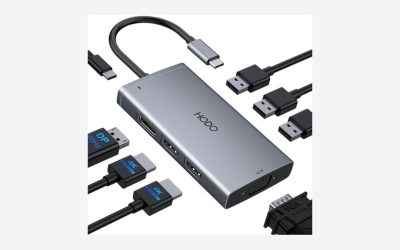
Anker Laptop Docking Station 8-in-1 with 4K HDMI
At $39.99, this is less a docking station and more a capable USB-C hub that happens to drive two monitors. For travelers or anyone with a lightweight laptop who just needs HDMI out, a couple of USB-A ports, and a card reader without carrying a brick to the office, it works. Owners praise its pocketability and the fact that it handles 4K through HDMI without drama.
- Genuinely compact and travel-friendly at a fraction of full dock pricing
- Dual monitor support via HDMI and USB-C
Con: No Ethernet, no meaningful power delivery, and the 8-port total fills up fast for a permanent desk.
Skip this if you want a one-cable-desk-setup experience or need 100W+ charging.
Anker Prime 14-in-1 Docking Station
Anker’s Prime 14-in-1 targets creators who want full port coverage without Thunderbolt 5 pricing. The 14 ports cover SD/microSD, USB-A and USB-C, Ethernet, and dual 4K monitor output. Owner reviews consistently call it the best value in Anker’s current dock lineup for people running dual-screen editing workflows on MacBooks or Windows laptops.
- Fourteen ports eliminate nearly every dongle you would otherwise carry
- Dual 4K display support with strong color accuracy through DP
Con: Bulkier than competitors with similar port counts, and cable routing on the back can be awkward on shallow desks.
Skip this if your laptop already has enough native ports or you need the smallest possible footprint.
Anker Prime TB5 14-in-1 Docking Station
This is the bandwidth king of the list. Thunderbolt 5 doubles the theoretical throughput of Thunderbolt 4, which means it can drive multiple 4K displays while simultaneously feeding data from fast NVMe enclosures without the bottleneck that older docks impose. At $399.99 it demands commitment, but for someone building a workstation around a TB5-equipped laptop, it removes the need to upgrade again for years.
- Thunderbolt 5 provides the widest available pipe for multi-monitor and storage-heavy workflows
- Fourteen ports with pro-grade connectivity in one compact tower
Con: No current laptop benefits fully from TB5 speeds yet, and the price is steep if you are on an older machine.
Skip this if you do not own a Thunderbolt 5 laptop or have no plans to buy one within two years.
Anker Nano 13-in-1 Dock with Detachable Hub
The Nano 13-in-1 splits its design into a base dock and a removable 6-in-1 USB-C hub, which means you can unplug the hub and toss it in a bag for travel while the dock stays on your desk. This is a clever answer to the “I want one-cable simplicity at home but also need ports on the road” problem. Owners describe it as the most versatile form factor in this bracket.
- Detachable hub adds genuine dual-use value without buying a second product
- Thirteen ports in a slim vertical design that saves desk space
Con: The detachable mechanism is the one potential failure point in an otherwise solid build, and some owners note it loosens over months.
Skip this if you prefer a single fixed device with no moving parts.
Anker 13-in-1 Triple Display Docking Station
Triple monitor output at $149.99 makes this the most affordable path to three screens in a single dock. It is a natural fit for spreadsheet-heavy professionals, developers with side-by-side terminal windows, or anyone whose workflow has outgrown two displays. Owner feedback is overwhelmingly positive on the multi-monitor setup experience, though the three-display mode requires specific port combinations that some laptops handle less gracefully.
- Three simultaneous display outputs at a price that beats most dual-monitor docks
- Thirteen ports cover Ethernet, USB-A, USB-C, and audio in one unit
Con: Running all three displays at full refresh rate taxes the laptop’s GPU and may force compromises on older machines.
Skip this if two monitors are sufficient for your workflow or your laptop struggles with multi-display rendering.
Dell Thunderbolt Dock WD19TBS
The WD19TBS remains a favorite among Dell laptop owners because it integrates cleanly with Dell’s BIOS-level power management, meaning your XPS or Latitude charges at its rated maximum without the handshake quirks that third-party docks sometimes introduce. It delivers 130W and supports dual 4K monitors. At $105.29 it is arguably the best price-to-reliability ratio on this list for Dell users specifically.
- Seamless power negotiation with Dell laptops, avoiding the slow-charge complaints that plague generic docks
- Proven track record with long-term durability and enterprise support
Con: Dual-display limit only, and the industrial design looks dated next to Anker’s consumer-facing units.
Skip this if you use a non-Dell laptop and care about aesthetics or need three or more screens.
Dell Thunderbolt Dock WD22TB4
The WD22TB4 is the successor that closes the gap with third-party options. It keeps the 130W delivery and enterprise reliability that made Dell docks a default in office IT, adds a cleaner port layout, and supports dual 4K displays. Owner reviews position it as the “set it and forget it” choice. At $159 it sits between the WD19TBS and the Anker Prime models in both price and capability.
- Refined port arrangement over its predecessor makes cable management noticeably easier
- 130W power delivery that handles workstation-class laptops without throttling
Con: Still limited to dual displays, so multi-screen professionals will outgrow it quickly.
Skip this if you need three or more monitors or prefer the value of an Anker dock with more ports at similar cost.
Buying Guide
Power Delivery and Laptop Compatibility
Your dock must deliver at least as much wattage as your laptop’s included charger, or you will drain the battery during heavy workloads even while plugged in. Most ultrabooks need 65-96W; mobile workstations need 130W. A dock rated at 130W gives you headroom for laptops that peak above their nominal charger rating, which is why several models on this list specify 130W rather than the lower tier. Check your laptop’s power requirements before choosing a dock with less.
Display Output: Count, Resolution, and Bandwidth
The number of supported displays is less important than the bandwidth available to each one. A dock that advertises “dual 4K” may only deliver 4K at 30Hz, which looks blurry and sluggish on text-heavy screens. Look for docks specifying DisplayPort 1.4 with HBR3 or HDMI 2.1 for 4K at 60Hz minimum. If you run three or more monitors, Thunderbolt 5 or a dock with dedicated multi-stream transport is essential to avoid resolution compromises on the third display.
Port Layout and Daily Ergonomics
A dock with 14 ports is only useful if those ports face the right direction and are spaced to accommodate your cable heads. Rear-facing USB-A ports are a common frustration for users who swap flash drives daily, while front-facing ports on vertical towers solve this at the cost of desk footprint. Audio jacks and SD card readers at the front of the unit save you the awkward reach behind the monitor stand. This is where owner reviews matter more than any spec sheet.
Our Verdict
The Dell Pro SD25TB4 is our top pick overall. It combines 130W power delivery, four-display support, and enterprise-grade stability in a package that also runs cool and respects your desk aesthetics. The budget pick goes to the Anker 8-in-1 at $39.99, which handles the two-monitor-plus-peripherals use case without pretension. The Anker Prime TB5 becomes the better choice if you already own or plan to buy a Thunderbolt 5 laptop, because the bandwidth headroom justifies its premium for the first time in that generation’s product cycle.
FAQ
Is a Thunderbolt docking station worth it over a regular USB-C hub?
If you drive two or more monitors, need Ethernet, or want a single-cable desk setup, a dedicated Thunderbolt dock is worth the upgrade because it provides stable bandwidth allocation, higher power delivery, and multi-stream display support that simple USB-C hubs cannot match. For a single external display and a few USB ports, a hub saves money.
Can I use a Thunderbolt dock with a laptop that only has USB-C?
Most Thunderbolt docks will function in USB-C mode with limited capabilities—typically one display and reduced power delivery. You lose the multi-monitor and high-bandwidth advantages, so check whether the specific dock explicitly states USB-C fallback support before relying on it.
Do I need Thunderbolt 5, or is 4 enough for 2026?
Thunderbolt 4 handles dual 4K displays and fast storage for the vast majority of users without breaking a sweat. Thunderbolt 5 matters if you run three or more high-resolution displays, use external GPU enclosures, or work with multi-gigabit NVMe drives through the dock daily. For most people, Thunderbolt 4 remains sufficient and saves you the premium.
Why does my laptop charge slowly even through a dock rated for enough wattage?
Power negotiation between laptop and dock can fail if the cable is not rated for the full wattage, if the dock is already drawing power for connected peripherals, or if the laptop’s firmware has a known compatibility issue with that dock brand. Try a different certified Thunderbolt cable first, then update your laptop’s BIOS or firmware before assuming the dock is at fault.