A laptop docking station is supposed to be the one cable you plug in when you sit down at your desk — and the one you forget about the rest of the day. In practice, many cheap options drop your external displays to 1080p, throttle charging below what a modern laptop expects, or simply refuse to wake a second monitor reliably. The difference between a good dock station and a mediocre one usually comes down to three things: whether it handles your screen count and resolution without fuss, whether its power delivery actually matches your laptop’s requirements, and whether the port layout on the chassis is convenient enough that you do not end up reaching behind it for a USB drive.
This roundup compares eight docking stations currently available in 2026, ranging from a $19.99 basic hub to a $269.99 premium unit. We lined up published specs and owner feedback to separate the genuinely useful picks from those that look impressive on a product page but deliver a frustrating daily experience. The prices below reflect the listed retail figures, and each review calls out who should reach for a given dock and who should walk past it.
Our top picks
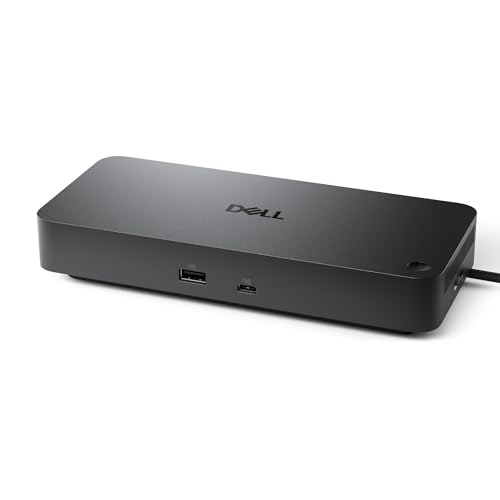 Dell Pro Laptop Docking Station WD25
- Powerful compatibility: Power essential productivity across the AI…
- Modern manageability: The Dell Pro Dock is part…
- Thoughtful design: Configure your workspace with an ambidextrous…
 Anker USB C Hub
- 5-in-1 Connectivity: Equipped with a 4K HDMI port,…
- Powerful Pass-Through Charging: Supports up to 85W pass-through…
- Transfer Files in Seconds: Move files to and…
| Product | Key specs | |
|---|---|---|
 Anker Laptop Docking Station Dual Monitor Anker Laptop Docking Station Dual Monitor | Check price | |
| Dell Pro Laptop Docking Station WD25 | Powerful compatibility: Power essential productivity across the AI… Modern manageability: The Dell Pro Dock is part… Thoughtful design: Configure your workspace with an ambidextrous… | Check price |
| Anker USB C Hub | 5-in-1 Connectivity: Equipped with a 4K HDMI port,… Powerful Pass-Through Charging: Supports up to 85W pass-through… Transfer Files in Seconds: Move files to and… | Check price |
 UGREEN USB C Docking Station Dual Monitor UGREEN USB C Docking Station Dual Monitor | Check price | |
 Anker Nano Laptop Docking Station Anker Nano Laptop Docking Station | Detachable 2-in-1 Design for Desk & Travel Triple Display with Flexible Monitor Setup All the Ports You Need in One Dock | Check price |
 Lenovo USB-C Dual Display Travel Dock Lenovo USB-C Dual Display Travel Dock | Powerful Performance: Achieve more with 7 expertly engineered… Universal Compatibility: Our sleek, universal travel dock, engineered… Modern Aesthetic: Lenovo USB-C Travel Dock merges style,… | Check price |
 Anker Laptop Docking Station Anker Laptop Docking Station | Turn your laptop into a desktop workstation with… Charge your laptop at 85W and your phone… Run up to 3 external monitors at 1080p@60Hz… | Check price |
 Anker Prime Docking Station Anker Prime Docking Station | 14-in-1 Connectivity: Bring together all your devices with… Ultra-Fast Docking Station: Deliver a powerful charge with… Master Your Data Flow with 11 Ports: Efficiently… | Check price |
As an Amazon Associate we earn from qualifying purchases at no extra cost to you.
Quick Picks
| Product | Best for | Price |
|---|---|---|
| Anker Laptop Docking Station Dual Monitor, 8-in-1 | Best overall value for dual 4K displays | $39.99 |
| Dell Pro Laptop Docking Station WD25 | Dell and enterprise environments | $152.49 |
| Anker USB C Hub, 5-in-1 | Best budget single-display option | $19.99 |
| UGREEN USB C Docking Station Dual Monitor, 7-in-1 | Budget dual monitor with aluminum build | $28.98 |
| Anker Nano Laptop Docking Station, 13-in-1 | Modular expandability | $111.99 |
| Lenovo USB-C Dual Display Travel Dock | Travel and universal compatibility | $61.99 |
| Anker Laptop Docking Station, 13-in-1 Triple Display | Triple monitor productivity | $149.99 |
| Anker Prime Docking Station, 14-in-1 | Premium full-featured desk setup | $269.99 |
How We Picked
We narrowed this list using four criteria that owners repeatedly flag in reviews: display capability (how many monitors it supports and whether they run at 4K simultaneously), power delivery (whether it passes through enough wattage to keep a laptop charged under load), port selection and layout (enough USB-A and USB-C for real workflows without a dongle chain), and day-to-day reliability (firmware stability, sleep-wake behavior, and whether the cable is integrated or detachable — a detail that matters more than spec sheets suggest).
The 8 Best Dock Station in 2026
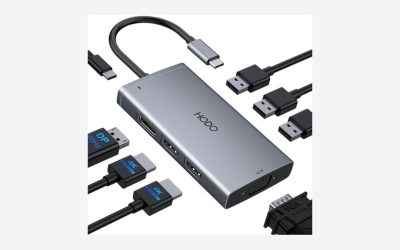
Anker Laptop Docking Station Dual Monitor, 8-in-1 USB C Hub with 4K HDMI
At under forty dollars, this Anker dock station is the most straightforward way to run two external displays from a single USB-C port. Owners praise the 4K HDMI output as genuinely usable for text-heavy work, and the eight ports cover the essentials: USB-A, USB-C, SD card, and Ethernet. The main limitation is power delivery, which some laptop models may not top off under heavy load. Skip this if you need triple-monitor support or if your laptop demands more than what a compact hub typically delivers.
- Pro: Dual 4K monitor support at a budget price point
- Pro: Broad port coverage including Ethernet and card reader
- Con: Power delivery may not satisfy high-wattage laptops under sustained load
Dell Pro Laptop Docking Station WD25, USB-C, 100W
The WD25 is the safest choice for anyone already embedded in a Dell fleet or who wants a dock station with enterprise-grade driver support. The 100W power delivery is a standout, meaning even a mobile workstation charging at full speed will stay topped off. It includes both DisplayPort and HDMI, giving flexibility across monitor types. The downside is price and the fact that non-Dell machines may not expose every management feature. Skip if you want value or a travel-friendly form factor.
- Pro: Full 100W pass-through charging supports demanding laptops
- Pro: DisplayPort and HDMI combined for flexible monitor choices
- Con: Premium pricing that is hard to justify outside a Dell ecosystem
Anker USB C Hub, 5-in-1 USBC to HDMI Splitter with 4K Display
This is the entry point for anyone who simply needs one 4K external display without a full dock station footprint. At twenty dollars, it is hard to fault. Owners like the compact size and the fact that it handles 4K output reliably for single-screen work. The five-port layout is intentionally sparse, so adding a wired keyboard, mouse, and a USB drive simultaneously will push it to its limit. Skip if you ever plan to add a second monitor or need more than a handful of peripherals.
- Pro: Exceptional value for a single 4K display workflow
- Pro: Truly pocket-sized, ideal for occasional desk use
- Con: Five ports become a bottleneck quickly with multiple peripherals
UGREEN USB C Docking Station Dual Monitor, 7-in-1 Aluminum Dock with 2xHDMI
UGREEN undercuts Anker’s dual-monitor dock by a few dollars while offering a full aluminum chassis that dissipates heat passively. The two HDMI outputs are the headline feature, and owners confirm both can run at 4K for many laptop configurations. The seven-port arrangement is leaner than the Anker, and the integrated cable keeps things tidy on a desk. Skip if you need USB-C passthrough data ports or an SD card reader, as the port mix skews heavily toward legacy USB-A.
- Pro: Aluminum body runs cooler and feels more durable than plastic competitors
- Pro: Dedicated dual HDMI outputs simplify a two-monitor setup
- Con: Limited USB-C data ports compared to similarly priced rivals
Anker Nano Laptop Docking Station, 13in1 Dock with Detachable 6in1 USBC Hub
The Nano’s modular design is the concept here: the 6-in-1 hub detaches from the 13-in-1 base, so you carry a compact hub to a client site and plug back into the full station at your desk. Owners call it one of the most clever dock station formats available. The trade-off is that the combined footprint is larger than competitors at this price, and the detachable mechanism introduces a potential failure point over years of use. Skip if your setup is stationary and you do not split time between locations.
- Pro: Detachable hub module lets you carry just what you need on the go
- Pro: Thirteen ports in total cover nearly any peripheral combination
- Con: Larger desk footprint than simpler docks at a similar price
Lenovo USB-C Dual Display Travel Dock – 7 Ports, Integrated Cable
Lenovo’s travel dock is purpose-built for the laptop bag. The integrated cable means there is nothing separate to lose, and dual 4K display support keeps a mobile setup functional when you plug into a monitor. Owners highlight broad compatibility beyond Lenovo hardware, including Macs. The seven-port count is modest for a dock station at this price, and there is no SD card reader. Skip if your desk setup is permanent and you can benefit from more ports.
- Pro: Integrated cable eliminates the lost-accessory problem for travelers
- Pro: Dual 4K support in a compact, bag-friendly form factor
- Con: No card reader or extra USB ports for multi-peripheral desk work
Anker Laptop Docking Station, 13-in-1 USB C Docking Station, Triple Display
Triple monitor support is the entire reason to pick this Anker dock station over the dual-display options above. The 13-in-1 port layout means you will not need an additional hub for most peripherals. Owners report it works well with laptops that support DisplayPort Alt Mode through multiple display paths. The caveat is that not every laptop GPU configuration supports three external displays simultaneously, so verify your hardware first. Skip if you only ever use two screens.
- Pro: True triple-display output for power users who need the screen real estate
- Pro: Thirteen ports eliminate the need for a secondary hub
- Con: Requires a laptop whose GPU and USB-C controller support three external displays
Anker Prime Docking Station, 14-in-1 Laptop Docking Station Dual Monitor
The Prime is the flagship of this lineup and the most feature-dense dock station here at fourteen ports and dual monitor support. It is built for people who want a single, permanent desk anchor that handles every connection — displays, Ethernet, audio, multiple USB devices, and card readers — without compromise. The price is the obvious barrier. Skip if a $40 alternative covers your actual needs, which for most people it does.
- Pro: Fourteen ports make it the most self-contained option on this list
- Pro: Premium build quality and layout designed for long-term desk permanence
- Con: Price is more than double the best mid-range competitors
Buying Guide
Display Output and Resolution
The single most common complaint in dock station reviews is resolution degradation. A dock advertised as “4K capable” may only run one display at 4K while dropping the second to 1080p, depending on your laptop’s USB-C implementation. Before buying, confirm whether both HDMI or DisplayPort outputs can run at 4K simultaneously with your specific laptop model. Triple-display docks add a further layer of complexity because they often rely on DisplayPort Alt Mode or software-based MST, which not all systems support natively.
Power Delivery Pass-Through
Power delivery wattage determines whether your laptop actually charges while docked under load. The Dell WD25 advertises 100W, which covers most 14-inch and 16-inch laptops even while compiling code or rendering. Budget hubs in the $20 to $40 range often pass through less, and some do not support passthrough at all. Check whether the dock uses a dedicated power adapter or draws power from the laptop, because a bus-powered dock will never sustain high-wattage charging while also driving displays and peripherals.
Port Count Versus Port Layout
A “13-in-1” claim sounds better than a “7-in-1,” but layout matters as much as quantity. Front-facing USB-A ports are far more useful than six ports buried on the back panel. Think about what you plug in daily — a flash drive, a phone for syncing, a headset — and whether those connections will be easy to reach. An integrated cable saves desk space and prevents loss, while a detachable cable gives flexibility if the dock sits under a monitor arm or in a confined area.
Our Verdict
The Anker Laptop Docking Station Dual Monitor, 8-in-1 is the top pick. It covers dual 4K output, a well-rounded port set, and a price that leaves little room for a more capable dock to justify the upgrade for most buyers. For the absolute lowest entry point, the Anker USB C Hub, 5-in-1 delivers a reliable single 4K display at twenty dollars, making it the obvious budget choice. However, if your laptop requires full-speed charging while docked and you want DisplayPort alongside HDMI, the Dell WD25 is the one that wins on those two conditions despite its price.
FAQ
Do all USB-C laptops work with any dock station?
No. A dock station requires your laptop’s USB-C port to support DisplayPort Alt Mode and power delivery passthrough. Some older or very thin laptops have USB-C ports that handle data only, which means displays will not output. Check your laptop’s port specifications before purchasing.
Can a dock station replace a second USB-C hub?
Yes, and that is the main appeal. A quality dock station combines display outputs, charging, Ethernet, and peripheral ports into one unit. If you are already using a small hub plus a separate HDMI adapter plus a power brick, consolidating into one dock station usually reduces cable clutter and improves reliability.
Why does my monitor flicker or not wake from sleep when using a dock?
This is one of the most common complaints across every price tier and typically stems from a firmware issue in the dock, a driver mismatch on the laptop, or a cable that does not meet the bandwidth requirements of the resolution and refresh rate you are attempting. Updating both the dock firmware and the laptop’s USB and GPU drivers resolves the problem in most reported cases.
Is an aluminum dock station better than a plastic one?
Aluminum helps with passive heat dissipation, which matters because the controller chips inside a dock station generate noticeable warmth during sustained high-bandwidth use. A plastic housing can trap that heat and contribute to throttling or instability over long sessions. The practical benefit is real but incremental; it is not a reason to pass over a better-featured plastic dock.