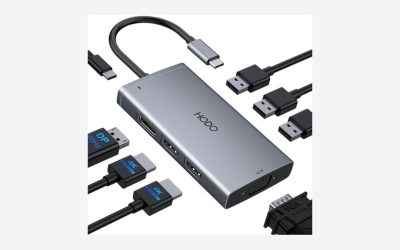
A modern laptop ships with two or three USB-C ports and a headphone jack, which sounds adequate until you connect a monitor, charge the machine, plug in a keyboard, and realize every port is occupied. A docking station collapses all those connections into a single cable from your laptop to a desk-side hub that handles video, power, and peripherals simultaneously.
What separates a good dock from a disappointing one comes down to three things: how much power it passes through to your laptop, whether it drives the number and resolution of displays you need, and whether it requires a software driver that complicates setup or creates conflicts with OS updates. The products below range from under $20 to around $150, and the price difference usually reflects power delivery ceiling, port count, and display architecture rather than raw build quality. Owner feedback consistently highlights reliability over a year of daily use as the deciding factor, so we weighted long-term impressions alongside published specifications for this roundup.
Our top picks
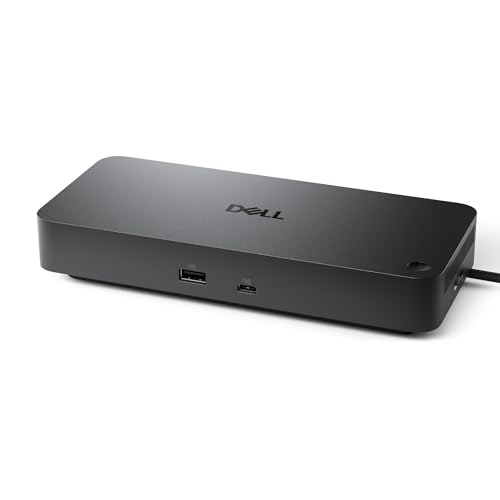 Dell Pro Laptop Docking Station WD25
- Powerful compatibility: Power essential productivity across the AI…
- Modern manageability: The Dell Pro Dock is part…
- Thoughtful design: Configure your workspace with an ambidextrous…
 Anker USB C Hub
- 5-in-1 Connectivity: Equipped with a 4K HDMI port,…
- Powerful Pass-Through Charging: Supports up to 85W pass-through…
- Transfer Files in Seconds: Move files to and…
| Product | Key specs | |
|---|---|---|
 Anker Laptop Docking Station Dual Monitor Anker Laptop Docking Station Dual Monitor | Check price | |
| Dell Pro Laptop Docking Station WD25 | Powerful compatibility: Power essential productivity across the AI… Modern manageability: The Dell Pro Dock is part… Thoughtful design: Configure your workspace with an ambidextrous… | Check price |
| Anker USB C Hub | 5-in-1 Connectivity: Equipped with a 4K HDMI port,… Powerful Pass-Through Charging: Supports up to 85W pass-through… Transfer Files in Seconds: Move files to and… | Check price |
 Anker Laptop Docking Station Anker Laptop Docking Station | Turn your laptop into a desktop workstation with… Charge your laptop at 85W and your phone… Run up to 3 external monitors at 1080p@60Hz… | Check price |
 Anker Nano Laptop Docking Station Anker Nano Laptop Docking Station | Detachable 2-in-1 Design for Desk & Travel Triple Display with Flexible Monitor Setup All the Ports You Need in One Dock | Check price |
 Dell WD19S 180W Docking Station Dell WD19S 180W Docking Station | WD19S180W Built for the future Power your connections | Check price |
 USB C Docking Station Dual Monitor for USB C Docking Station Dual Monitor for | Check price | |
 Plugable Universal Laptop Docking Station Dual HDMI Plugable Universal Laptop Docking Station Dual HDMI | Flexible Expandability: Featuring a hybrid 2-in-1 USB 3.0… Dual HD Monitors (Driver Required): Supports dual HDMI… Universal Compatibility: Windows 11, 10 with plug-and-play driver… | Check price |
As an Amazon Associate we earn from qualifying purchases at no extra cost to you.
Quick Picks
| Product | Best for | Price |
|---|---|---|
| Anker 8-in-1 Dual Monitor | Two-monitor setups on a budget | $39.99 |
| Dell WD25 Pro | Dell and Latitude users wanting 100W | $152.49 |
| Anker 5-in-1 USB C Hub | Single external monitor under $20 | $19.99 |
| Anker 13-in-1 Triple Display | Multi-monitor power without a driver | $149.99 |
| Anker Nano 13-in-1 | Travelers wanting a detachable hub | $111.99 |
| Dell WD19S 180W | Workstations needing high power delivery | $116.00 |
| USB C Dock for HP (3 Monitors) | HP users wanting triple display cheaply | $37.99 |
| Plugable UD-3900 | Legacy USB 3.0 laptops needing dual HDMI | $99.95 |
How We Picked
We evaluated every dock on four criteria: power delivery wattage (how fast it charges your laptop through the single cable), display output (number of simultaneous monitors and maximum resolution per port), port variety (does it include Ethernet, SD cards, or USB-A so you avoid a second hub), and driver requirement (plug-and-play via USB-C DisplayPort Alt Mode versus software-dependent setups that risk OS-update breakage). Where owner feedback flagged a recurring issue—thermal throttling, intermittent disconnects, or flaky driver behavior—we noted it even when the spec sheet looked strong.
The 8 Best What Is A Docking Station in 2026
Anker Laptop Docking Station Dual Monitor, 8-in-1 USB C Hub with 4K HDMI
This is the dock for someone with a 4K monitor and a 1080p secondary who refuses to spend more than forty dollars. The 8-in-1 layout gives you two HDMI outputs plus a handful of USB-A and USB-C data ports, which covers most office peripherals without daisy-chaining another hub.
- Pro: Two HDMI ports at 4K on the primary output; no driver needed on most machines.
- Pro: Compact enough to slide behind a monitor stand without cluttering the desk.
- Con: Power delivery is modest, so it tops out below what a 96-watt laptop expects for full-speed charging.
Skip this if you run three monitors or need to charge a high-wattage workstation through the same cable.
Dell Pro Laptop Docking Station WD25, USB-C, 100W, DisplayPort, HDMI
The WD25 targets Dell and Latitude fleet buyers who want guaranteed compatibility and a 100-watt pass-through that keeps a Precision or XPS running at full performance without a separate power brick on the desk.
- Pro: 100W power delivery handles the vast majority of Dell laptops at full rated wattage.
- Pro: DisplayPort and HDMI outputs together give flexibility for mixed-monitor offices.
- Con: The $152 price is steep when generic docks offer similar port counts for less.
Consider skipping if your laptop is not Dell-branded, since the compatibility advantage mostly evaporates with other manufacturers.
Anker USB C Hub, 5-in-1 USBC to HDMI Splitter with 4K Display
At under twenty dollars, this five-in-one hub is the simplest way to add a single 4K HDMI output plus a couple of USB-A ports to a thin-and-light laptop that lacks them.
- Pro: Cheapest reliable entry point for one external monitor in this group.
- Pro: Bus-powered with no wall adapter, so it travels without extra cables.
- Con: Single HDMI means no dual-monitor setup; power passthrough is minimal.
Skip if you need more than one external display or require meaningful charging through the hub.
Anker Laptop Docking Station, 13-in-1 USB C Docking Station, Triple Display
Thirteen ports and triple-display support place this Anker squarely in the premium tier for users who want a command-center setup without installing a DisplayLink driver. The wide USB-A selection eliminates dongle clutter for keyboards, mice, and flash drives.
- Pro: Drives three monitors simultaneously over USB-C Alt Mode with no software.
- Pro: High port count covers Ethernet, card readers, and multiple USB-A in one unit.
- Con: The $149 price approaches Dell and Lenovo corporate docks that carry longer warranties.
Skip if your laptop supports only two Alt Mode streams or you do not need triple display.
Anker Nano Laptop Docking Station, 13in1 Dock with Detachable 6in1 USBC Hub
The detachable top section is the headline feature: leave the dock on your desk and pull off a six-in-one USB-C hub for travel, effectively getting two products in one box at $112.
- Pro: 13 ports on the base plus a separate 6-in-1 hub for on-the-go use.
- Pro: Slim profile keeps the desk clean and does not block adjacent ports.
- Con: The detachable hinge is a potential long-term failure point; some owners report loosening over months.
Skip if you need a permanently bolted-down station and will never remove the hub for portable use.
Dell WD19S 180W Docking Station (130W Power Delivery) USB-C, HDMI, Dual DisplayPort
The WD19S draws from a 180-watt wall adapter and delivers up to 130 watts to your laptop, making it the right pick for power-hungry mobile workstations and multi-monitor setups that strain smaller docks.
- Pro: 130W pass-through keeps Precision-class laptops at full CPU and GPU performance.
- Pro: Dual DisplayPort plus HDMI supports mixed-vendor monitor arrangements.
- Con: At $116 it sits mid-range, and the large power brick adds desk clutter.
Skip if your laptop draws under 65W and you prefer a compact, bus-powered design.
USB C Docking Station Dual Monitor for HP, Laptop Docking Station 3 Monitors
This unnamed-brand dock markets triple-monitor support and HP compatibility for under thirty-eight dollars, undercutting every other triple-display option here by a wide margin.
- Pro: Lowest price in this group for three simultaneous monitor outputs.
- Pro: Broad USB-A and USB-C port selection for its tier.
- Con: Owner feedback notes inconsistent third-monitor detection and occasional resolution drops.
Skip if reliability is non-negotiable; this is a gamble compared to the Anker or Dell triple-display options.
Plugable Universal Laptop Docking Station Dual HDMI Monitor for Windows and Mac (Driver Required)
The Plugable UD-3900 is the only dock here that works with USB 3.0 Type-A laptops, making it a lifeline for older machines lacking USB-C entirely. It drives two HDMI monitors through a DisplayLink driver on both Windows and Mac.
- Pro: USB 3.0 compatibility means it works on laptops from a decade ago.
- Pro: Gigabit Ethernet and six USB ports in a single unit.
- Con: Requires a DisplayLink driver, which occasionally conflicts with Windows or macOS updates.
Skip if your laptop already has USB-C Alt Mode; a driver-free dock will serve you better.
Buying Guide
Power Delivery: Match the Wattage to Your Laptop
A dock that passes only 60W to a laptop rated at 96W will charge slowly or let the battery drain under load. Check your laptop’s charger wattage and buy a dock whose power-delivery number meets or exceeds it. In this group, the Dell WD19S tops the list at 130W, while the Anker 5-in-1 and 8-in-1 sit well below that threshold. Anything in the middle covers typical ultrabooks.
Display Architecture: Alt Mode Versus DisplayLink
USB-C Alt Mode docks drive monitors using the laptop’s internal GPU with no software install. DisplayLink docks use a CPU-based rendering driver that works on older USB-A ports but can stutter with video playback and may break after OS updates. If your laptop has a USB-C port that supports DisplayPort Alt Mode, prefer an Alt Mode dock for zero-friction reliability.
Port Selection: Plan Your Desk Before You Buy
Count every device you plug in at your desk: keyboard, mouse, headset, Ethernet, SD card reader, external SSD. A dock missing Ethernet forces you into a second adapter; one missing SD slots keeps a reader on the shelf. The 13-in-1 Anker docks and the Dell WD19S carry the most varied port arrays, while the $20-class hubs assume you already own a separate Ethernet adapter and keyboard with built-in USB passthrough.
Our Verdict
Top pick: The Anker 13-in-1 Triple Display earns the recommendation because it covers three monitors, delivers strong power passthrough, and avoids any driver dependency, all at a price that lands below Dell corporate alternatives. Budget pick: The Anker 8-in-1 Dual Monitor at $39.99 handles the common two-screen office setup without compromise on video quality. Conditional winner: If you own a Precision-class workstation that pulls over 100W, the Dell WD19S is the only option here that keeps your CPU at full speed under sustained load.
FAQ
What is a docking station and how is it different from a USB hub?
A docking station connects to your laptop with a single cable and provides a permanent desk-side arrangement of video outputs, power delivery, Ethernet, and multiple USB ports. A basic USB hub only extends data ports and rarely carries meaningful power or video signals.
Do I need a driver for a docking station?
USB-C docks using DisplayPort Alt Mode require no driver and work plug-and-play on Windows, macOS, and Linux. DisplayLink-based docks, like the Plugable UD-3900, need a software driver to render additional monitors and can occasionally conflict with OS updates.
Can any dock drive three monitors?
No. A dock that advertises triple display either uses DisplayLink to split one video stream across three outputs or requires a laptop with a high-bandwidth USB-C port (Thunderbolt or USB4) that carries enough lanes natively. Check your laptop’s port specification before assuming compatibility.
Is a more expensive docking station worth it?
Only if you need higher power delivery, more simultaneous displays, or enterprise-grade reliability with a longer warranty. A $40 dock and a $150 dock often produce identical video output; the price gap reflects wattage ceiling, port count, and build consistency rather than image quality.