Key takeaways
- Shared wireless backhaul (dual-band systems): the nodes communicate on the same radio band your devices use. The rule of thumb is you lose roughly a third to half of throughput per wireless hop, so the far end of the house gets a fraction of your plan speed.
- Dedicated wireless backhaul (tri-band and quad-band systems): one whole radio — a second 5 GHz band on WiFi 6 kits, or the 6 GHz band on WiFi 6E/7 kits — is reserved for node-to-node traffic. This is why tri-band systems perform dramatically better at distance.
- Wired Ethernet backhaul: connect nodes with Ethernet and wireless bandwidth is freed entirely for your devices. If your home has Ethernet runs, this is the single best upgrade you can make — it turns a mid-range kit into a high-end performer.
A whole home mesh WiFi system is a kit of two or more router nodes that share a single network name and pass your devices between them as you move through the house — and you need one if your home is over roughly 2,000 square feet, spans more than one floor, or has rooms where a single router’s signal falls apart. If you live in a small apartment where the router sits in the middle of everything, a good standalone router is cheaper and simpler.
Our top picks

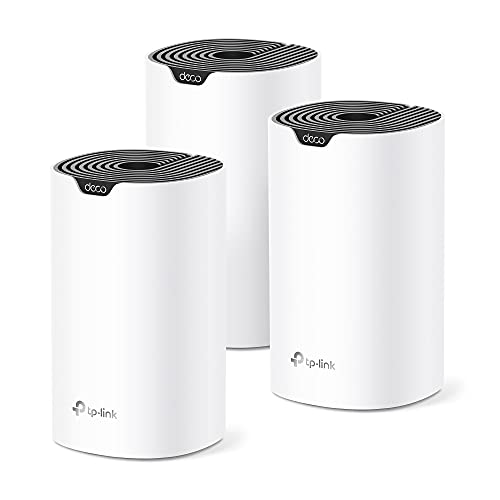


As an Amazon Associate we earn from qualifying purchases at no extra cost to you. Ratings are shown as listed on Amazon.
How Nodes and Backhaul Actually Work
Each node in a mesh kit is a full router. One connects to your modem and acts as the primary; the others mirror the same SSID (network name) and use standards like 802.11k/v/r to steer your phone or laptop to whichever node has the strongest signal. The critical part most buyers overlook is backhaul — the invisible link the nodes use to talk to each other.
Backhaul comes in three flavors:
- Shared wireless backhaul (dual-band systems): the nodes communicate on the same radio band your devices use. The rule of thumb is you lose roughly a third to half of throughput per wireless hop, so the far end of the house gets a fraction of your plan speed.
- Dedicated wireless backhaul (tri-band and quad-band systems): one whole radio — a second 5 GHz band on WiFi 6 kits, or the 6 GHz band on WiFi 6E/7 kits — is reserved for node-to-node traffic. This is why tri-band systems perform dramatically better at distance.
- Wired Ethernet backhaul: connect nodes with Ethernet and wireless bandwidth is freed entirely for your devices. If your home has Ethernet runs, this is the single best upgrade you can make — it turns a mid-range kit into a high-end performer.
How Many Nodes Do You Actually Need?
Manufacturer coverage ratings assume open space. In real homes with drywall and wood framing, plan on each node delivering about 60% of its rated coverage; with lath-and-plaster, brick, or concrete walls, drop that to 35–45%. So a node rated for 2,200 square feet realistically covers about 1,200–1,400 square feet in a typical house.
Worked examples:
- 1,500 sq ft single-story apartment: 1,500 ÷ ~1,200 effective = 2 nodes, placed roughly 30 feet apart with clear line between them.
- 2,500 sq ft two-story: one node per floor plus one for overlap = 3 nodes.
- 4,000+ sq ft multi-floor: 4,000 ÷ ~1,200 ≈ 3.3, so 3 nodes minimum on paper — but stairwells, thick interior walls, and wanting coverage in a yard or garage push most homes this size to 4 nodes. At this scale, wired backhaul (or a strong dedicated wireless backhaul) stops being optional.
| Home size & layout | Construction | Nodes | Suggested system class | Typical spend |
|---|---|---|---|---|
| Up to 1,500 sq ft, one level | Drywall | 2 | Dual-band WiFi 6 (AX3000 class) | $120–200 |
| 1,500–3,000 sq ft, 1–2 floors | Drywall | 3 | Tri-band WiFi 6 or entry WiFi 6E | $250–450 |
| 4,000+ sq ft, multi-floor | Drywall | 4 | Tri-band with dedicated backhaul; wired backhaul ideal | $350–600 |
| 4,000+ sq ft, dense walls | Plaster, brick, concrete | 4–5 + Ethernet runs | WiFi 6E/7 tri- or quad-band | $600–1,200 |
How the Main System Types Compare
Coverage numbers below are manufacturer ratings — apply the 60% discount from above. The differentiators that matter are bands, backhaul type, and ports.
| System | Class | Bands | Backhaul | Rated coverage | Wired ports per unit |
|---|---|---|---|---|---|
| TP-Link Deco X55 (3-pack) | WiFi 6 AX3000 | Dual | Shared 5 GHz (Ethernet optional) | ~6,500 sq ft | 3× Gigabit |
| Netgear Orbi RBK752 (2-pack) | WiFi 6 AX4200 | Tri | Dedicated 5 GHz | ~5,000 sq ft | Gigabit (router: WAN + 3 LAN) |
| ASUS ZenWiFi XT8 (2-pack) | WiFi 6 AX6600 | Tri | Dedicated 5 GHz-2 (4×4) | ~5,500 sq ft | 2.5G WAN + 3× Gigabit |
| TP-Link Deco XE75 (3-pack) | WiFi 6E AXE5400 | Tri | 6 GHz capable | ~7,200 sq ft | 3× Gigabit |
| ASUS ZenWiFi ET8 (2-pack) | WiFi 6E AXE6600 | Tri | 6 GHz (dedicated-capable) | ~5,500 sq ft | 2.5G WAN + 3× Gigabit |
| TP-Link Deco BE63 (3-pack) | WiFi 7 BE9300 | Tri | 6 GHz + MLO | ~7,600 sq ft | 4× 2.5G |
If you’re shopping specifically for the best WiFi 6 mesh system rather than jumping to 6E or WiFi 7, the pattern is clear: for internet plans of 500 Mbps or less, a dual-band AX3000 kit like the Deco X55 is enough; for gigabit plans or node-to-node distance beyond one room, spend up for tri-band with dedicated backhaul — the ZenWiFi XT8 or Orbi 750 series are the classic picks and are frequently discounted now that WiFi 7 exists.
Stepping up, the product family listed as the ASUS ZenWiFi whole home tri-band mesh WiFi 6E system (the ET8, and the higher-end ET12) is the reference point in the 6E tier: the 6 GHz radio does double duty as a fast dedicated backhaul, ASUS bundles its AiProtection security suite and full web-admin control with no subscription, and every node carries a 2.5G port for multi-gig WAN or wired backhaul. The main tradeoff is a higher price than Deco equivalents and a steeper app/learning curve than Eero.
What the Community Consensus Says
If you search “best mesh wifi system reddit,” the same advice surfaces across years of threads: TP-Link Deco for value buyers, ASUS ZenWiFi for people who want deep settings and no subscriptions, Eero for true set-and-forget simplicity (with a paid tier for advanced security), and Netgear Orbi for maximum raw performance at a premium price. The most-upvoted practical advice in those threads isn’t about brands at all: buy wired backhaul if you can, place nodes where signal is still strong rather than inside the dead zone, and add one more node than the box suggests for multi-floor homes.
Placement Mistakes That Waste Nodes
- Putting a satellite in the dead zone. Nodes need a strong link to the primary. Place them at the edge of good coverage — about 30–45 feet away, or one floor apart — not in the room that has no signal.
- Too many hops. Each extra wireless hop adds latency. Prefer a star layout (all satellites linking back to the primary) over daisy-chaining three nodes in a line.
- Hiding nodes. Inside cabinets, behind TVs, or on the floor all choke radios. Elevate them, keep them in the open.
- Buying dual-band for a gigabit plan. Shared backhaul will cap remote rooms well below what you’re paying your ISP for.
- Ignoring the backhaul setting. Most tri-band systems let you force dedicated backhaul or plug in Ethernet — check the app rather than assuming it’s configured optimally.
Ownership Realities
Mesh systems have no consumables — what ages them is the WiFi standard itself, which is why WiFi 5 mesh kits now feel dated. Expect a useful life of five to seven years. What actually goes wrong in practice: satellites occasionally desync after firmware updates (a reboot fixes it), nodes run warm and shouldn’t be stacked, and subscriptions are the quiet cost — Eero’s advanced features, Netgear’s Armor, and TP-Link’s HomeShield Pro all sit behind optional paid tiers, while ASUS includes its security suite free. Mixing brands generally doesn’t work unless both systems are EasyMesh-certified, so buy the kit size you need rather than planning to mix later.
FAQ
Is mesh better than one powerful router?
For homes under ~2,000 square feet with the router placed centrally, a single good router is usually faster per dollar. Mesh wins when physics — distance, floors, dense walls — is the enemy, which no single router can defeat.
Will a whole home mesh WiFi system make my internet faster?
No — it can’t exceed your plan speed. It extends usable speed into rooms where it currently collapses. How much speed survives at the far node depends almost entirely on backhaul quality.
Can I mix nodes from different brands or generations?
Generally no. Stick to one ecosystem, though within a brand (e.g., different Deco models or ASUS AiMesh routers) mixing is usually supported.
Do I still need a modem?
Yes, on cable and DSL. Fiber customers connect the primary node to the ISP’s optical network terminal. Some providers let you run their gateway in bridge mode.