Key takeaways
- 2.4 GHz band – longer range and better wall penetration, but fewer non-overlapping channels (three in the US: 1, 6 and 11), narrower channels and more interference from neighbors, Bluetooth and microwaves.
- 5 GHz band – much more channel space and wider channels (80 MHz, sometimes 160 MHz), so far higher throughput, but the signal weakens faster through walls and floors.
A TP-Link dual band router is any Archer-series router that broadcasts two separate Wi-Fi networks at once, one on 2.4 GHz and one on 5 GHz, and for most apartments and small-to-medium homes it is all the router you need. The real decision is not “dual band or not” but which Wi-Fi generation (Wi-Fi 5, 6 or 7) and which speed class makes sense for your internet plan and devices. This guide explains what dual band actually means, then maps TP-Link’s dual-band lineup to real household situations.
Our top picks


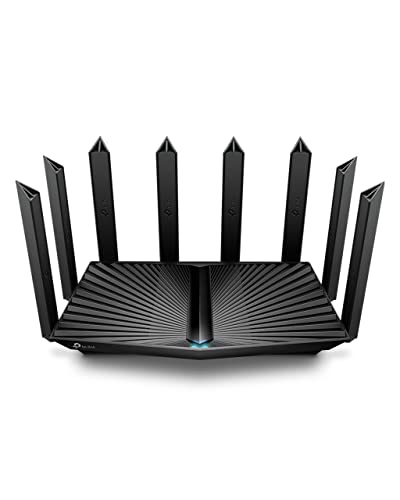
As an Amazon Associate we earn from qualifying purchases at no extra cost to you. Ratings are shown as listed on Amazon.
Dual band router meaning, in plain terms
“Dual band” describes the radios, not the speed. The router contains two radios running simultaneously:
- 2.4 GHz band – longer range and better wall penetration, but fewer non-overlapping channels (three in the US: 1, 6 and 11), narrower channels and more interference from neighbors, Bluetooth and microwaves.
- 5 GHz band – much more channel space and wider channels (80 MHz, sometimes 160 MHz), so far higher throughput, but the signal weakens faster through walls and floors.
Older “single band” routers only had the 2.4 GHz radio. “Tri band” routers add a third radio, either a second 5 GHz radio or a 6 GHz radio (Wi-Fi 6E and Wi-Fi 7). A dual band router lets slow, distant or smart-home devices sit on 2.4 GHz while phones, laptops and TVs close to the router use 5 GHz.
The same definition applies to every brand. A D-Link dual band router, a Netgear one or a TP-Link Archer all follow the same IEEE standards; the differences are in radio count (streams), processor, software features and price.
How to read the TP-Link model name
TP-Link labels its routers with a class code like AC1200 or AX3000. That number is simply the maximum link rate of the 2.4 GHz band plus the 5 GHz band, rounded. It is not the speed any single device will get.
| Class | Wi-Fi generation | 2.4 GHz max link rate | 5 GHz max link rate | Example TP-Link model |
|---|---|---|---|---|
| AC1200 | Wi-Fi 5 | 300 Mbps | 867 Mbps | Archer A6 / Archer C6 |
| AC1750 | Wi-Fi 5 | 450 Mbps | 1,300 Mbps | Archer A7 |
| AC1900 | Wi-Fi 5 | 600 Mbps | 1,300 Mbps | Archer C80 |
| AX1800 | Wi-Fi 6 | 574 Mbps | 1,201 Mbps | Archer AX21 |
| AX3000 | Wi-Fi 6 | 574 Mbps | 2,402 Mbps | Archer AX55 |
| BE3600 | Wi-Fi 7 | 688 Mbps | 2,882 Mbps | Archer BE230 |
A typical two-stream laptop or phone connected to an AX3000 router at a few meters will usually see real throughput in the 600–1,000 Mbps range on 5 GHz, and a fraction of that two rooms away. On 2.4 GHz, 50–150 Mbps is a realistic everyday number. Use the class code to compare routers against each other, not to predict your speed test.
Which dual-band TP-Link fits your situation
The single best predictor of the right model is your internet plan, followed by home size and how many devices are active at the same time.
| Your situation | Sensible class | Why | Typical price range |
|---|---|---|---|
| Plan under 300 Mbps, small apartment, under 15 devices | AC1200 (Archer A6/C6) | Wired and wireless both exceed the plan; gigabit ports included | Roughly $35–$60 |
| Plan 300–500 Mbps, 2–3 bedrooms | AX1800 (Archer AX21) | Wi-Fi 6 handles many devices better via OFDMA; affordable | Roughly $60–$90 |
| Gigabit plan, many streaming and gaming devices | AX3000 (Archer AX55) | 160 MHz support lets newer laptops and phones get closer to gigabit | Roughly $90–$140 |
| Multi-gig fiber (1.2–2 Gbps) or future-proofing | BE3600 (Archer BE230) | Wi-Fi 7 plus 2.5 Gbps wired ports, so the WAN is not capped at 1 Gbps | Roughly $110–$170 |
| Large or multi-story home, thick walls | Mesh (Deco) rather than one router | A single dual-band box cannot fix distance; extra nodes can | Varies by node count |
If you already own Wi-Fi 6 laptops and phones, skip new Wi-Fi 5 models unless budget is the hard limit. If most of your devices are older or are smart plugs and cameras, an AC1200 still does the job.
Dual band vs tri band: when the third radio matters
A tri-band router is worth it in two cases: dense homes with dozens of busy clients where one 5 GHz radio becomes congested, and mesh setups where a dedicated band carries traffic between nodes. For a single router serving one household of normal size, a good dual-band Wi-Fi 6 model usually delivers the same real-world experience for less money. The dedicated Wi-Fi 6 lineup comparison on this site covers the higher-end Archer AX models in more depth; this article focuses on the dual-band choice itself.
Setup choices that decide how well a dual band router works
Smart Connect: one network name or two?
TP-Link’s Smart Connect (band steering) merges both bands under one SSID and moves devices automatically. It is convenient, but some smart-home devices only speak 2.4 GHz and fail to pair when the phone doing the setup is on 5 GHz. If you hit that, split the bands into two names (for example “Home” and “Home-5G”) during setup, then merge them again later if you prefer.
Channel width
- Keep 2.4 GHz at 20 MHz. 40 MHz rarely helps in neighborhoods with other networks.
- Use 80 MHz on 5 GHz as a stable default. Enable 160 MHz only on models that support it and if your devices do; it can be affected by DFS radar channel rules, which occasionally force the router to change channels.
Placement
Put the router high, central and in the open. A router on the floor of a closet at one end of the house can lose more than half of its 5 GHz performance before it reaches the far rooms. Each wall or floor in between costs signal, and the 5 GHz band pays that cost first.
Firmware and security
- Change the admin password on first login and use WPA3 or WPA2/WPA3 mixed mode where available.
- Turn off WPS if you do not use it.
- Update firmware through the Tether app or web interface; TP-Link adds fixes and features over the product’s life.
Ownership realities
Consumer routers rarely “wear out” mechanically, but they do age. The most common reasons people replace a dual band router are: the internet plan outgrew the WAN port (1 Gbps ports cap multi-gig plans), the device count grew past what an older Wi-Fi 5 processor handles smoothly, or firmware support ended. Expect a usable life of roughly four to six years. Rebooting on a schedule can mask an overloaded router but does not fix it; if you need weekly reboots, the router is undersized for your home.
Common questions
Is dual band the same as 5G?
No. “5G” in a router’s network name refers to the 5 GHz Wi-Fi band. It has nothing to do with 5G cellular service.
Can older devices connect to a dual band Wi-Fi 6 or Wi-Fi 7 router?
Yes. Both bands are backward compatible, so a 2.4 GHz-only printer or an old Wi-Fi 4 tablet still connects; it just runs at its own maximum speed.
Do I need to buy TP-Link specifically?
No. Equivalent dual-band classes exist from D-Link, Netgear, ASUS and others. TP-Link’s appeal is a wide range at competitive prices, a simple Tether app and OneMesh compatibility on many models, which lets you add a compatible TP-Link extender later.